


Depression is a common and serious medical condition that can present in various ways or levels of severity, but it often involves feelings of sadness, sleep issues, and irritability. One in four young adults will experience depression by age 24.1 While all college students will have times of frustration or sadness, it’s important to know the signs of depression to get timely help.
Adulting Is Difficult.
Therapy can help. BetterHelp has over 30,000 licensed therapists who provide convenient and affordable online therapy. BetterHelp starts at $65 per week and is FSA/HSA eligible by most providers. Take a free online assessment and get matched with the right therapist for you.
Why Are College Students More Vulnerable to Depression?
The college years come with many expectations, and the stress that comes along with these expectations can be great. For a number of reasons, this transition can be more difficult than expected and make college students more vulnerable to depression. Many students have a hard time adjusting, as they may experience homesickness in college or feel anxious about figuring out their career path.
A new college student may not understand or have the tools to prioritize the benefits of self-care along with their other responsibilities, which can lead to college burnout. Many times there are changes in sleep patterns, differences in food intake, and difficulties in keeping daily responsibilities organized. This can lead to physical changes that in turn impact the student’s mental health.
Financial stress is another factor that makes college students susceptible to depression. The cost of college tuition is high and many students are faced with high student loans and future debt. Other financial stressors include financial aid responsibilities, scholarships, and pressure associated with family finances and expectations.
Signs of Depression In College Students
Although there is no specific diagnosis for depression in college students, there are depression symptoms that are more specific to college life. Most college students will feel anxious or sad at times and this is expected. If these feelings don’t pass within a few days, it is a good idea to take a closer look at the warning signs of depression.
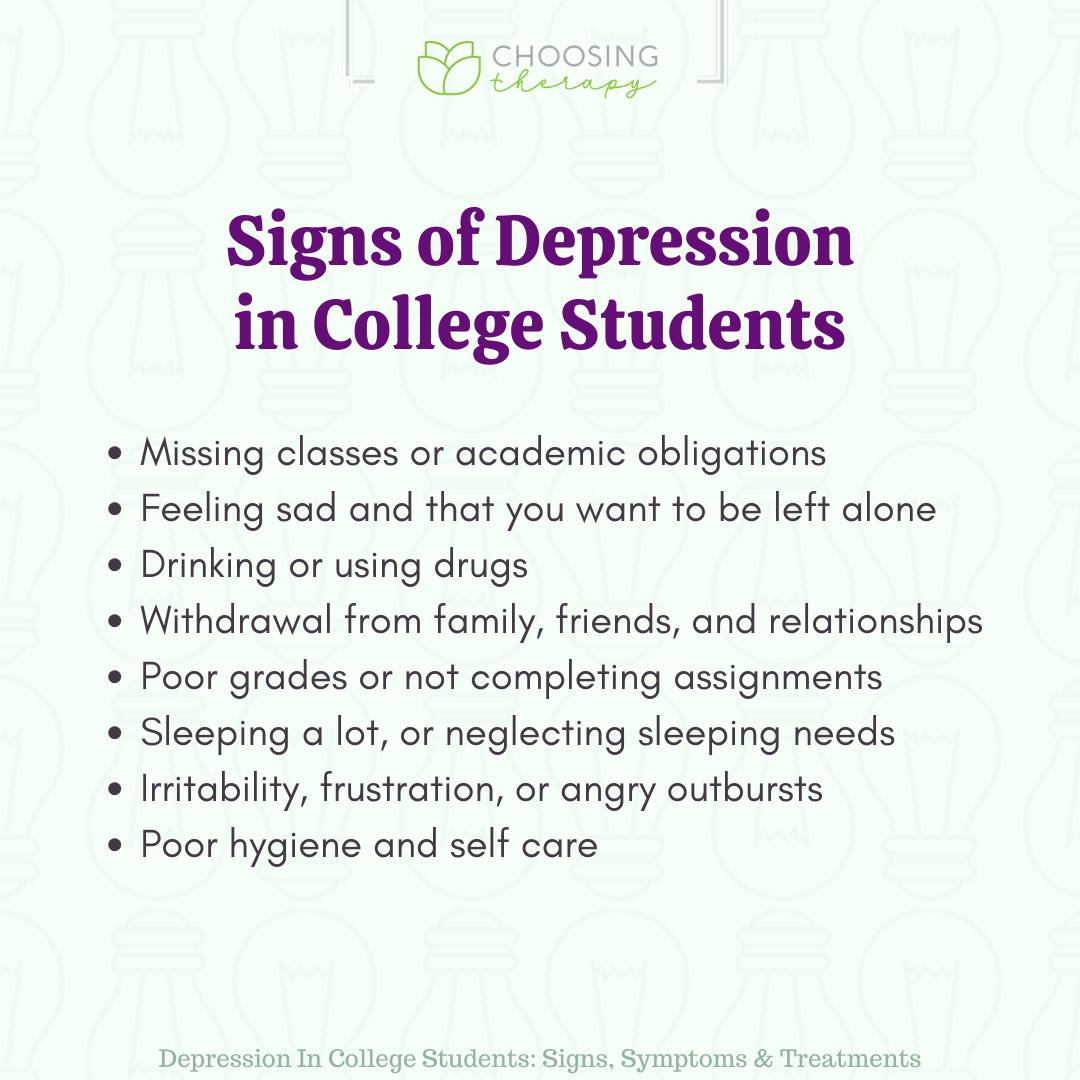
Signs and symptoms of depression in college students may include:2
- Missing classes or academic obligations
- Feeling sad and that you want to be left alone
- Drinking or using drugs
- Withdrawal from family, friends, and relationships (i.e., dating someone with depression)
- Poor grades, or not completing assignments
- Sleeping a lot, or neglecting sleeping needs
- Irritability, frustration, or angry outbursts
- Poor hygiene and self care
College Students & Suicide
Thoughts of suicide or suicidal ideation are directly correlated to disturbances in sleep patterns. 80% of college students who were classified with suicide risk were also classified with sleep disturbances.3 Many college students, for a variety of reasons, pressures, or stress, lack the ability to enact a proper sleep schedule. This could be directly related to depression or come from stress related to educational, extra-curricular, or social demands.
Suicide is the second leading cause of death for people ages 10-34.1 Depression is a treatable illness; however, the stigma attached to seeking help is sometimes difficult to break through and causes some people to exhibit smiling depression.
If you’re thinking of suicide, remember that these thoughts can be a symptom of depression and with the right treatment, you can feel better again. Take that step and let a family member, friend, or healthcare professional know how you are feeling.
When to Get Help With Depression
If you’re a college student dealing with depression, or know someone who is, there are many resources available that can help. Start by scheduling an appointment at your university’s counseling center.
Depression is a serious and common mental condition that requires treatment. It’s better to address symptoms of depression as early as possible to decrease the amount of time the individual is suffering and avoid the possibility of harm.
Untreated depression can lead to worsening of symptoms, other mental or physical problems, and a negative impact on school performance. Early detection of depression increases the likelihood that interventions will be helpful and that successful relapse prevention methods can be implemented.
Many times when a college student is depressed, they struggle academically and socially. Lower academic achievement can be a contributing factor to depressive symptoms and in turn, worsen the impact of the condition for that student. This is another reason to get help early, before the problem spirals.
Life Is Complex. Work. Relationships. Sex.
A therapist can help you figure it out. BetterHelp has over 30,000 licensed therapists who provide convenient and affordable online therapy. BetterHelp starts at $65 per week and is FSA/HSA eligible by most providers. Take a free online assessment and get matched with the right therapist for you.
How Depression Is Treated On College Campuses
How to treat depression is similar on a college campus vs. the community. One of the benefits of seeking help while in college is that the services are convenient to access and usually low cost or free to the student. Campus mental health counselors are usually well prepared to engage in therapy, and they’re also able to refer students to the health center for a medication evaluation if indicated.
Depression treatments for college students may include:
- Therapy: provided by a licensed mental health professional. Through the therapeutic process, you will talk about your struggles and develop a plan to help you cope. Depression therapy can be life-changing for many people and is often helpful for gaining a more positive and recovery-oriented perspective.
- Medication: sometimes, medication for depression is necessary. A primary care doctor or a psychiatrist can complete a medication evaluation and determine if medication is right for your specific situation. Many people find that once they are taking the right medication, their mood improves and they are able to better implement coping strategies.
- Exercise: exercise can help with mild to moderate symptoms of depression. Physical movement can also help in preventing relapse of symptoms.4
- Complementary Approaches: meditation for depression, yoga, acupuncture, nutrition, support groups, and spirituality can all be components that contribute to a well-rounded recovery from depression.
How to Get Help For Depression as a College Student
The first step is to contact the counseling center and schedule an appointment for an evaluation. The counselor will be able to discuss your mental health needs and work with you to determine the best course of treatment.
Most colleges and universities are able to provide both counseling and medication management right on campus. If more services are needed that are not available on campus, referrals can be made to local providers.
What Resources at My University Can Help?
There are many resources to assist with your mental health needs on a college campus. Familiarize yourself with the services that are available at your school so that if you or someone you know is in need of support you will be prepared. Most campuses will have the same support services in place although what they’re called and the exact services provided may vary between campuses.
Mental health resources on college campuses typically include:
- Counseling Center: therapy services, community referrals, online assessments, group programming, and mental health education and outreach services
- Health and Wellness Center: ambulatory care, primary care services, health education, and wellness programs
- Student Support Groups: usually run by a mental health professional. On many campuses, support groups are available both in-person and online
- Campus Police: responsible for safety, security, and upholding the laws. Police are trained to respond to mental health crises when they arise.
Do Universities Make Accommodations For Students With Depression?
According to Title II of the Americans with Disabilities Act and Section 504 of the Rehabilitation Act of 1973, college campuses are required to provide reasonable accommodations to students with physical and/or mental disabilities. These services are put in place to give all students an equal opportunity for success. Some examples include additional testing time, audio recordings of lectures and books, and additional time to complete assignments.
To qualify for services, an application must be submitted through the school’s disability office. This process can begin once the student receives their acceptance letter or at any point during their educational experience. Colleges have different documentation requirements; most include a letter from a doctor or mental health professional, assessments supporting the diagnosis, relevant treatment data, and records of functional limitations requiring accommodations.5
It is important to note that accommodations are based on being disabled or impaired due to the symptoms of depression, and do not necessarily apply to everyone diagnosed with depression.
How to Cope With Depression
There are lots of resources available to help navigate the road to recovery from depression. Mental health apps, for example, can help track moods and provide tips and tools for coping. These apps can be used for guided meditations, positive thinking, mindfulness activities, and improving sleep habits. They’re not an alternative to treatment with a mental health professional, but apps can be used as a tool.
Here are some additional tips for college students with depression:
- Talk to someone about how you are feeling
- Seek professional help from a counselor or doctor
- Track your moods and symptoms
- Get the recommended amount of sleep
- Exercise on a regular basis
- Eat a well-balanced diet
- Decrease stress where possible
What to avoid:
- Trying to “make yourself better” or “do it on your own”
- Dismissing thoughts of harm to yourself or others
- Using alcohol or drugs to cope
How Parents Can Help Their Kids With Depression at College
For parents and guardians, it can be difficult to identify when their child is experiencing symptoms of depression when they are living away from home. Parents or guardians may notice that their student is more distant and this could be a way for them to keep their symptoms a secret if they are feeling embarrassed.
If you suspect your child is struggling, here are things parents can do to provide support:6
- Talk to your child about how they are feeling. Ask open-ended questions and create a safe space for sharing.
- Be an active listener
- Provide resources and information to assist with initiating treatment
- Ask your child to sign a consent form allowing access to information about their mental health treatment—this will allow you to speak with mental health providers
- Find support groups for yourself as well to help you cope and/or understand how to best help your loved one
If you or someone that you know is feeling depressed and in need of immediate assistance, you can call The National Suicide Prevention Hotline at 1−800−273−TALK (8255) to reach a 24−hour crisis center or dial 9-1-1.
Parenting Is Stressful and Challenging!
Get support. BetterHelp has over 30,000 licensed therapists who provide convenient and affordable online therapy. BetterHelp starts at $65 per week and is FSA/HSA eligible by most providers. Take a free online assessment and get matched with the right therapist for you.
Depression in College Students Infographics
ChoosingTherapy.com strives to provide our readers with mental health content that is accurate and actionable. We have high standards for what can be cited within our articles. Acceptable sources include government agencies, universities and colleges, scholarly journals, industry and professional associations, and other high-integrity sources of mental health journalism. Learn more by reviewing our full editorial policy.
-
National Alliance on Mental Health (2019, September) Mental Health by the Numbers. Retrieved from https://www.nami.org/mhstats
-
American Psychiatric Association. (2013). Diagnostic and Statistical Manual of Mental Disorders (5th ed.). Arlington, VA.
-
J Psychiatr Res. (April 2019) Sleep Problems and Suicidal Behaviors in College Students. Retrieved from https://www.ncbi.nlm.nih.gov/pmc/articles/PMC5962276/
-
Rethorst, C., Wipfli B., Landers D. Sports Medicine (2009); 39 (6):491-511 The Antidepressive Effects of Exercise A Meta-Analysis of Randomized Trials.
-
U.S. Department of Education (2020, January). Students with Disabilities Preparing for Postsecondary Education: Know Your Rights and Responsibilities. Retrieved From https://www2.ed.gov/about/offices/list/ocr/transition.html
-
Mayo Clinic (2020, February). College Depression: What Parents Need to Know. Retrieved from https://www.mayoclinic.org/healthy-lifestyle/tween-and-teen-health/in-depth/college-depression/art-20048327

We regularly update the articles on ChoosingTherapy.com to ensure we continue to reflect scientific consensus on the topics we cover, to incorporate new research into our articles, and to better answer our audience’s questions. When our content undergoes a significant revision, we summarize the changes that were made and the date on which they occurred. We also record the authors and medical reviewers who contributed to previous versions of the article. Read more about our editorial policies here.
Author: No Change
Reviewer: No Change
Primary Changes: Updated for readability and clarity. Reviewed and added relevant resources.
Author: No Change
Reviewer: No Change
Primary Changes: Updated statistics, improved readability, shortened “Treatments” section, updated “Resources” section.
Author: Michelle Friedman, LCSW, PMH-C
Reviewer: Maloa Affuembey, MD
Your Voice Matters
Can't find what you're looking for?
Request an article! Tell ChoosingTherapy.com’s editorial team what questions you have about mental health, emotional wellness, relationships, and parenting. Our licensed therapists are just waiting to cover new topics you care about!
Leave your feedback for our editors.
Share your feedback on this article with our editors. If there’s something we missed or something we could improve on, we’d love to hear it.
Our writers and editors love compliments, too. :)
Additional Resources
To help our readers take the next step in their mental health journey, ChoosingTherapy.com has partnered with leaders in mental health and wellness. ChoosingTherapy.com is compensated for marketing by the companies included below.
Eating Disorder Treatment
Equip – Struggling with your relationship with food? Do you find yourself constantly thinking about food or your body? It can be exhausting to have these thoughts. The good news is: you don’t have to feel this way. Take the first step towards healing by taking Equip’s free, confidential eating disorder screener. Learn more.
Online Therapy
Talkspace – Feeling better starts with a single message. Start texting with a therapist. Starting at $69 per week, much less if you have insurance from Cigna, Optum, or Aetna. Talkspace also accepts Medicare in some states. The average copay is $15, but many people pay $0. Get Started
Psychiatry, with You in Mind
Talkiatry – Psychiatry that helps kids thrive. Safe, virtual mental health care from doctors who take insurance. Your child’s first visit is 75 minutes and includes a clinical evaluation. Free Assessment

Best Online Therapy Services
There are a number of factors to consider when trying to determine which online therapy platform is going to be the best fit for you. It’s important to be mindful of what each platform costs, the services they provide you with, their providers’ training and level of expertise, and several other important criteria.
Best Online Psychiatry Services
Online psychiatry, sometimes called telepsychiatry, platforms offer medication management by phone, video, or secure messaging for a variety of mental health conditions. In some cases, online psychiatry may be more affordable than seeing an in-person provider. Mental health treatment has expanded to include many online psychiatry and therapy services. With so many choices, it can feel overwhelming to find the one that is right for you.
