





The Dark Triad describes a personality displaying high levels of three specific traits–narcissism, subclinical psychopathy, and Machiavellianism. Individuals possessing these traits are manipulative, impulsive, and amoral. Some experts have conceptualized the Dark Triad as the basic components of evil.1
ChoosingTherapy.com may earn a commission from the companies whose services are linked on this page.
You Can Escape from a Narcissist Therapy can help you leave and recover from a narcissistic relationship. BetterHelp has a large network of licensed therapists worldwide who provide convenient and affordable online therapy. Take a brief assessment and get matched with a therapist who fits your needs in as little as 48 hours. Insurance options may be available for eligible members.* *Insurance availability and coverage may vary by state, plan, provider network, and therapist availability.
What Is the Dark Triad?
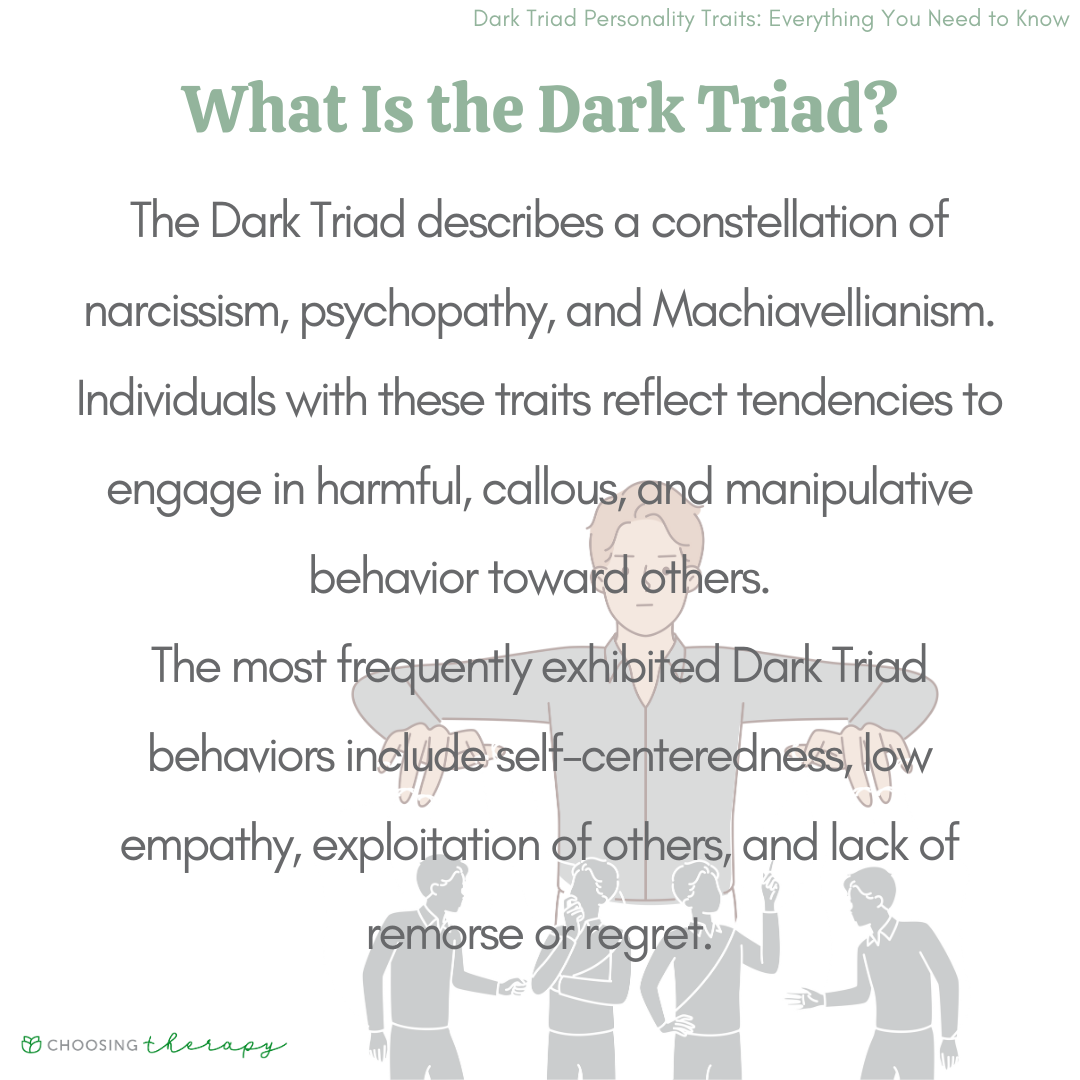
The Dark Triad describes a constellation of narcissism, psychopathy, and Machiavellianism. Individuals with these traits reflect tendencies to engage in harmful, callous, and manipulative behavior toward others.2
The most frequently exhibited Dark Triad behaviors include self-centeredness, low empathy, exploitation of others, and lack of remorse or regret. Sometimes, the triad may manifest as a combination of borderline personality disorder, narcissism, and psychopathy, known as the “vulnerable dark triad.”
What Are Personality Traits?
Personality encompasses a variety of measurable traits, attitudes, thoughts, and behaviors, providing a vocabulary for understanding different individuals. Personality traits are the product of nature and nurture. For instance, some people are naturally outgoing, while others are more reserved.
Experts began assessing personality traits in the 1940s with the Five Factor Model of Personality.3 The Big Five include openness to new experiences, conscientiousness, extraversion, agreeableness, and neuroticism. Most of these characteristics, particularly agreeableness, are generally lower in individuals exhibiting Dark Triad traits.4
What Are the Dark Triad Traits?
The Dark Triad traits are narcissism, subclinical psychopathy, and Machiavellianism. Those possessing this personality have little interest in pleasing others or following the rules. Dark Triad features often drive individuals to manipulate and harm others.
Below are the three traits of the Dark Triad:
1. Narcissism
Narcissism describes behavior reflecting an overly inflated ego and sense of entitlement. Other traits associated with narcissism include grandiosity, feelings of superiority, an excessive need for admiration, and a lack of empathy. Individuals must exhibit at least five of nine specific traits to be diagnosed with narcissistic personality disorder (NPD).5
2. Subclinical Psychopathy
Those with subclinical psychopathy, also termed adaptive or successful psychopathy, exhibit core features of psychopathy but can utilize these traits for personal gain.6 These individuals gravitate toward thrill-seeking and impulsive behavior compounded by a lack of remorse for harm caused.7 Clinical psychopaths also lack morals, empathy, and guilt for harming others.8 They are less likely to follow societal rules or obey laws.8
3. Machiavellianism
Machiavellianism is the tendency to lie or use deceit to obtain personal desires. The term comes from the 16th-century figure Niccolò Machiavelli. Machiavelli was an Italian political leader who highlighted the necessity of manipulation to achieve personal gain in his book, The Prince.3 The coldness, callousness, and lack of empathy characteristic of his work helped coin the term now associated with the Dark Triad.9
Signs of a Dark Triad Personality
Identifying a person with Dark Triad traits can be challenging. The constellation of these traits empowers individuals to use deception and manipulation to mask their behavior. However, some clear signs of the Dark Triad show up in their interactions with others.
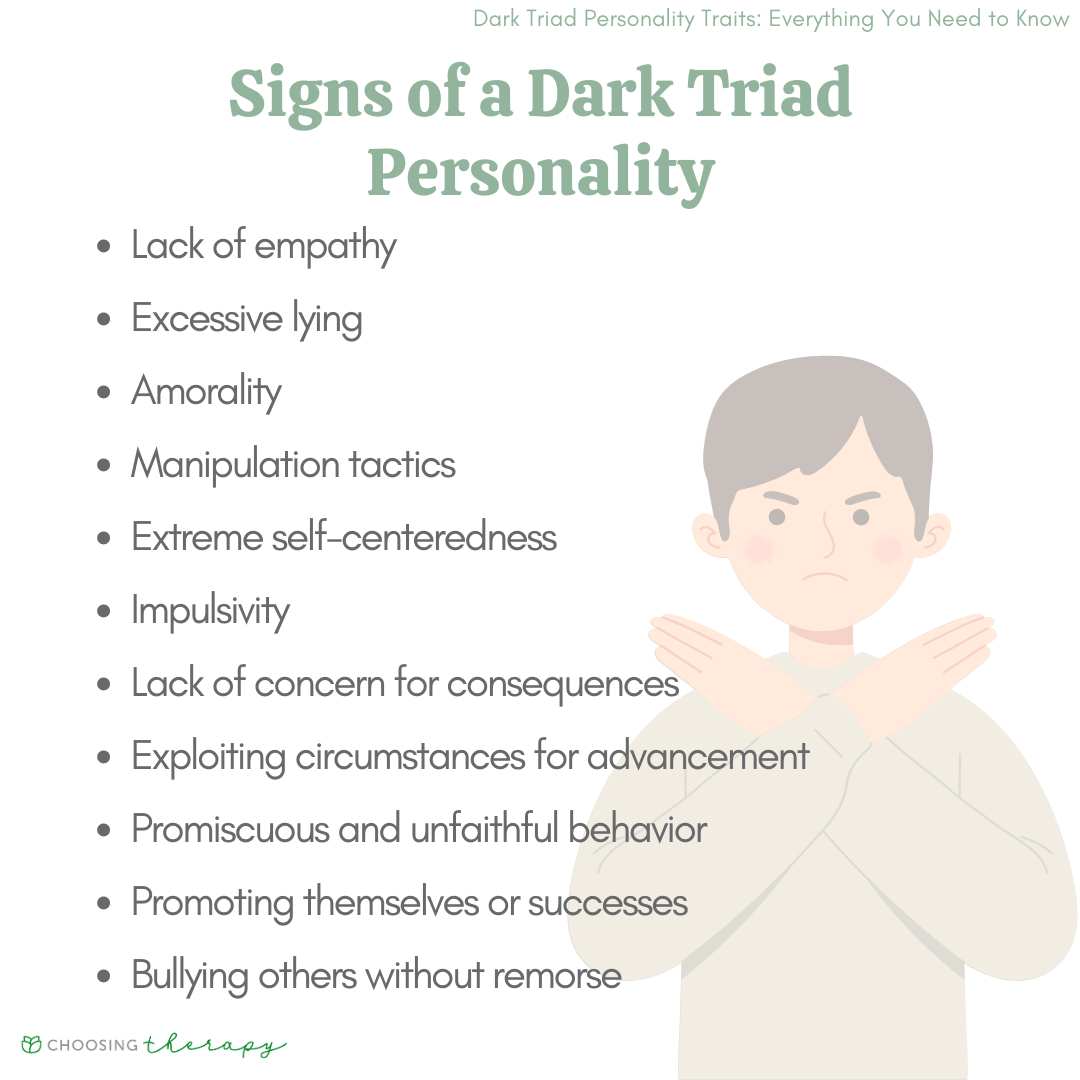
Personality characteristics of the Dark Triad include:
- Lack of empathy
- Excessive lying
- Amorality
- Manipulation tactics
- Extreme self-centeredness
- Impulsivity
- Lack of concern for consequences
- Exploiting circumstances for advancement
- Promiscuous and unfaithful behavior
- Promoting themselves or successes
- Bullying others without remorse
Are You Dating or Married to a Narcissist?
Whether you’re trying to move on or rebuild a relationship, a licensed therapist can guide you. BetterHelp has a large network of licensed therapists worldwide who provide convenient and affordable online therapy. Take a brief assessment and get matched with a therapist who fits your needs in as little as 48 hours. Insurance options may be available for eligible members.* *Insurance availability and coverage may vary by state, plan, provider network, and therapist availability.
What Causes the Dark Triad Personality?
Research suggests that all three Dark Triad traits stem from combined genetic and environmental factors.10 People are born with the propensity to exhibit narcissism, subclinical psychopathy, and Machiavellianism, but their environments can support or prevent development.
Parental involvement appears to play a role in Dark Triad personality traits. For example, children who receive too little or too much parental praise may lean toward narcissistic behavior. Parental maltreatment, compromised family functioning, and reinforcement of manipulative behaviors may contribute to Machiavellianism. Finally, punitively oriented parents and inconsistent parenting practices can exacerbate predispositions to subclinical psychopathy. While one factor is not responsible for a Dark Triad personality, childhood emotional neglect and other parental missteps may impact its development.
What Is the Light Triad?
The Light Triad exists on the opposite side of the personality spectrum.11 Light Triad personalities describe people who embody caring orientations toward the world juxtaposed against Dark Triad malevolence. The Light Triad includes humanism, Kantianism, and faith in humanity.
Below are the Light Triad traits:
- Humanism: Humanism is the belief that everyone possesses and deserves dignity, value, and worth.
- Kantianism: This trait refers to a sense of obligation to help fellow humans in times of need.
- Faith in humanity: Having “faith in humanity” means seeing the best in people and believing that most people are good.
How to Deal With Someone Who Exhibits Dark Traits
Realizing that someone you trust is exploiting you for personal gain is disconcerting. Dark Triad individuals are master manipulators who can use their charm, lack of concern, and skills at deception to trick others.
The most effective way of dealing with a Dark Triad personality is to put distance between you and that person. These individuals seldom change, and even legal entanglements may not encourage improvement. Be aware of any danger and ensure self-protection when approaching the Dark Triad.
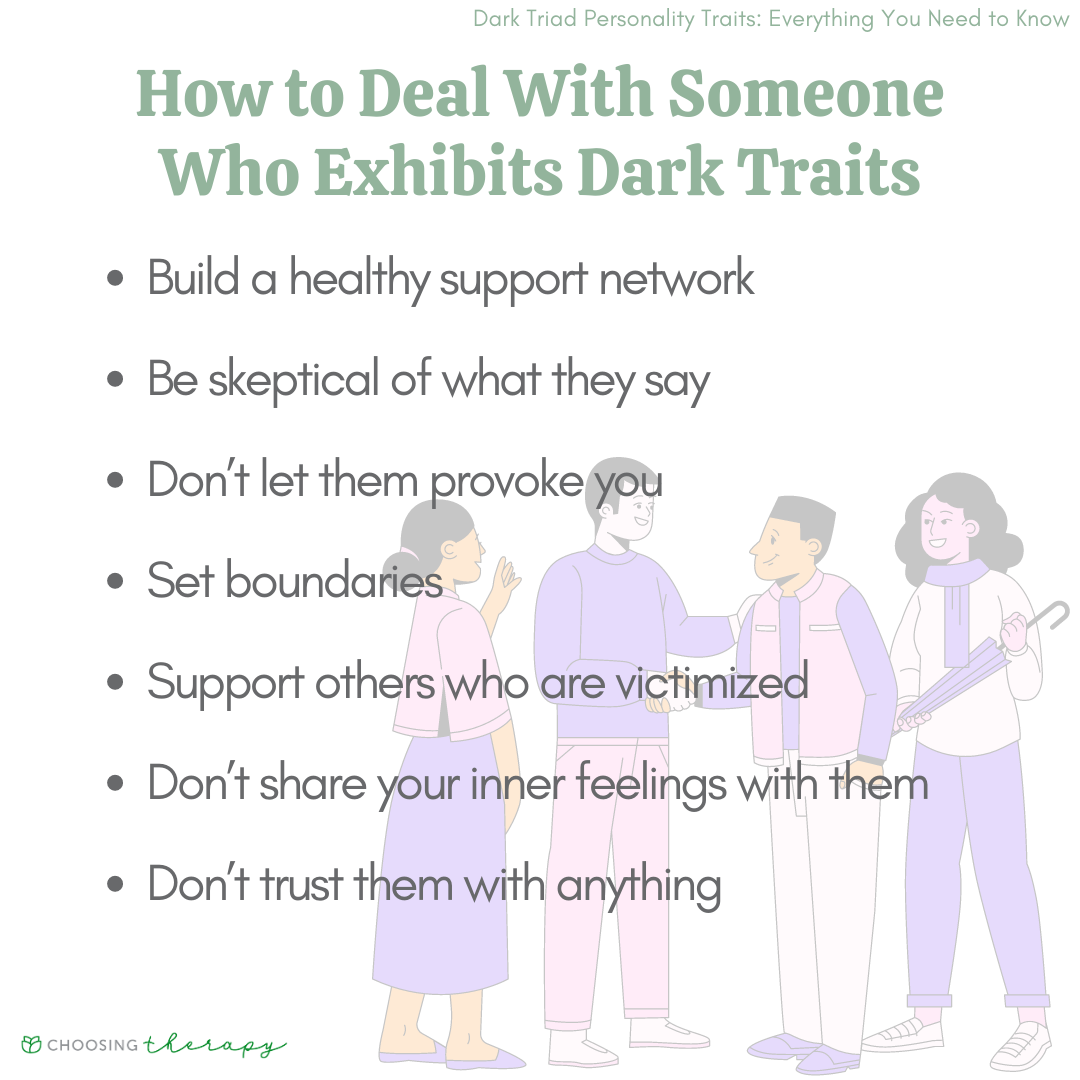
Below are ways to deal with Dark Triad personality traits:
- Build a healthy support network: Your social network can provide emotional and instrumental support when you share your concerns and challenges. Knowing that someone else understands your situation and has your back can provide a sense of ease.
- Be skeptical of what they say: Never trust what a Dark Triad individual tells you. They will only say what they think you want to hear. Their goal is to manipulate you.
- Don’t let them provoke you: Do not react to their behavior. They view extreme responses as a weakness that feeds their ego and unveils your vulnerabilities.
- Set boundaries: Boundaries are essential in any relationship, but even more so when dealing with dark traits. These individuals are experts at deception and have no conscience. They will go to great lengths to manipulate you, so setting boundaries is crucial.
- Support others who are victimized: If the Dark Triad personality is harming co-workers, friends, or family members, step up and offer them support.
- Don’t share your inner feelings with them: The more information this personality gathers about you, the more harm they can do. Keep your thoughts and feelings to yourself, especially if this person is a colleague.
- Don’t trust them with anything: You must keep your guard up as long as this person is in your life. The less information they have about you and your life, the better.
When to Seek Professional Help
Individuals who exhibit Dark Triad personality traits seldom pursue professional help in reshaping their behavior. However, some research suggests that these people may change their behavior if motivated.12
You may benefit from therapy if you are involved with someone who exhibits the Dark Triad. Your relationship may be overwhelming and taxing, so learning new coping strategies can be especially helpful. If you’re unsure how to find a therapist, using an online therapist directory can get you started. Finding and choosing an online therapist is another viable option.
You Can Escape from a Narcissist Therapy can help you leave and recover from a narcissistic relationship. BetterHelp has a large network of licensed therapists worldwide who provide convenient and affordable online therapy. Take a brief assessment and get matched with a therapist who fits your needs in as little as 48 hours. Insurance options may be available for eligible members.* *Insurance availability and coverage may vary by state, plan, provider network, and therapist availability.
In My Experience
In my experience, individuals exhibiting Dark Triad personality traits can be superficially charming, exciting, and deceptively manipulating. Overlooking possible danger can be easy until their behavior causes personal harm. Seeking help can help you restore your self-esteem and self-confidence. Rather than being disappointed in yourself for falling victim to their manipulation, remember they have been honing their tactics since childhood. No one intentionally chooses to become involved with the wrong person, but knowing the signs to look out for can leave you more alert in the future.

Dark Triad Infographics
ChoosingTherapy.com strives to provide our readers with mental health content that is accurate and actionable. We have high standards for what can be cited within our articles. Acceptable sources include government agencies, universities and colleges, scholarly journals, industry and professional associations, and other high-integrity sources of mental health journalism. Learn more by reviewing our full editorial policy.
-
Book, A., Visser, B. A., & Volk, A. A. (2015). Unpacking “evil”: Claiming the core of the Dark Triad. Personality and Individual Differences, 73, 29-38.
-
Curtis, S. R., & Jones, D. N. (2020). Understanding what makes dark traits “vulnerable”: A distinction between indifference and hostility. Personality and Individual Differences, 160, 109941.
-
Fiske, D. W. (1949). Consistency of the factorial structures of personality ratings from different sources. Journal of Abnormal and Social Psychology, 44, 329– 344.
-
Hudson, N. W. (2022). Lighten the darkness: Personality interventions targeting agreeableness also reduce participants’ levels of the dark triad. Journal of Personality.
-
American Psychiatric Association. (2013). Diagnostic and statistical manual of mental disorders (5th ed.). https://doi.org/10.1176/appi.books.9780890425596
-
Smith, C. S., & Hung, L.-C. (2013). Subclinical psychopaths: How they adapt, their interpersonal interactions with and effect on others, and how to detect them. Charles C Thomas Publisher.
-
Lilienfeld, S. O., Watts, A. L., & Smith, S. F. (2015). Successful psychopathy: A scientific status report. Current Directions in Psychological Science, 24, 298-303.
-
Anderson, N. E., & Kiehl, K. A. (2014). Psychopathy: developmental perspectives and their implications for treatment. Restorative neurology and neuroscience, 32(1), 103–117. https://doi.org/10.3233/RNN-139001
-
Jones, D. N., & Paulhus, D. L. (2009). Machiavellianism. In M. R. Leary & R. H. Hoyle (Eds.), Handbook of individual differences in social behavior (pp. 93–108). The Guilford Press.
-
Vernon, P. A., et al. (2008). A behavioral genetic investigation of the Dark Triad and the Big 5. Personality and individual Differences, 44(2), 445-452.
-
Aruta, J. J. B. R. (2022). Psychometric validation and environmental psychological correlates of the Light Triad traits: Evidence from a non-Western country. Journal of Individual Differences. Advance online publication. https://doi.org/10.1027/1614-0001/a000389
-
Hudson, N. W. (2022). Lighten the darkness: Personality interventions targeting agreeableness also reduce participants’ levels of the dark triad. Journal of Personality.

We regularly update the articles on ChoosingTherapy.com to ensure we continue to reflect scientific consensus on the topics we cover, to incorporate new research into our articles, and to better answer our audience’s questions. When our content undergoes a significant revision, we summarize the changes that were made and the date on which they occurred. We also record the authors and medical reviewers who contributed to previous versions of the article. Read more about our editorial policies here.
Author: ChoosingTherapy.com Editorial Team
Primary Changes: Link maintenance: 1 outdated link removed, 1 link re-pointed to current sources.
Your Voice Matters
Can't find what you're looking for?
Request an article! Tell ChoosingTherapy.com’s editorial team what questions you have about mental health, emotional wellness, relationships, and parenting. Our licensed therapists are just waiting to cover new topics you care about!
Leave your feedback for our editors.
Share your feedback on this article with our editors. If there’s something we missed or something we could improve on, we’d love to hear it.
Our writers and editors love compliments, too. :)
Additional Resources
To help our readers take the next step in their mental health journey, ChoosingTherapy.com has partnered with leaders in mental health and wellness. ChoosingTherapy.com is compensated for marketing by the companies included below.
Online Therapy
BetterHelp – Get support and guidance from a licensed therapist. BetterHelp has over 30,000 therapists who provide convenient and affordable online therapy. BetterHelp starts at $65 per week and is FSA/HSA eligible by most providers. Take a free online assessment and get matched with the right therapist for you. Free Assessment
Online-Therapy – Online-Therapy.com provides a weekly live video session, unlimited text messaging, and self-guided activities like journaling. Starting at $64 per week, this is one of the most affordable options for CBT therapy. Try Online-Therapy
Narcissism Newsletter
A free newsletter from the experts at ChoosingTherapy.com for those recovering from narcissistic abuse. Get helpful tips and the latest information. Sign Up
ChoosingTherapy.com Directory
Find local therapists that offer online and in-person therapy. Search for therapists by specialty, experience, insurance, and location. Find a therapist near you.

Related reading: 51 Quotes About Narcissism From Actual Therapists

