


OCD is not curable, but various treatment options are available to help those with the disorder. While OCD is typically considered to be a chronic condition, different therapeutic approaches (most commonly exposure and response prevention) and medications can be effective in managing symptoms and helping people with OCD experience happy, satisfying lives.
ChoosingTherapy.com may earn a commission from the companies whose services are linked on this page.
What is the best therapy for OCD?
Exposure And Response Prevention Therapy (ERP) – Do live video sessions with a therapist specialized in ERP, the gold standard treatment for OCD. Treatment from NOCD is covered by many insurance plans. Start With A Free 15 Minute Call
What Is OCD?
Obsessive-compulsive disorder (OCD) is a mental health condition marked by intrusive thoughts, known as obsessions, and completing repetitive behaviors, known as compulsions, in response to these obsessions. Roughly 2-3% of the U.S. population experience symptoms of OCD.1
OCD symptoms typically emerge between eight to 12 years old or late adolescence to early adulthood.2 With OCD, there is often a delay between the onset of symptoms and diagnosis (roughly a 12-year gap).3 Family history of OCD and exposure to childhood trauma are possible risk factors for this disorder.4
What Causes OCD?
OCD appears to have a genetic factor, particularly when people have immediate family members with OCD.4 Researchers have also explored environmental factors, such as birth complications and exposure to traumatic events, as risk factors for the condition.5 Neuroimaging has also observed possible differences in the brains of those with OCD.
Causes of OCD may include:
- Genetics: Genes may play a role in OCD, especially if a parent or sibling has the disorder. Genetics are not the only cause for having OCD, and protective factors may mediate this risk.
- Environmental factors: Different environmental factors may correlate with OCD, such as birth complications, traumatic events, or life stressors.
- Brain differences: Neuroimaging research suggests that impaired communication between the front part of the brain and deeper structures may affect individuals with OCD. Neurotransmitters, such as serotonin, may also be impacted.6
Can OCD Be Cured?
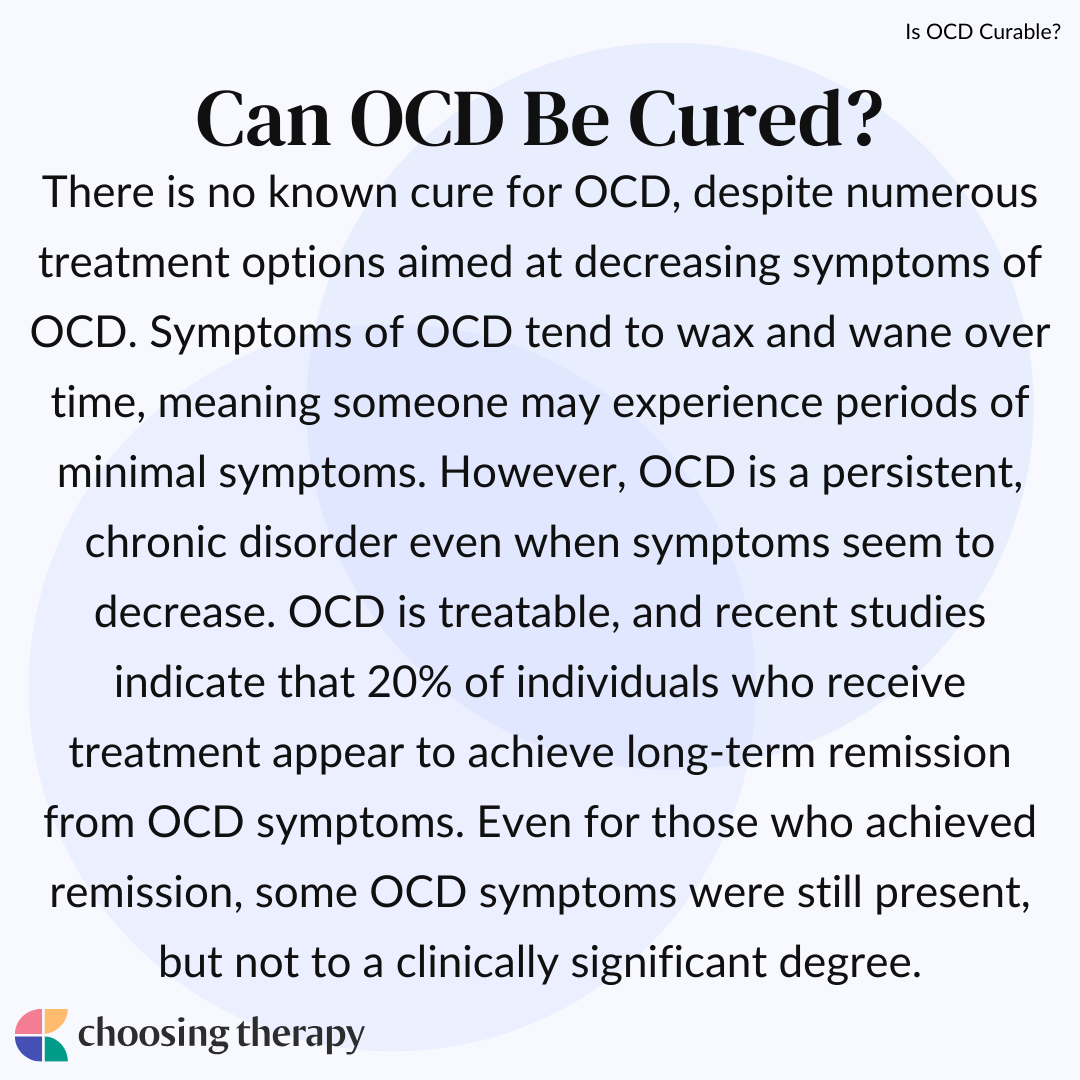
There is no known cure for OCD, despite numerous treatment options aimed at decreasing symptoms of OCD.7 Symptoms of OCD tend to wax and wane over time, meaning someone may experience periods of OCD recovery. However, OCD is a persistent, chronic disorder even when symptoms seem to decrease.
OCD is treatable, and recent studies indicate that 20% of individuals who receive treatment appear to achieve long-term remission from OCD symptoms.7 Even for those who achieved remission, some OCD symptoms were still present but not to a clinically significant degree.
Getting Early Treatment Can Help
A shorter duration between the onset of symptoms and diagnosis of OCD may lead to improved functioning and less severe OCD symptoms.3 Therefore, receiving diagnosis and treatment early on can lead to a better prognosis in managing symptoms. While OCD does not “go away,” treatment for OCD can remarkably reduce symptoms, allowing individuals to lead happy, healthy lives.
OCD Is Chronic, But Not Terminal
OCD is a chronic or lifelong condition.8,9 However, children and adolescents often experience better treatment outcomes than those treated in adulthood.9 Symptoms can worsen or lessen over time depending on treatment, life events, and other factors.
Several things can worsen OCD symptoms, such as elevated stress levels, significant life changes, trauma, or a co-occurring mental health condition. Even though OCD is a permanent condition, there may be periods when symptoms decrease, especially with treatment.
Can OCD Be Prevented?
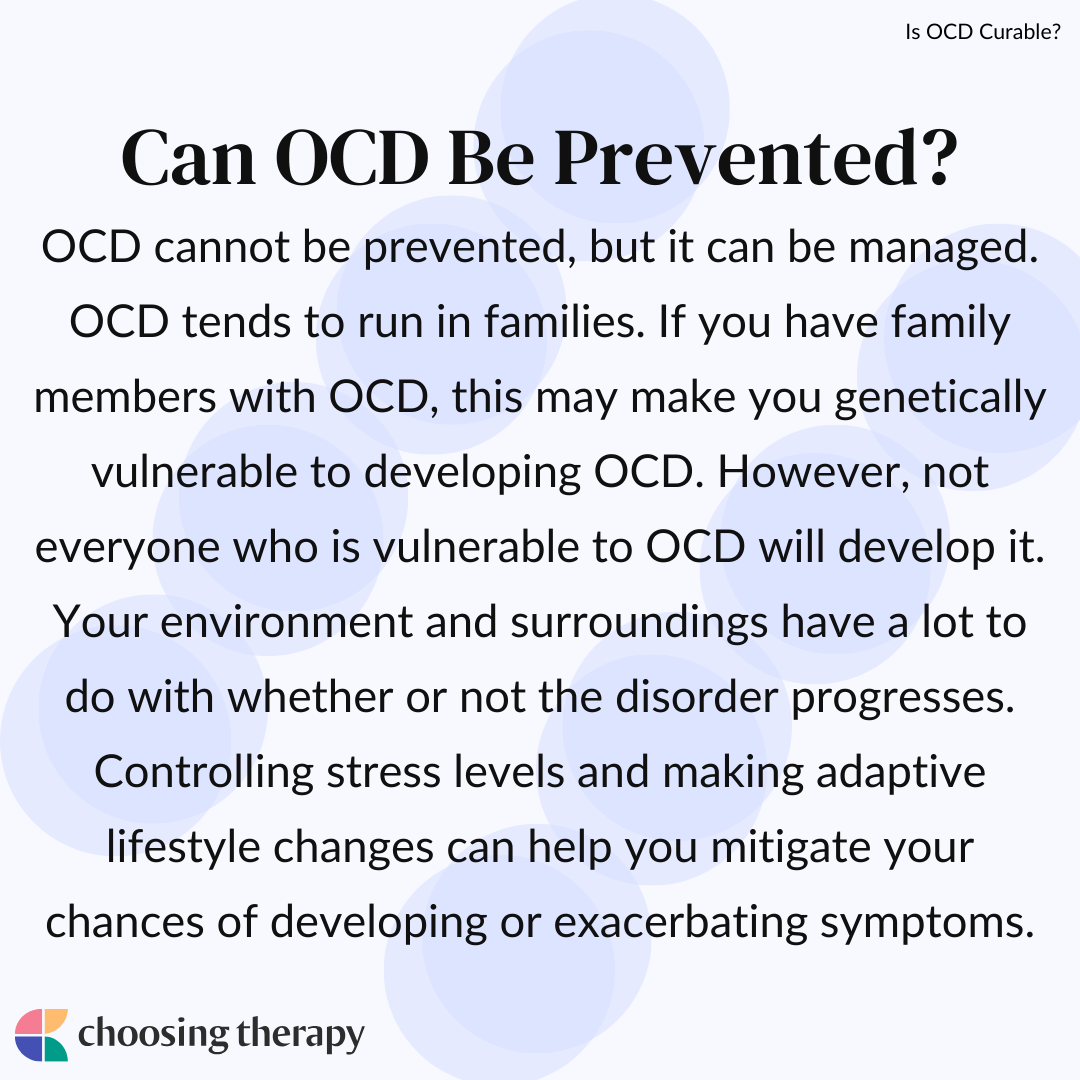
OCD cannot be prevented, but it can be managed. OCD tends to run in families. If you have family members with OCD, this may make you genetically vulnerable to developing OCD. However, not everyone who is vulnerable to OCD will develop it. Your environment and surroundings have a lot to do with whether or not the disorder progresses. Controlling stress levels and making adaptive lifestyle changes can help you mitigate your chances of developing or exacerbating symptoms.
Treatment for OCD
A comprehensive OCD treatment plan typically involves working with a therapist and/or medication management. The frontline treatment for OCD is exposure and response prevention therapy (ERP), which has been shown to benefit 70% of individuals with OCD.10
Providers may also recommend medication in combination with therapy to manage symptoms. Psychiatric medication can help mitigate the distress produced by obsessive thoughts.
Treatment options for OCD may include:
- Exposure and response prevention (ERP): ERP for OCD involves exposing someone to their feared obsession without engaging in compulsive behaviors. While working with a therapist, clients create a hierarchy to guide sessions, typically starting with a lower distress exposure and working up to higher distress exposures.
- Medications: OCD medications often include selective serotonin reuptake inhibitors (SSRIs), also called antidepressants. Luvox, Prozac, Zoloft, and Paxil may help reduce certain symptoms.11
- Cognitive behavioral therapy (CBT): CBT for OCD emphasizes the connection between thoughts, feelings, and behaviors. Therapists help clients break the link between obsessive thoughts and compulsive behaviors.
- Acceptance and commitment therapy (ACT): ACT for OCD focuses on psychological flexibility and encourages clients to explore alternative ways to respond to the distress caused by obsessive thoughts.
- Mindfulness-based CBT (MBCT): MBCT emphasizes allowing intrusive thoughts to pass without judgment or acting on them. By taking an observational stance on these obsessions, the drive to use compulsions can decrease.
- Eye movement desensitization and response therapy (EMDR): EMDR for OCD can be beneficial if the onset of symptoms traces back to a stressful or traumatic event. EMDR works to desensitize and reprocess prior traumatic events contributing to present-day distress, therefore reducing symptoms of OCD.
- IOP and residential programs: Sometimes, OCD symptoms may be severe enough to affect someone’s ability to fulfill basic living tasks and work obligations. When this happens, it can be helpful for the person to seek a higher level of care than weekly therapy, such as intensive outpatient programs (IOP) or residential programs. Through these programs, a person often receives individuals and group therapy, psycho-education groups, and additional life skills classes.
- Deep brain stimulation: Deep brain stimulation is helpful for severe OCD symptoms that have not responded to traditional treatments. Efficacy rates for deep brain stimulation are around 60%.12
- Transcranial magnetic stimulation: Repetitive transcranial magnetic stimulation (rTMS) may be helpful for comorbid OCD and depression symptoms.13 Some research supports that rTMS is moderately effective at reducing OCD symptoms.13
Treatment for OCD
NOCD: Online OCD Treatment Covered by Insurance – Regain your life from OCD. Do live video sessions with a licensed therapist specialized in treating OCD. Treatment from NOCD is covered by most major insurance plans. Learn how you can use your insurance benefits. Visit NOCD
Talkiatry: Is OCD Medication Right for You? Speak with a Doctor – Talkiatry can match you with a psychiatrist who takes your insurance and is accepting new patients. They’re in-network with major insurers and offer medication management with supportive therapy. Free Assessment
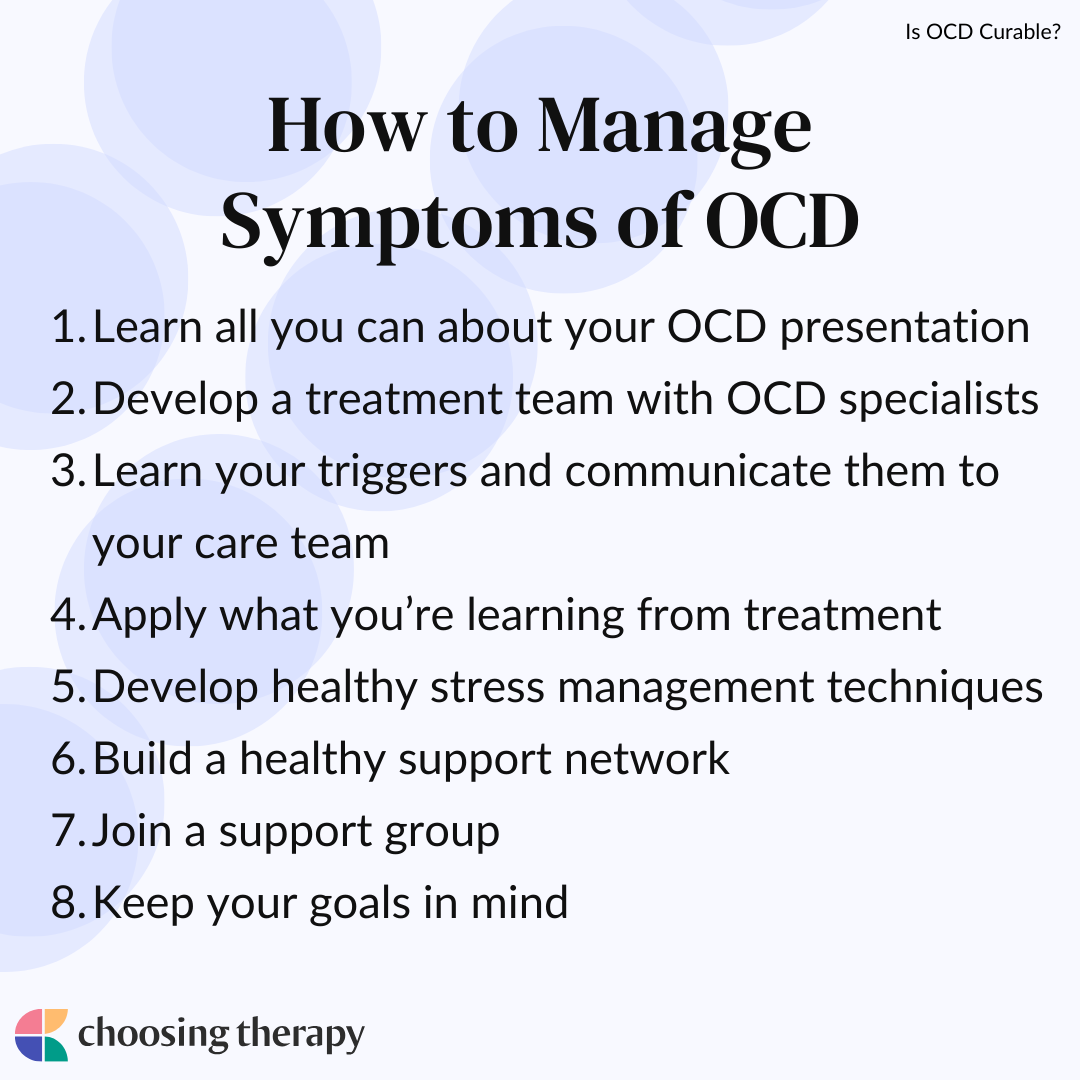
How to Manage Symptoms of OCD
Discovering that OCD is un-curable can be anxiety-provoking. However, you can decrease your symptoms and improve your ability to function with treatment and self-help tools. There is hope for a future where your OCD is manageable.
Here are six ways to manage OCD symptoms:
1. Learn All You Can About Your OCD Presentation
While you cannot treat OCD on your own, an initial step to symptom management is learning more about OCD. Looking up symptoms, possible causes, and treatment options can be beneficial. Depending on the type of OCD, the content of your obsessions and compulsions may center on a specific theme. Identifying the type of OCD you have can help you learn about challenges and strengths within your subtype.
2. Develop a Treatment Team With OCD Specialists
Finding a trusted treatment team specializing in OCD is essential, and a combination of both medication and therapy is the most effective approach. Look for a therapist who can provide evidence-based treatment for OCD.
Some people may also work with family therapists if OCD symptoms significantly impact the family unit. Group therapy is also an option. Either way, ensure everyone in your treatment team is in contact with each other to collaborate and provide you with the best care.
3. Learn Your Triggers & Communicate Them to Your Care Team
Identifying your triggers is one of the most important parts to beginning treatment. Once you understand the people, places, and situations that can cause your OCD obsessions to begin, you can work with your care team to determine a course of treatment.
Your therapist may help you determine which triggers can be minimized and which can be confronted through exposures. For example, you may not be able to ignore people you live with that trigger you, but you may be able to minimize how often you ask them to reinforce your behaviors, like reassurance-seeking.
4. Apply What You’re Learning From Treatment
Once you start therapy or medication, follow your providers’ recommendations. Most therapists, particularly those using ERP, will assign you homework activities to complete outside of sessions. Completing these tasks is crucial to decreasing your OCD symptoms.
Compliance with medications is important as well. Taking your prescriptions as advised by your psychiatrist and continuing to do so throughout treatment will provide the most efficacy.
5. Develop Healthy Stress Management Techniques
Stress can exacerbate existing OCD symptoms. Early on in treatment, it can be beneficial to try out various stress management techniques and OCD coping skills to figure out which ones work best for you. Sometimes, it can be helpful to involve support people in your stress management techniques for purposes of accountability. For example, you may not feel like going to the gym or attending yoga for OCD sessions alone, but taking a friend with you can provide support and encourage commitments.
6. Build a Support Network
Having a support network can be beneficial throughout OCD treatment. Research has indicated that an empathetic and positive support system leads to long-lasting gains from treatment.12 Therefore, building a network of people who provide positive support is essential.
After educating yourself on OCD symptoms, consider disclosing this information to your support system (if you are comfortable doing so). You can also ask people in your support network, such as a significant other or family member, to accompany you in your treatment. Their added support can help you address any difficulties OCD may be causing in your relationships.
7. Join a Support Group
Finding a support group of others who can relate to your experiences can be beneficial and validating. Hearing other members’ stories and coping strategies can provide a sense of community, support, and a reminder that you’re not alone.
8. Keep Your Goals In Mind
The treatment of OCD is an ongoing process, and sometimes you may feel discouraged. Treatment may feel overwhelming, especially during the initial stages. Keep your long-term goals in mind during these times. Refocusing on what you want to accomplish and gain from your treatment can help you keep going when things feel tough.
When to Seek Professional Support
Symptoms can worsen if OCD is left untreated. If your condition impacts your ability to perform daily tasks, work, and have fulfilling relationships, consider seeking treatment. An online therapist directory allows you to filter providers based on specialty, location, and insurance. You are not alone, and help is available to get you started in symptom management. You can also use and online OCD resource, like NOCD, to start seeking treatment from the comfort of your home.
NOCD: Online OCD Treatment Covered By Insurance
Regain your life from OCD. Do live video sessions with a licensed therapist specialized in treating OCD. Treatment from NOCD is covered by most major insurance plans. Learn how you can use your insurance benefits.
What’s the Best Someone With OCD Can Hope For?
Through treatment, you can experience hope for living a life not ruled by the cycle of obsessions and compulsions. A therapist can teach you strategies for not getting knocked off course by obsessive thoughts and urges. Through learning not to assign as much meaning to your obsessions, you can feel more confident about your future life goals despite OCD symptoms.


OCD Workbook
Our workbook includes our best OCD worksheets to help you understand OCD, challenge intrusive thoughts, and effectively care for yourself.
In My Experience
In my experience, I have found that seeking therapy to help with OCD can be highly beneficial. Although there is no cure for OCD, there is hope for a future where your OCD doesn’t rule your life. Building a support network, finding a treatment team, and continuing to take steps to manage your symptoms are all beneficial.

Is OCD Curable? Infographics
ChoosingTherapy.com strives to provide our readers with mental health content that is accurate and actionable. We have high standards for what can be cited within our articles. Acceptable sources include government agencies, universities and colleges, scholarly journals, industry and professional associations, and other high-integrity sources of mental health journalism. Learn more by reviewing our full editorial policy.
-
American Psychiatric Association. (2022). What Is Obsessive-Compulsive Disorder? Retrieved from https://www.psychiatry.org/patients-families/obsessive-compulsive-disorder/what-is-obsessive-compulsive-disorder
-
International OCD Foundation. (n.d.). Who Gets OCD? Retrieved from https://iocdf.org/about-ocd/who-gets-ocd/
-
Ziegler, S., et al. (2021). Long durations from symptom onset to diagnosis and from diagnosis to treatment in obsessive-compulsive disorder: A retrospective self-report study. PloS one, 16(12), e0261169. https://doi.org/10.1371/journal.pone.0261169
-
BeyondOCD. (n.d.). What Causes Obsessive Compulsive Disorder (OCD)?. Retrieved from https://beyondocd.org/ocd-facts/what-causes-ocd
-
Bloch, M.H., et al. (2013), LONG-TERM OUTCOME IN ADULTS WITH OBSESSIVE-COMPULSIVE DISORDER. Depression and Anxiety, 30: 716-722. https://doi.org/10.1002/da.22103
-
Stanford Medicine. (n.d.). About OCD | Obsessive-Compulsive and Related Disorders | Stanford Medicine. Retrieved from https://med.stanford.edu/ocd/about.html
-
Bloch, M.H., et al. (2013), LONG-TERM OUTCOME IN ADULTS WITH OBSESSIVE-COMPULSIVE DISORDER. Depression and Anxiety, 30: 716-722. https://doi.org/10.1002/da.22103
-
Stanford Medicine. (n.d.). About OCD | Obsessive-Compulsive and Related Disorders | Stanford Medicine. Retrieved from https://med.stanford.edu/ocd/about.html
-
Obsessive-Compulsive Disorder. (2021). MedlinePlus. Retrieved from https://medlineplus.gov/obsessivecompulsivedisorder.html
-
Jenike, M. (n.d.). Medications for OCD. Retrieved from https://iocdf.org/about-ocd/ocd-treatment/meds/
-
Steketee, G. (1993). Social Support and Treatment Outcome of Obsessive Compulsive Disorder at 9-Month Follow-up. Behavioural and Cognitive Psychotherapy, 21(2), 81-95. doi:https://doi.org/10.1017/S014134730001805X
-
Abdelnaim, M. A., Lang-Hambauer, V., Hebel, T., Schoisswohl, S., Schecklmann, M., Deuter, D., Schlaier, J., & Langguth, B. (2023). Deep brain stimulation for treatment resistant obsessive compulsive disorder; an observational study with ten patients under real-life conditions. Frontiers in psychiatry, 14, 1242566. https://doi.org/10.3389/fpsyt.2023.1242566
-
Steuber, E. R., & McGuire, J. F. (2023). A Meta-analysis of Transcranial Magnetic Stimulation in Obsessive-Compulsive Disorder. Biological psychiatry. Cognitive neuroscience and neuroimaging, 8(11), 1145–1155. https://doi.org/10.1016/j.bpsc.2023.06.003

We regularly update the articles on ChoosingTherapy.com to ensure we continue to reflect scientific consensus on the topics we cover, to incorporate new research into our articles, and to better answer our audience’s questions. When our content undergoes a significant revision, we summarize the changes that were made and the date on which they occurred. We also record the authors and medical reviewers who contributed to previous versions of the article. Read more about our editorial policies here.
Author: No Change
Reviewer: No Change
Primary Changes: Added OCD Workbook with six worksheets.
Author: No Change
Reviewer: No Change
Primary Changes: Updated for readability and clarity. Reviewed and added relevant resources. Added “Can OCD Be Prevented?”, “Learn Your Triggers & Communicate Them to Your Care Team”, “Develop Healthy Stress Management Techniques”, “What’s the Best Someone With OCD Can Hope For?”. Amended “Treatment for OCD”. New material written by Christina Canuto, LMFT-A and reviewed by Heidi Moawad, MD.
Author: Elizabeth Yoak, LMHC, NCC
Reviewer: Heidi Moawad, MD
Your Voice Matters
Can't find what you're looking for?
Request an article! Tell ChoosingTherapy.com’s editorial team what questions you have about mental health, emotional wellness, relationships, and parenting. Our licensed therapists are just waiting to cover new topics you care about!
Leave your feedback for our editors.
Share your feedback on this article with our editors. If there’s something we missed or something we could improve on, we’d love to hear it.
Our writers and editors love compliments, too. :)
Additional Resources
To help our readers take the next step in their mental health journey, ChoosingTherapy.com has partnered with leaders in mental health and wellness. ChoosingTherapy.com is compensated for marketing by the companies included below.
OCD Therapy
NOCD: Effective, Affordable, & Convenient OCD Therapy Do live, face-to-face video sessions with a therapist who specializes in treating OCD and get 24/7 support between sessions. NOCD is covered by many insurance plans and is available nationwide. Visit NOCD
Treatment from an Online Psychiatrist
Talkiatry OCD is treatable. Talkiatry specializes in OCD and provides personalized care with medication and additional support. Get started with a short assessment.
OCD Newsletter
A free newsletter from the experts at ChoosingTherapy.com for those impacted by OCD. Get helpful tips and the latest information. Sign-Up

Best OCD Therapy Online
To find the best online OCD therapy, our team reviewed over 50 providers. Many of these options accept insurance, prescribe medication, and provide peer- or therapist-led OCD support. The best, NOCD, offers evidence-based treatment from specialists, providing Exposure and Response Prevention (ERP) therapy for OCD and its many subtypes.
Best Online OCD Resources
We evaluated numerous online OCD resources and treatment options to bring you our top recommendations. These platforms, apps, and podcasts provide trustworthy information and support, whether through peer communities or expert guidance. Whether you’re looking for therapeutic options, medication management, or education, this list – compiled by a clinical psychologist – will meet your needs.
