Coping skills for OCD are strategies individuals use to manage their obsessions and compulsions in ways that support daily functioning. Because these symptoms can significantly disrupt everyday life, learning effective coping strategies is essential for regaining a sense of control.
ChoosingTherapy.com may earn a commission from the companies whose services are linked on this page.
What is the best therapy for OCD? Exposure And Response Prevention Therapy (ERP) – Do live video sessions with a therapist specialized in ERP, the gold standard treatment for OCD. Treatment from NOCD is covered by many insurance plans. Start With A Free 15 Minute Call
What Are OCD Coping Skills?
Coping skills for OCD involve specific practices you can use to manage both obsessions and compulsions, such as mindfulness skills and journaling. When you have good coping skills, you’re able to live with more ease and not let OCD dictate how you live. A skilled therapist with experience in OCD can help you develop the best coping strategies for managing your specific symptoms.
Why Are OCD Coping Skills Important?
Without effective treatment and coping skills, OCD can be quite debilitating.1 OCD has two main components that need to be addressed: obsessions and compulsions. You’ll need to build skills and approaches that help you calm both in order to support yourself during flare-ups.
9 Effective OCD Coping Skills
Coping skills for OCD should help you manage your specific obsessions and compulsions. You’ll likely need a variety of skills, as there’s no one-size-fits-all approach to OCD. When you have healthy and adaptive strategies for managing OCD, you’re more likely to reduce anxiety and related symptoms.2
Here are nine coping skills you can try:
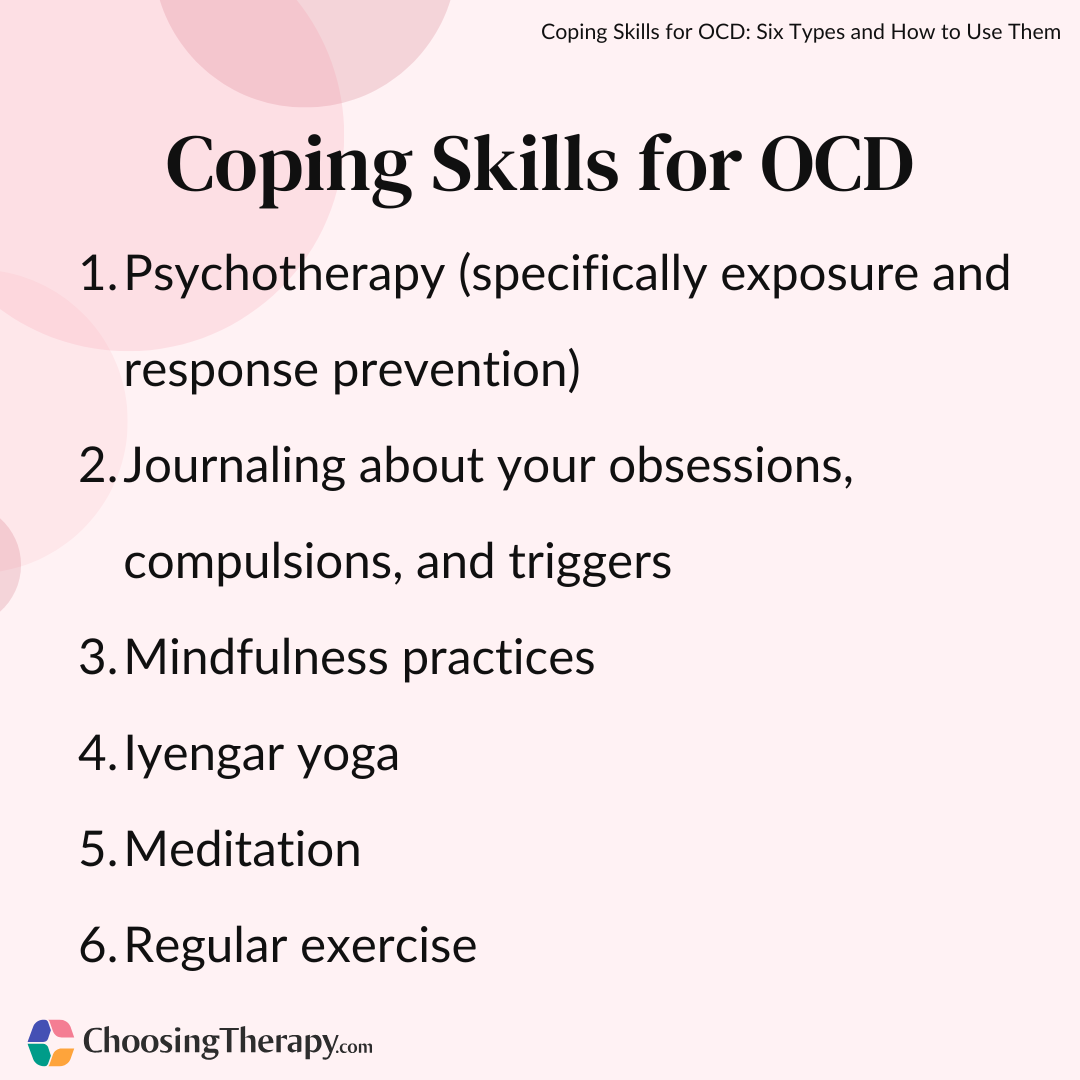
1. Exposure & Response Prevention Therapy
Meeting with a licensed mental health clinician is the first line of treatment for OCD. A psychotherapist will be able to make the proper recommendations based on your symptoms. Exposure and response prevention is considered the gold standard for OCD treatment. It involves gradually confronting triggers while resisting the urge to perform compulsive behaviors.is the gold standard treatment for OCD, which involves exposing yourself to triggers while preventing yourself from acting out their compulsions.
Therapy for OCD, especially when combined with medication, is more effective than medication alone.3
Make sure you find a provider you really trust, as the relationship between the therapist and client is the biggest predictor of how effective the therapy will be.4
2. Keep an OCD Journal
Journaling about your obsessions, compulsions, and triggers can help you get thoughts and feelings out of your head. It’s a valuable tool to use when you’re triggered by an obsession or compulsion.
You may not even be aware of some of your intrusive thoughts until you write them down. Journaling helps you express those thoughts and feelings instead of bottling them up or suppressing them.
3. Mindfulness Practices
Mindfulness is a great tool for OCD. It helps you observe your thoughts and feelings without judgment. It also encourages self-compassion and present-moment awareness, and you can practice it anytime, anywhere.
4. Iyengar Yoga
Iyengar yoga is a type of yoga that focuses on classical poses, sequencing, alignment, and overall health. Iyengar yoga is specific in its instruction and demands a person’s full attention in the present moment. The practice of yoga stimulates the parasympathetic nervous system, cueing the relaxation response and helping slow down an over-active mind.
5. Meditation
Meditation, a practice of focusing the mind using different techniques, has been shown to be beneficial for people with OCD. A recent study showed that meditation for OCD in conjunction with medication was more effective for treating OCD than those who took medication alone.5
6. Regular Exercise
Exercise is gaining traction as a major support for OCD. In a 2019 study, people diagnosed with OCD who exercised reported an increase in mood, less anxiety, and reduced urges to engage in their compulsions.6 There isn’t a specific type of exercise or duration that has been proven to be most beneficial, so it is really up to the individual. The most important factor is to start moving your body.
7. Use Thought-Stopping Techniques
Thought-stopping is a cognitive-behavioral therapy technique focused on interrupting an obsessive thought when it arises. The idea is that you deliberately attempt to suppress a thought to avoid giving it power or meaning. However, recent research suggests that thought-stopping may be ineffective or even counterproductive for some individuals.7 In some cases, it may actually exacerbate distressing feelings.
8. Join a Support Group
Support groups (also known as self-help groups) offer a sense of validation and camaraderie for people experiencing similar life experiences. They can provide hope for your recovery, as you’ll be surrounded by others trying to improve their symptoms and work on themselves. In groups, you’ll ideally receive a blend of education along with immediate resources you can use to take care of yourself.
9. Refocus Your Attention
Distraction has its merit, and when OCD symptoms arise, it may be helpful to divert your attention elsewhere. Consider making a list of adaptive coping skills you can engage in to reduce or avoid compulsive behavior. Such activities may include journaling, grounding exercises like deep breathing, reaching out to a friend, taking a shower, or exercising.
Treatment for OCD NOCD: Online OCD Treatment Covered by Insurance – Regain your life from OCD. Do live video sessions with a licensed therapist specialized in treating OCD. Treatment from NOCD is covered by most major insurance plans. Learn how you can use your insurance benefits. Visit NOCD Talkiatry: Is OCD Medication Right for You? Speak with a Doctor – Talkiatry can match you with a psychiatrist who takes your insurance and is accepting new patients. They’re in-network with major insurers and offer medication management with supportive therapy. Free Assessment
When Should OCD Coping Skills Be Used?
While these coping skills for OCD are helpful, they work best when used in conjunction with treatment from a licensed therapist. It won’t hurt anyone to use these coping skills, but when used as a way to support OCD symptoms, a mental health professional with experience in OCD can help you determine which coping skills will have the best likelihood of working. They can also help you learn how to keep track of whether or not the specific OCD coping skills are helping mitigate your symptoms.
Coping skills for OCD can also be specifically targeted for particular times. For example, if someone is ruminating with obsessions, it could help to move the body and to journal until they subside. If someone feels the urge to act out on the compulsion, it can be useful to meditate and slowly learn not to act out on the compulsion.
How to Know If a Coping Skill Is Effective Vs. Ineffective
Figuring out if a coping skill is working for you will involve a combination of both subjective and objective information from you and your therapist. A good way to find out if a particular coping skill is effective or not is to commit to the skill for a week at a time and gauge how your obsessions and compulsions have been during that period of time.
Another effective way to gauge if a certain OCD coping skill is effective is to keep a daily log that records your moods, obsessions, and compulsions. This way you can see over a period of a week or a month what skill or new habit you have implemented and how your moods and symptoms have changed as a result.
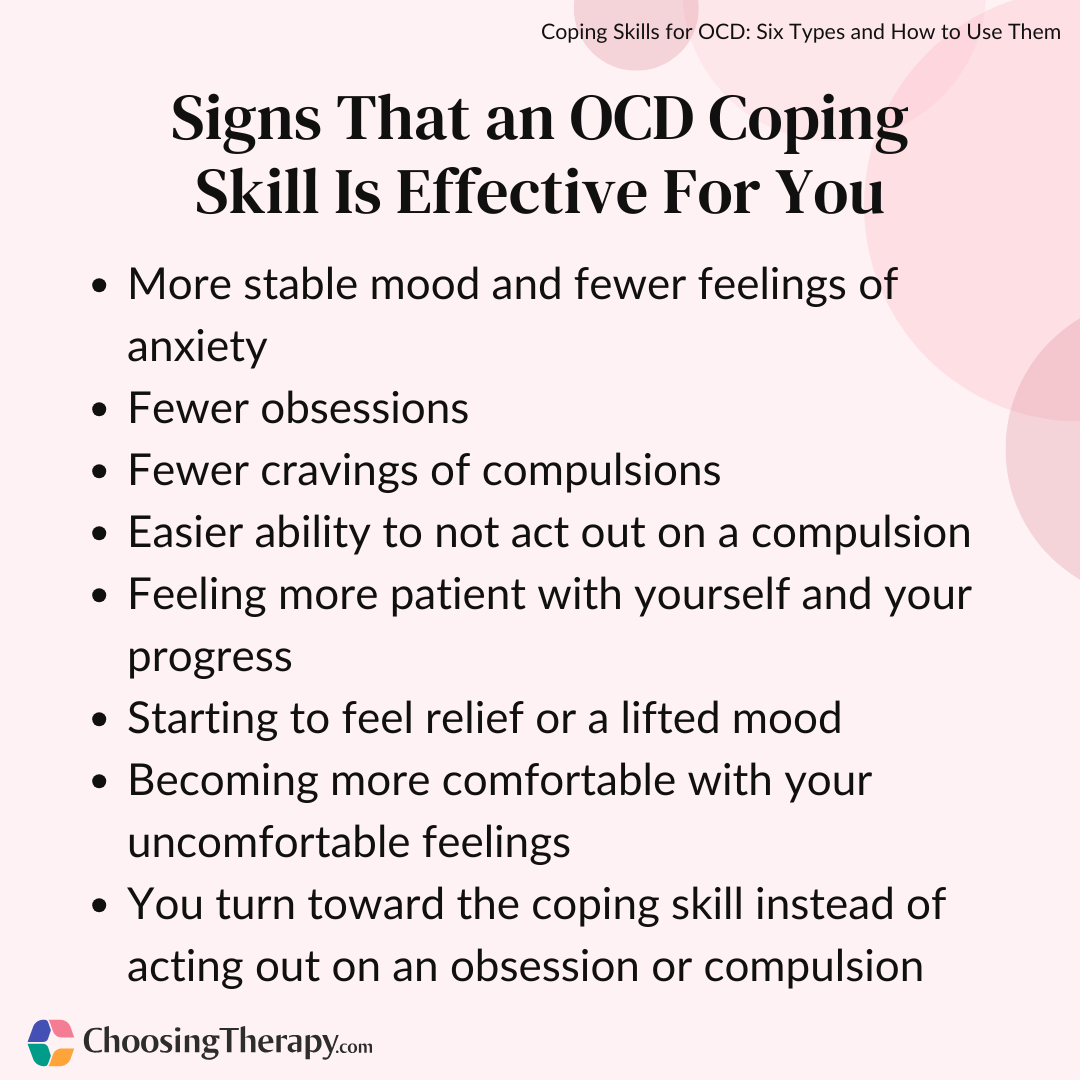
Here are a few signs that a coping skill is effective for you:
- More stable mood and fewer feelings of anxiety
- Fewer obsessions
- Fewer cravings of compulsions
- Easier ability to not act out on a compulsion
- Feeling more patient with yourself and your progress
- Starting to feel relief or a lifted mood
- Becoming more comfortable with your uncomfortable feelings
- You turn toward the coping skill instead of acting out on an obsession or compulsion
- The coping skill is woven into your life as a way to manage difficult obsessions and compulsions
When to Seek Professional Support
A good time to seek professional support is when you feel either your obsessions or compulsions are too much for you to manage alone. When you start to change your daily life to avoid things that trigger you, that is a sign your OCD symptoms have become unmanageable. Often, people feel an increase in anxiety and distress about their compulsions, and that is another good time to seek professional support.
You can find a therapist for OCD through an online therapist directory or through online OCD therapy services. If you’re interested in medication on top of therapy support, online psychiatrist options can also be an excellent way to start seeking help.
Common treatment options for OCD include:
- Exposure and response prevention therapy (ERP): ERP for OCD is a type of therapy that treats anxiety. In exposure therapy, the client is exposed, with the support of the therapist, to the stimuli that cause the anxiety. The purpose is that with exposure in the supportive setting, the client’s anxiety will decrease.
- Medications: Medication for OCD, in conjunction with therapy, is an effective treatment for OCD. Selective serotonin reuptake inhibitors are often the first line of medication treatment for OCD.8
- Gestalt therapy: Gestalt therapy is a present-centered approach to therapy where the client and therapist look at how the person continues their pattern of obsessive thoughts and compulsions and finds alternative ways of meeting the client’s needs.
- Group therapy: Group therapy can be effective in working with OCD because so much of OCD is based on irrational fear. The power of the group can help to break down some of the fears and help with reality testing for the client.
- Eye-Movement-Desensitizing and Reprocessing (EMDR): EMDR for OCD is an effective type of treatment when the OCD has been trauma-induced. This therapy involves reprocessing traumatic memories by using either tapping or eye moments.
Why NOCD for OCD? 9 in 10 People Show Improvement NOCD Therapy is clinically proven to reduce OCD symptoms in over 90% of members. Our licensed ERP-trained therapists help you get better, we have 24/7 support to make sure you stay better, and we’re covered by many insurance plans.
In My Experience
“In my experience, I have seen the most success when people combine coping skills as well as psychotherapy into their treatment of OCD. Each case of OCD is different and there isn’t a quick fix, so each individual has to explore for themselves, with the support of the therapist, what is most supportive for them to address their obsessions and compulsions. What I have seen is that some people remove major stressors in their lives, and they are able to manage symptoms of OCD. Other people need the support of medication. What is vital to remember is to go about your treatment without judgment, as each person needs different things.”
Coping Skills for OCD Infographics
ChoosingTherapy.com strives to provide our readers with mental health content that is accurate and actionable. We have high standards for what can be cited within our articles. Acceptable sources include government agencies, universities and colleges, scholarly journals, industry and professional associations, and other high-integrity sources of mental health journalism. Learn more by reviewing our full editorial policy.
-
Kohler, K. Coetzee, B, Lochner, C. (2018) Living with obsessive-compulsive disorder (OCD): A South African Narrative. International Journal of Mental Health Systems. Retreived from https://www.ncbi.nlm.nih.gov/pmc/articles/PMC6271582/
-
Alcazar, A., Garcia-Hernandez, M., Parada-Navas, J., Olivares-Olivares, P., Martinz-Murillo, S., Rosa-Alcazar, A. (2021) Coping strategies in obsessive-compulsive patients during Covid-19 lockdown. Vol 21(2). Retrieved from https://www.ncbi.nlm.nih.gov/pmc/articles/PMC7837202/
-
Lack, C. (2012) Obsessive-compulsive disorder: Evidence-based treatments and future directions of research. World Journal Psychiatry. Retrieved from https://www.ncbi.nlm.nih.gov/pmc/articles/PMC3782190/
-
DeAngelis, T. (2019). Better relationship with patients leads to better outcomes. American Psychological Association. Retrieved from https://www.apa.org/monitor/2019/11/ce-corner-relationships
-
Lee, S.M., Suh, H.-W., Kwak, H.-Y., Kim, J. W., Chung, S.-Y. (2022) Meditation-based intervention for obsessive-compulsive disorder: A PRISMA-compliant systematic review and meta-analysis.101(30) Retrieved from https://www.ncbi.nlm.nih.gov/pmc/articles/PMC9333541/
-
Landau, M. (2019). Why it’s smart to stay active when you have OCD. Retrieved from https://www.healthcentral.com/slideshow/exercise-helps-ocd
-
The Combination of Thought-Stopping And Exposure and Response Prevention in the Treatment of Predominant Obsessions: A Case Report (2022, September). National Library of Medicine. Retrieved from: https://pmc.ncbi.nlm.nih.gov/articles/PMC9578504/.
-
Kellner, M. (2010) Drug treatment of obsessive-compulsive disorder. Dialogues in Clinical Neuroscience. Vol 12(2) Retrieved from https://www.ncbi.nlm.nih.gov/pmc/articles/PMC3181958/

We regularly update the articles on ChoosingTherapy.com to ensure we continue to reflect scientific consensus on the topics we cover, to incorporate new research into our articles, and to better answer our audience’s questions. When our content undergoes a significant revision, we summarize the changes that were made and the date on which they occurred. We also record the authors and medical reviewers who contributed to previous versions of the article. Read more about our editorial policies here.
Author: No Change
Reviewer: No Change
Primary Changes: Edited for readability and clarity. Added “Use Thought-Stopping Techniques”, “Join a Support Group”, “Refocus Your Attention”. New material written by Nicole Arzt, LMFT and medically reviewed by Rajy Abulhosn, MD.
Author: Anna Hindell, LCSW-R, CIYT
Reviewer: Kristen Fuller, MD
Your Voice Matters
Can't find what you're looking for?
Request an article! Tell ChoosingTherapy.com’s editorial team what questions you have about mental health, emotional wellness, relationships, and parenting. Our licensed therapists are just waiting to cover new topics you care about!
Leave your feedback for our editors.
Share your feedback on this article with our editors. If there’s something we missed or something we could improve on, we’d love to hear it.
Our writers and editors love compliments, too. :)
To help our readers take the next step in their mental health journey, ChoosingTherapy.com has partnered with leaders in mental health and wellness. ChoosingTherapy.com is compensated for marketing by the companies included below. OCD Therapy NOCD: Effective, Affordable, & Convenient OCD Therapy Do live, face-to-face video sessions with a therapist who specializes in treating OCD and get 24/7 support between sessions. NOCD is covered by many insurance plans and is available nationwide. Visit NOCD Treatment from an Online Psychiatrist Talkiatry OCD is treatable. Talkiatry specializes in OCD and provides personalized care with medication and additional support. Get started with a short assessment. OCD Newsletter A free newsletter from the experts at ChoosingTherapy.com for those impacted by OCD. Get helpful tips and the latest information. Sign-UpAdditional Resources
Best OCD Therapy Online To find the best online OCD therapy, our team reviewed over 50 providers. Many of these options accept insurance, prescribe medication, and provide peer- or therapist-led OCD support. The best, NOCD, offers evidence-based treatment from specialists, providing Exposure and Response Prevention (ERP) therapy for OCD and its many subtypes. Best Online OCD Resources We evaluated numerous online OCD resources and treatment options to bring you our top recommendations. These platforms, apps, and podcasts provide trustworthy information and support, whether through peer communities or expert guidance. Whether you’re looking for therapeutic options, medication management, or education, this list – compiled by a clinical psychologist – will meet your needs.