


It’s common for couples to wonder if certain actions are considered cheating if you’re on a break from your relationship. Any behavior that is different from what has been mutually agreed upon can be considered cheating when you are on a break. And, any actions that violate your partner’s trust can also be considered cheating.
ChoosingTherapy.com may earn a commission from the companies whose services are linked on this page.
Whether You’re Trying to Move On or Rebuild a Relationship, a Licensed Therapist from BetterHelp Can Guide You.
BetterHelp has a large network of licensed therapists worldwide who provide convenient and affordable online therapy. Take a brief assessment and get matched with a therapist who fits your needs in as little as 48 hours. Insurance options may be available for eligible members.* *Insurance availability and coverage may vary by state, plan, provider network, and therapist availability.
Licensed therapist Nicole Kleiman-Reck does a good job of summarizing this topic in this video:
What Does It Mean When You’re on a Break?
When people in a relationship decide to take a break from it, this means that they have not officially broken up, but they are taking some time away from each other and the relationship. People choose to take a break for various reasons (see below) depending on their situation. Sometimes, there is work that each person is doing individually while on this break in order to make this time apart productive. Doing so is a healthy way to increase the odds of a satisfactory outcome.
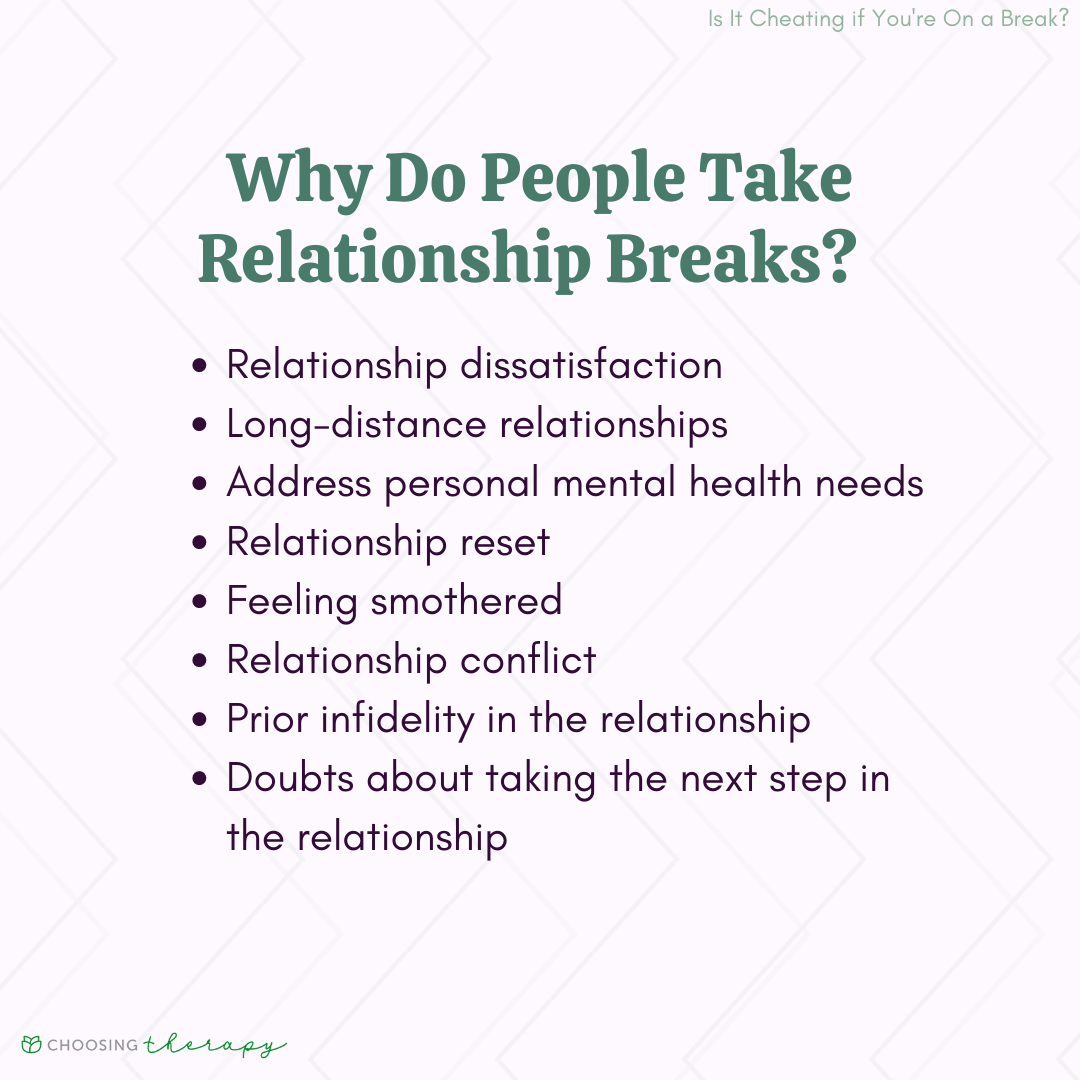
Why Do People Take Relationship Breaks?
People choose to take a break in their relationship for many different reasons. Some reasons can be healthy, while others can be damaging to the relationship. When exploring a relationship break as an option, it is helpful for couples to ask themselves and each other: What is the end goal for this break? Is the goal to make up or break up? A break should not be seen as a solution to any difficulties in the relationship, but rather an opportunity to do some needed work to address them.
Some reasons people may want to take relationship breaks include:
- Relationship dissatisfaction
- Long-distance relationships
- Address personal mental health needs
- Relationship reset
- Feeling smothered
- Relationship conflict
- Prior infidelity in the relationship
- Doubts about taking the next step in the relationship
What Does It Mean to a Man?
How men understand taking a break in a relationship varies from situation to situation, especially depending on who initiates it. Often taking a break in the relationship is an indication to men that something is going wrong. Men may be more susceptible to using the break to explore other partners.
A relationship break might mean many things for men, including:
- They want to reassess the relationship
- They want to regain control over their life
- They want to regain control in the relationship
- This is a step closer to breaking up
- They can hook up with whoever they want
What Does It Mean to a Woman?
How women understand taking a break in a relationship also varies from situation to situation. Women often perceive a break in the relationship to be an opportunity to reset themselves. Women tend to focus on themselves and their self-improvement as opposed to exploring connections of any kind.
A relationship break might mean many things for women, including:
- They are unhappy with the relationship
- They are not feeling valued
- They may not seek physical intimacy outside of the relationship
- They may be open to exploring emotional connections they’re more compatible with
- They may see the break as a temporary thing
Would You Like to Try Therapy?
Most people (76%) who try therapy have a positive experience! Stat Source BetterHelp has a large network of licensed therapists worldwide who provide convenient and affordable online therapy. Take a brief assessment and get matched with a therapist who fits your needs in as little as 48 hours. Insurance options may be available for eligible members.* *Insurance availability and coverage may vary by state, plan, provider network, and therapist availability.
Can You Date Other People While on a Relationship Break?
When taking a break in your relationship, it is important to establish clear boundaries and expectations of what this time apart could and should look like. The iconic image of Ross Geller in Friends screaming “We were on a break” comically depicts the possibility for conflict if expectations are not clearly defined. When establishing these guidelines, it is important to keep the motivation and goal of the break in mind; if dating other people conflicts with this goal, then this would not be a healthy choice for your relationship. Also keep in mind that a break does not mean you have broken up, so your behaviors and actions should be reflective of this.
When Is It Considered Cheating During a Relationship Break?
Having sexual relations with someone other than your partner while in a monogamous relationship is commonly considered to be cheating.1 More ambiguous behaviors are often less commonly agreed upon. These can include emotional connections or may signal deeper sexual or romantic interest.
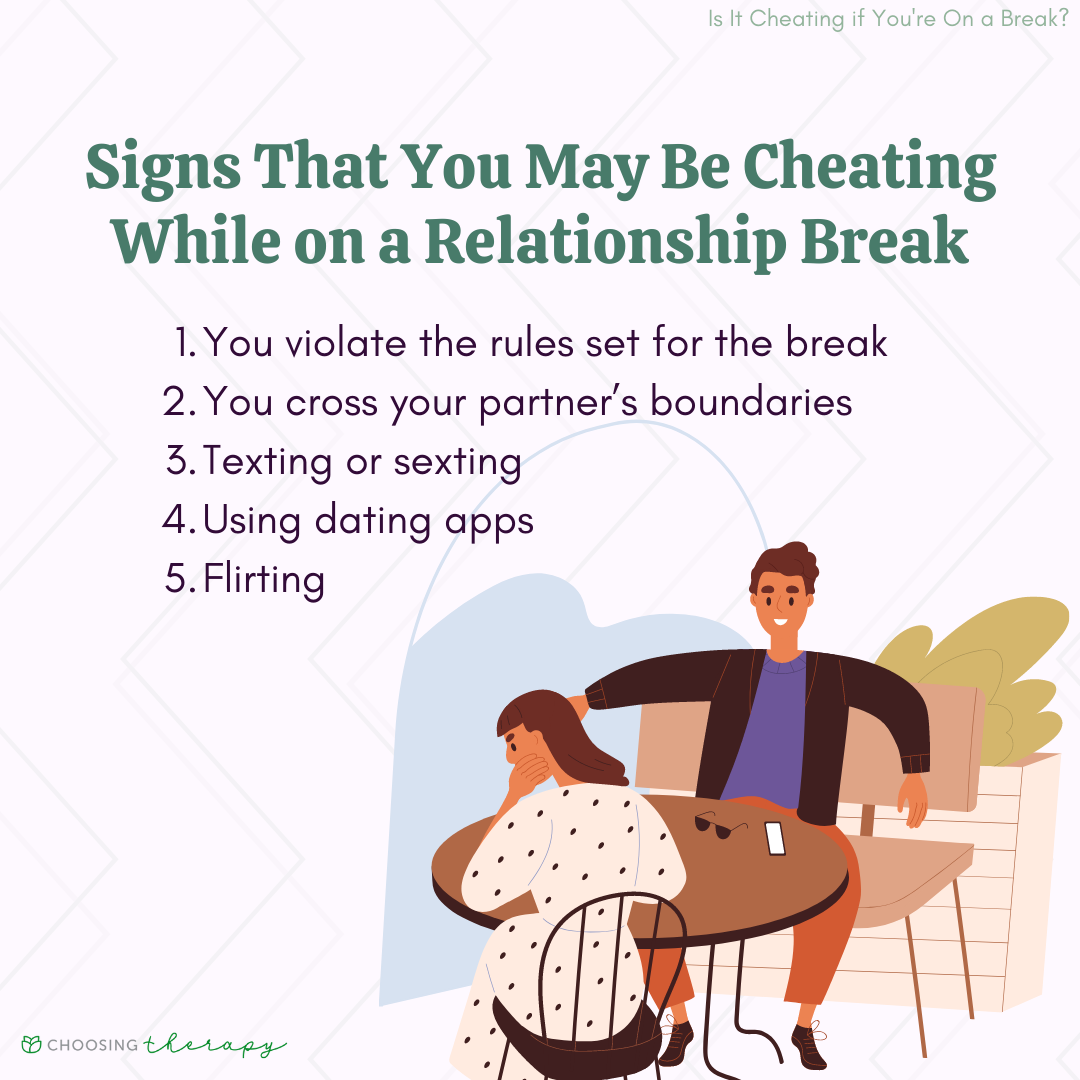
Here are 5 signs that you may be cheating while on a relationship break:
1. You Violate the Rules Set for the Break
This would commonly be understood as cheating while on a break, because it breaks the rules that were mutually established.
2. You Cross Your Partner’s Boundaries
Healthy boundaries in relationships are the limit and rules we set for ourselves within that relationship.2 Intentionally crossing these boundaries is disrespectful and is a violation of your partner’s trust and can be considered cheating.
3. Texting or Sexting
Texting, or sexting, outside of platonic interactions often involves emotional intimacy, which can lead to physical intimacy.3 Even without the presence of physical contact, the emotional connection that is created can also distract from the focus of the break.
4. Using Dating Apps
If the request for the relationship break is done with the expectation you and your partner will reconnect and “make up”, exploring alternative options sends the message you are not invested in making up or that you are lining up “plan B’. This can also give the impression you are looking for a better option than your partner.
5. Flirting
Like texting, flirting can be considered cheating if it leads to, or is intended to lead to, a physical or emotional connection that is typically reserved for a committed relationship.
When Can Therapy Help?
When infidelity in a relationship has happened, whether you were on a break or not, it is common for both partners to experience depression, anxiety, and / or a great sense of loss after it has been discovered. Many couples choose to see how couples counseling can help repair the hurt that has occurred. Couples who want to rebuild their relationship need to resolve any ambivalence about staying in the relationship, or work toward separating in a constructive way.4 Couples therapy is also a great option to gain support prior to taking a break, in order to develop the mutual guidelines and terms of the break. You can find a couples counselor near you or search the online therapist directory.
Some therapeutic methods for addressing problems in a relationship include:
- Individual therapy: Individual therapy is a type of psychotherapy in which a trained professional helps an individual work through personal issues they have been facing. This can be helpful both prior to taking a break, to help decide if a break is the right choice for you, as well as during the break, to address the concerns and positive changes you would like to make.
- Couples therapy: Couples therapy is similar to individual therapy in that the couple would work with a trained professional to address issues they are facing as a couple. Couples therapy is successful when both partners are equally invested in finding solutions to relationship issues together and willing to put in the work both individually and as a couple.
- Online therapy options: Therapists offer online therapy that is similar to what is traditionally provided through in-person therapy using video technology equipment for visual connection during the meeting. This option can be very helpful if a couple have busy/alternative schedules or when living separately.
Recover, heal, and rebuild.
Infidelity can shatter your world. OurRitual combines expert-led sessions with science-backed digital exercises to improve your relationship on your terms. OurRitual starts at just $36 per week. Get 20% off your first month with code: choosingtherapy20
Final Thoughts
What is considered cheating when you are on a break is not always cut and dry. Good communication about expectations is important to have as early as possible to avoid additional stress on the relationship. Talking to a professional can be a great support in clearly establishing this for you, as well as supporting you in addressing the concerns to promote a break that is healthy.
Is It Cheating If You’re on a Break? Infographics
ChoosingTherapy.com strives to provide our readers with mental health content that is accurate and actionable. We have high standards for what can be cited within our articles. Acceptable sources include government agencies, universities and colleges, scholarly journals, industry and professional associations, and other high-integrity sources of mental health journalism. Learn more by reviewing our full editorial policy.
-
Kruger, D. J., Fisher, M. L., Edelstein, R. S., Chopik, W. J., Fitzgerald, C. J., & Strout, S. L. (2013). Was That Cheating? Perceptions Vary by Sex, Attachment Anxiety, and Behavior. Evolutionary Psychology, 11(1). https://doi.org/10.1177/147470491301100115
-
Setting Boundaries: Info and practice (2023) Therapyaide.com. Retrieved from: https://www.therapistaid.com/therapy-worksheet/setting-boundaries
-
Online Infidelity. (2022). Aamft.org. Retrieved from: https://aamft.org/Consumer_Updates/Online_Infidelity.aspx?WebsiteKey=8e8c9bd6-0b71-4cd1-a5ab-013b5f855b01
-
Infidelity. (2016). Aamft.org. Retrieved from: https://aamft.org/Consumer_Updates/Infidelity.aspx

Your Voice Matters
Can't find what you're looking for?
Request an article! Tell ChoosingTherapy.com’s editorial team what questions you have about mental health, emotional wellness, relationships, and parenting. Our licensed therapists are just waiting to cover new topics you care about!
Leave your feedback for our editors.
Share your feedback on this article with our editors. If there’s something we missed or something we could improve on, we’d love to hear it.
Our writers and editors love compliments, too. :)
Additional Resources
To help our readers take the next step in their mental health journey, ChoosingTherapy.com has partnered with leaders in mental health and wellness. ChoosingTherapy.com is compensated for marketing by the companies included below.
BetterHelp (Online Therapy) – Whether you’re feeling uneasy in your relationship, trying to rebuild trust, or working on forgiveness – a licensed therapist from BetterHelp can guide you. BetterHelp will ask you about the things you want to work on and what you’re looking for in a therapist. BetterHelp starts at $65 per week and is FSA/HSA eligible by most providers. Visit BetterHelp
OurRitual – Infidelity can shatter your world. OurRitual combines expert-led sessions with science-backed digital exercises to improve your relationship on your terms. OurRitual starts at just $36 per week. Get 20% off your first month with code: choosingtherapy20 Visit OurRitual
Talkspace (Counseling For Overcoming Adultery) – Talkspace offers you and your partner the support and structure you need. It’s private, convenient, and affordable. Talkspace also accepts Medicare in some states. The average copay is $15, but many people pay $0. Get Started

Best Online Marriage & Couples Therapy Options
Marriage and couples therapy can be helpful and a worthwhile investment for couples who want to seek help with their relationship. Which online platform will work best for you will depend on what issues you want to work on, what your goals are for your relationship, the cost, and if it’s available in your state.
Best Online Therapy Services
There are a number of factors to consider when trying to determine which online therapy platform is going to be the best fit for you. It’s important to be mindful of what each platform costs, the services they provide you with, their providers’ training and level of expertise, and several other important criteria.
