


The stages of alcoholism begin with occasional abuse and/or binge drinking and eventually escalate to alcohol addiction. Alcohol use often begins within social settings; however, increased use and drinking in isolation is where we find the progression of alcoholism. The later stages of alcoholism are the most life-altering and potentially damaging.
Ria Health: Effective, Evidence-Based Alcohol Treatment 100% Online
Quickly change your relationship to alcohol with our at-home program. On average, Ria Health members reduce their BAC levels by 50% in 3 months in the program. Services are covered by many major health plans. Visit Ria Health
What Is Alcoholism?
Alcoholism is a chronic disease where a person compulsively consumes alcohol to the point of psychological and physical harm.1 Over time, the term alcoholism has been replaced with alcohol use disorder (AUD). This change is an attempt to de-stigmatize the disorder, as AUD allows an understanding of alcohol misuse as a disease that does not define a person to their core.
AUD is a pattern of behavior related to alcohol, where the consumption of alcohol becomes compulsive, the quantity consumed increases over time, and a person often begins to experience significant consequences due to their drinking habits.2 The earlier a person enters treatment, the better their prognosis overall. However, it is never too late to enter recovery.
Diagnosing Alcohol Use Disorder
A therapist, alcohol, and drug counselor, or other clinical practitioner utilizes the DSM-5-TR to diagnose an AUD. All DSM-5-TR diagnoses have a clear set of criteria for which a person’s symptoms should correspond to make an informed diagnosis. At least two criteria should be present over the past year to be diagnosed with AUD.
The diagnosis also includes the level of severity for which a person is experiencing symptoms. Regarding AUD, 2-3 symptoms are equivalent to mild alcoholism, 4-5 criteria met is moderate alcoholism, and 6+ criteria met is severe alcoholism. Severity level helps to determine a person’s appropriate level of care needs in treatment, with moderate and severe cases requiring higher level intervention.
To receive an AUD diagnosis, you must meet two of these criteria in the past year:
- Had times when you ended up drinking more or longer than you intended
- More than once wanted to cut down or stop drinking, or tried to, but couldn’t
- Wanting a drink so badly you couldn’t think of anything else
- Found that drinking—or being sick from drinking—often interfered with taking care of your home and family or caused problems in school or at the workplace
- Continued to drink even though it was causing trouble with your family or friends
- Given up or cut back on activities that were important or interesting to you or gave you pleasure to drink
- More than once gotten into situations while or after drinking that increased your chances of getting hurt, such as driving, swimming, using machinery, walking in a dangerous area, or having unsafe sex
- Continued to drink even though it was making you feel depressed or anxious or adding to another health problem
- Had to drink much more than you once did to get the effect you want, or found that your usual number of drinks had much less effect than before
- Found that when the effects of alcohol were wearing off, you had withdrawal symptoms, such as trouble sleeping, shakiness, restlessness, nausea, sweating, a racing heart, or a seizure, or sensed things that were not there
Potential Risk Factors of Alcohol Use Disorders
Often, an AUD develops due to risk factors. These risk factors can range from family history to the age at which a person first drank. Risk factors do not mean developing an AUD is absolute. There are many protective factors, from resilience to social support, that can prevent risk factors from developing into an AUD.
Potential risk factors for developing alcohol use disorders include:3,4,5
- Genetics: Our family history has a large role to play, especially with substance use disorder and mental health disorders. Certain gene variants often contribute, among other factors, of developing AUD.
- Age of first drink: Data shows that the earlier a person experiments with alcohol the more potential they have for developing AUD, especially if other factors are at play. This occurs due to the impact of drinking alcohol at an early age on the growing brain and body in adolescents.
- Social/cultural factors: The use of alcohol is embedded in many cultures and has become socially acceptable to the point where it is glorified in mass media, from music to television. These facets of society as a whole have a considerable impact on a person’s potential vulnerability to alcohol.
- History of trauma: Anywhere from 30 to 60% of persons with AUD also experience post-traumatic stress disorder (PTSD). It is common for individuals experiencing PTSD to use alcohol to self-medicate because of how debilitating PTSD symptoms are.
- Co-Occurring Disorders: Up to 40% of people being treated for anxiety, depression, or other substance use disorder are also diagnosed with AUD. These disorders also have a higher potential for self-medication of symptoms.
- Low-self esteem: Many of us may have heard the term “liquid courage”. This speaks directly to the correlation between low self-esteem and alcohol use. In social settings, a person with low self-esteem may feel more comfortable with alcohol in their system. Again, it’s an agent many associates with “loosening up”.
- Stress: Psychosocial stressors put a person at a higher risk of developing an AUD. Stress is something we all experience. However, a person with a family history of AUD may have a greater likelihood of misusing alcohol when stressed as a means of self-medicating.
Help for Alcohol Use
Ria Health: Effective, Evidence-Based Alcohol Treatment 100% Online Quickly change your relationship to alcohol with our at-home program. On average, Ria Health members reduce their BAC levels by 50% in 3 months in the program. Services are covered by many major health plans. Visit Ria Health
Want to drink less? Sunnyside helps you ease into mindful drinking at your own pace. Think lifestyle change, not a fad diet. Develop new daily routines, so you maintain your new habits for life. Take a 3 Minute Quiz
What Are the Stages of Alcoholism?
Alcoholism can be broken down into five stages. Each stage has its own set of symptoms and as the stages progress, the severity of symptoms progress. These stages include occasional misuse of alcohol and binge drinking, increased drinking, problem drinking, alcohol dependence, and alcohol addiction.
Stage 1: Occasional Abuse & Binge Drinking
In this first stage of alcoholism, a person likely has an affinity to alcohol. They will spend more time around alcohol and getting alcohol. They will keep their drinking to the weekends and social settings; however, they are seeking out alcohol more readily. There is no set age at which this can occur, but it most commonly begins in young adulthood. For college-age persons, binge drinking is especially concerning. There is also no set time frame for a person to remain in this stage, as everyone is different.
Symptoms Associated with Stage 1 of Alcoholism
The symptoms of stage one of alcoholism range and can vary from person to person. Most often, you may see a person drinking heavily and more often. They may start to show their overindulgence with drinking by having alcohol at every social event or gathering and continue drinking even after the event/gathering is over.
A person in stage one of alcoholism may exhibit any combination of these symptoms:
- Spending more and more time around alcohol
- Alcohol is becoming a fixture of their weekends or social events
- Drinking to feel better or less self conscious
- Binge drinking
- Starting to feel as if they “need” a drink at social events
- Higher chance for alcohol poisoning
Stage 2: Increased Drinking
Stage two of alcoholism is increased drinking. People in this stage often start to have a preoccupation with alcohol. Drinking has become so natural to them that they almost do not have an “off switch” to this behavior. For a loved one, it may be beneficial to discuss concerns around drinking behaviors before it progresses into problem drinking and dependence. The earlier the help and support, the better. Again, each person and their time in a stage will vary.
Symptoms Associated with Stage 2 of Alcoholism
The most significant symptoms in stage two are drinking throughout the weeks and needing to drink in larger amounts. Drinking becomes a priority in a person’s life during this stage. While they may still function in some aspects of their life, their ability to control when and how much they drink is decreasing.
A person in stage two of alcoholism may exhibit any combination of these symptoms:
- Drinking most days of the week
- Drinking in larger amounts due to increased tolerance
- A higher chance of alcohol poisoning
- Blacking out from drinking
- Lying about drinking behaviors to loved one
- Missing events that do not include alcohol or choosing events with alcohol over sober events
Stage 3: Problem Drinking
The third stage of alcoholism is where consequences related to drinking behaviors become more prominent. The term “problem drinker” is commonly used in society to describe a person in this stage. Namely, problem drinking begins to cause stress emotionally, socially, and financially.
Legal issues are likely to begin in this stage due to a need to drink throughout the day, which heightens the potential for driving under or while intoxicated and public intoxication. Once a person enters this stage, alcohol dependence is not far behind.
Symptoms Associated with Stage 3 of Alcoholism
A person in stage three of alcoholism will often begin to withdraw from social drinking. The physical consequence in this stage continues to exacerbate as a person requires even more alcohol to feel any effects. Usually, in this stage, we see drinking becoming daily and throughout the day. Mood shifts are common in this stage, and sleep struggles become prominent.
A person in stage three of alcoholism may exhibit any combination of these symptoms:
- Irritability (even erratic behaviors at times)
- Relationship struggles
- Isolation
- Physical signs of alcohol abuse
- Insomnia or restless sleep
- Depression
Want to drink less?
Sunnyside helps you ease into mindful drinking at your own pace. Think lifestyle change, not a fad diet. Develop new daily routines, so you maintain your new habits for life. Take a 3 Minute Quiz.
Stage 4: Alcohol Dependence
In stage four of alcoholism, alcohol dependence is the clear marker. Alcohol dependence is a person’s physical need for alcohol due to withdrawal symptoms. This occurs because people experiencing alcohol dependence have a significant tolerance to alcohol. As a result, larger quantities of alcohol are needed to have the desired effect. Many misconstrue alcohol dependence and addiction as the same. However, alcohol dependence often comes before addiction.
Symptoms Associated with Stage 4 of Alcoholism
Alcohol withdrawal is the key symptom in this stage. Withdrawal is our body’s negative reaction when a substance is taken away and/or not consumed for a period of time. For some substances, withdrawal can occur within hours of not using. This is what starts the escalation to addiction. Additionally, In the case of alcohol, withdrawal can be fatal.
A person in stage four of alcoholism may exhibit any combination of these symptoms:5
- Body tremors
- Restlessness
- Agitation
- Nausea and vomiting
- Elevated heart rate
- Increased blood pressure
- Insomnia
- Delirium
- Grand mal seizures
Stage 5: Alcohol Addiction
Stage five of alcoholism is addiction has developed. Addiction can be best described as the continued and compulsive engagement in a behavior, despite ongoing and severe consequences. Often, at this stage, a person has lost people close to them and may have seen their schooling or career spiral, and yet they still continue to drink.
Symptoms Associated with Stage 5 of Alcoholism
One of the key facets in stage five of AUD is the difficulty a person has in cutting down or controlling alcohol use. These unsuccessful efforts leave a person at the whim of their compulsive behavior. Despite the potential for knowing they are on a destructive path, the drinking has become all-consuming and significantly impairs better judgment and insight.
A person in stage five of alcoholism may exhibit any combination of these symptoms:
- Alcohol is often taken in larger amounts or over a longer period than was intended
- A persistent desire or unsuccessful efforts to cut down or control alcohol use
- Craving or a strong desire or urge to use alcohol
- Recurrent alcohol use failing to fulfill obligations at work, school, or home
- Continued alcohol use despite problems caused or exacerbated by the effects of alcohol
- Recurrent alcohol use in situations in which it is physically hazardous (such as driving under the influence)
- Alcohol use is continued despite knowledge of having a persistent or recurrent physical or psychological problem, such as withdrawal
Treating Alcoholism
Individual and group therapy are the most effective means of treating AUD. Individual therapy helps a person to understand their triggers and instills coping skills that move them away from compulsion into self-care. It also can build self-awareness of how drinking got to a severe level. Group therapy lessens the feeling of loneliness and bridges the practices in individual work to a larger platform.
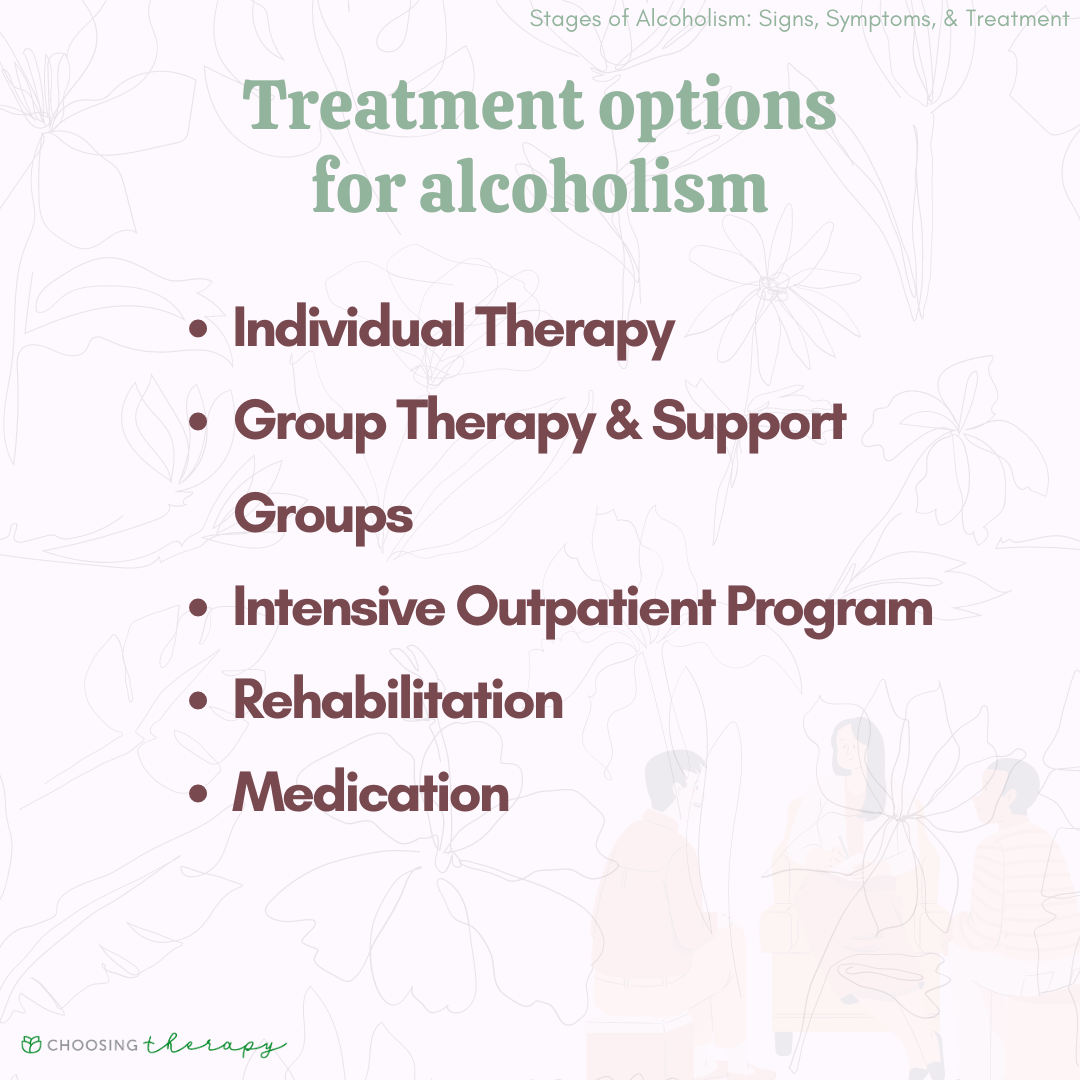
Treatment options for alcoholism include:
Individual Therapy
Individual therapy is a supportive way to begin one’s recovery process. Speaking with a licensed professional who has specialized in substance use disorders and can offer empathy around one’s consequences due to alcohol is affirming. In individual therapy, a person will identify the “why” behind their progression of alcoholism. The client works to build themselves up and establishes ways to cope without alcohol’s influence.
Individual therapy without medical treatment can be appropriate when a client has not progressed beyond stage 2 of alcoholism. However, once a person has reached the problem drinking stage and beyond, an inpatient or detox program is most appropriate before entering individual therapy. The reason is that withdrawal symptoms occur with higher tolerance, and these symptoms can be potentially fatal. For a therapist working with a person in stage 1 or 2 of alcoholism, it is best to remain mindful of symptoms that could be signs of alcoholism progressing.
Individual therapy modalities for treating AUD include:
- Cognitive behavioral therapy (CBT): CBT explores the connection between negative thoughts, feelings, and behaviors.
- Dialectical behavioral therapy (DBT): DBT addresses emotional dysregulation, distress tolerance, and difficulties in interpersonal relationships.
- Motivational interviewing (MI): MI has been shown to support clients through a specific conversational style in which clients talk themselves into changing their behaviors.
- Hypnotherapy: Hypnotherapy has been shown to help addictive behaviors, and a hypnotherapist may explore while a client is in a trance-like state, triggers, and cravings. Thereafter, suggestions are made about the client being in control rather than the substance.
- Narrative Therapy: Narrative therapy is an expressive therapy that works to separate the person and the problem, in this case, the misuse of alcohol. This affords a person the ability to look at the problem from an outsider’s perspective rather than solely as an internal deficit.
Group Therapy & Support Groups
There are many benefits to group therapy and support groups. Group therapy is done by licensed professionals specializing in substance use disorders. The group setting expands upon individual work by offering specific topics related to AUD for the group to discuss and explore based on their experiences. For example, a group may focus on processing their triggers, loved ones they wish to repair relationships with, or conflict resolution. Group therapy is found in nearly all treatment settings for AUD.
Additionally, 12-step programs like Alcoholics Anonymous (AA) have supported countless people in recovery for over half a century. AA has built the 12-step work around certain tenets or beliefs core to AA. Each step represents an area in a person’s life where alcohol took over, took control, and led to serious repercussions. For example, the 9th step of AA is making amends to people one has harmed due to alcohol misuse.
Intensive Outpatient Program
An intensive outpatient program (IOP) is a level of care that is a step up from outpatient care. It is generally appropriate for persons with a severe AUD but who do not display withdrawal symptoms. Any sign of withdrawal symptoms means a higher level of care is indicated. A higher level of care is detoxification or inpatient rehabilitation.
A person may have entered inpatient or intensive care and will subsequently be discharged to an IOP for continued work on their recovery. Most IOPs have an interdisciplinary model with individual therapy and group therapy run by licensed or credentialed clinicians and a psychiatrist or medical doctor.
Rehabilitation
Rehab for AUD is appropriate for a person in the alcohol dependence and alcohol addiction stages of alcoholism. Rehabilitation offers a secure and supportive 24/7 care environment. Several issues are addressed in these facilities, including managing the withdrawal caused by physical dependence, behavioral addiction, and the psychological aspects that lead to addiction. There are both inpatient and outpatient rehab options. Inpatient being within a facility. Outpatient rehab is an intensive option that occurs throughout the entire day, and the clients spend the evening at home to return the next day.
Medication
Medications may be used when a person is going through alcohol withdrawal. These medications include benzodiazepines, barbiturates, and antipsychotic medications. These medications are all utilized under the guidance of a medical professional. Benzodiazepine and barbiturates, for example, can be highly addictive, so medical supervision is needed when using them.6
Additionally, there are medications such as Naltrexone that can prevent you or a loved one from relapsing. Naltrexone is not used during detox. This medication supports ongoing abstinence as it helps to block the pleasure center of one’s brain that is triggered by drinking. Therefore, one’s urges to drink and enjoyment if they do drink become less, making recovery possible.
Ria Health: Effective, Evidence-Based Alcohol Treatment 100% Online
Quickly change your relationship to alcohol with our at-home program. On average, Ria Health members reduce their BAC levels by 50% in 3 months in the program. Services are covered by many major health plans. Visit Ria Health
In My Experience
In my experience, alcoholism or AUD is a progressive disease. I always advocate for the earlier one can get help, the better. However, realistically, asking for help is an extremely vulnerable act. Vulnerability can leave people feeling discomfort. Therefore, I cannot expect all persons to receive support sooner rather than later. I believe recovery is possible at all stages of AUD.
Getting support at the later stages of alcoholism means more physical stabilization is needed due to withdrawal. If a client comes to me experiencing withdrawal, I always emphasize the right to personal choice; however, I am also very clear about the potential and fatal consequences of not going to the recommended level of care. Once a client is on board with going into a rehabilitation or more intensive program, I sit with them and assist them in making the calls to get into the most appropriate setting.
I come from a place of transparency in my care with people experiencing AUD. I work diligently to ensure a plan is in place should my level of care not be appropriate at that time. As the old adage says: “Where there is a will, there is always a way.” I firmly believe that recovery is possible for everyone, no matter the timing.

Stages of Alcoholism: Signs, Symptoms, & Treatment Infographics


ChoosingTherapy.com strives to provide our readers with mental health content that is accurate and actionable. We have high standards for what can be cited within our articles. Acceptable sources include government agencies, universities and colleges, scholarly journals, industry and professional associations, and other high-integrity sources of mental health journalism. Learn more by reviewing our full editorial policy.
-
National Institute on Alcohol Abuse and Alcoholism. “The Cycle of Alcohol Addiction | National Institute on Alcohol Abuse and Alcoholism (NIAAA).” Www.niaaa.nih.gov, 2021, www.niaaa.nih.gov/publications/cycle-alcohol-addiction.
-
National Institute on Alcohol Abuse and Alcoholism. (2021). Understanding Alcohol Use Disorder. Www.niaaa.nih.gov. https://www.niaaa.nih.gov/publications/brochures-and-fact-sheets/understanding-alcohol-use-disorder
-
National Institute on Alcohol Abuse and Alcoholism. “Risk Factors: Varied Vulnerability to Alcohol-Related Harm | National Institute on Alcohol Abuse and Alcoholism (NIAAA).” Www.niaaa.nih.gov, 10 Apr. 2023, www.niaaa.nih.gov/health-professionals-communities/core-resource-on-alcohol/risk-factors-varied-vulnerability-alcohol-related-harm.
-
Castillo-Carniglia A, Keyes KM, Hasin DS, Cerdá M. Psychiatric comorbidities in alcohol use disorder. Lancet Psychiatry. 2019;6(12):1068-1080. doi:10.1016/S2215-0366(19)30222-6
-
Detoxification and Substance Abuse Treatment (A Treatment Improvement Protocol TIP 45). (2015). Substance Abuse and Mental Health Services Administration. https://store.samhsa.gov/sites/default/files/d7/priv/sma15-4131.pdf
-
Detoxification and Substance Abuse Treatment (A Treatment Improvement Protocol TIP 45). (2015). Substance Abuse and Mental Health Services Administration. https://store.samhsa.gov/sites/default/files/d7/priv/sma15-4131.pdf

Your Voice Matters
Can't find what you're looking for?
Request an article! Tell ChoosingTherapy.com’s editorial team what questions you have about mental health, emotional wellness, relationships, and parenting. Our licensed therapists are just waiting to cover new topics you care about!
Leave your feedback for our editors.
Share your feedback on this article with our editors. If there’s something we missed or something we could improve on, we’d love to hear it.
Our writers and editors love compliments, too. :)
Additional Resources
To help our readers take the next step in their mental health journey, ChoosingTherapy.com has partnered with leaders in mental health and wellness. ChoosingTherapy.com is compensated for marketing by the companies included below.
Alcohol Treatment – Cut Back or Quit Entirely
Ria Health – Quickly change your relationship to alcohol with our at-home program. On average, members reduce their BAC levels by 50% in 3 months in the program. Services are covered by many major health plans. Visit Ria Health
Drinking Moderation
Sunnyside – Want to drink less? Sunnyside helps you ease into mindful drinking at your own pace. Think lifestyle change, not a fad diet. Develop new daily routines, so you maintain your new habits for life. Take a 3 Minute Quiz
Treatment for Mental Health Conditions That Coexist With SUD
Talkiatry – Get help from a doctor who can treat the mental health conditions that commonly lead to or coexist with substance use disorders. Take our online assessment and have your first appointment in days. Take Assessment
Addiction Newsletter
A free newsletter from the experts at ChoosingTherapy.com for those impacted by addiction. Get helpful tips and the latest information. Sign Up

Best Online Medication-Assisted Treatment Programs
Online medication-assisted treatment programs are fairly new to the telehealth industry, but existing companies are expanding quickly with new programs emerging every day. It’s important to explore your options and understand the level of virtual care available so you can choose the best addiction treatment program for you.
Best Mindful Drinking Apps
If you’re thinking about joining the sober curious movement and you’d like to cut back on drinking, mindful drinking apps are a great place to start. Practicing mindful drinking can take some time, attention, and patience, but with the help of the right app, you can completely transform your relationship with alcohol.
