Grounding techniques help manage anxiety and trauma by reducing immediate distress and promoting calmness. Exercises such as deep breathing, physical activity, and cognitive strategies can empower you to navigate challenging situations more effectively.
Personalized Treatment for Anxiety
Talkiatry can match you with a real psychiatrist who accepts insurance. Talkiatry psychiatrists can evaluate you for anxiety and implement a personalized treatment plan, including medication. If appropriate for you and allowed by your state, this can include controlled substances. Get started with a short online assessment.
What Are Grounding Techniques?
Grounding techniques, also known as grounding exercises or grounding skills, can distract, reframe, or otherwise soothe distressing feelings and help to calm the body and mind from anxiety triggers. They shift your focus from past or future thinking into the present moment. You may already engage in some of these techniques without formally realizing it!
When to Use Grounding Techniques
Grounding exercises can be particularly beneficial for individuals dealing with:
- Anxiety or panic attacks
- PTSD or complex trauma
- Dissociation
- Self-harm urges
- Substance use or eating disorders
- Chronic pain or overwhelming emotion
Mental Grounding Techniques
Mental grounding techniques include cognitive, somatic, and behavioral exercises. These techniques can shift negative perceptions into more realistic or positive ones. Furthermore, they can support you in reframing difficult situations, as they encourage you to focus on your present feelings. When used effectively, they promote a sense of acceptance (without resistance) for your current state.
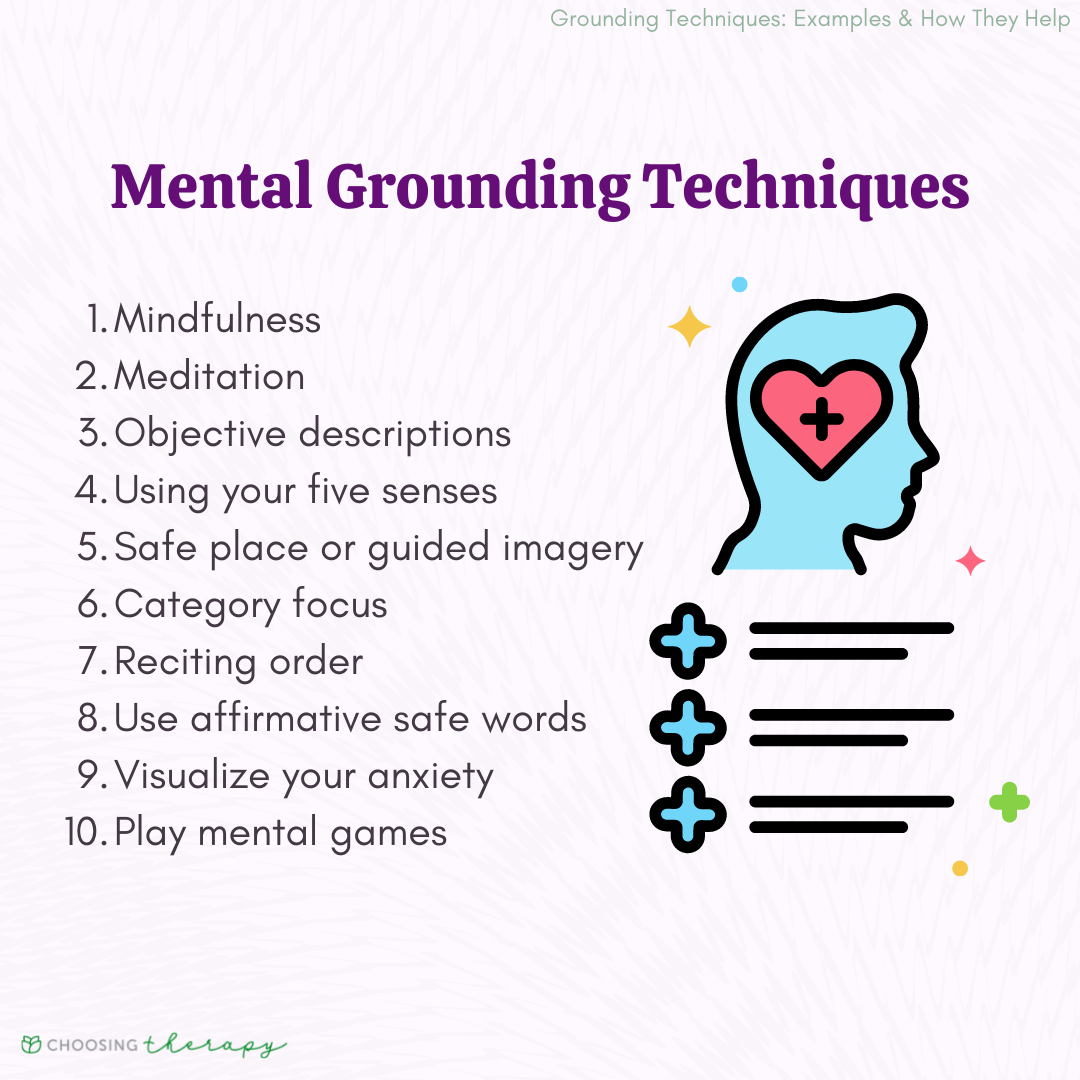
The following are 10 grounding techniques that use the mind to reduce anxiety or stress:
1. Mindfulness
Mindfulness is one of the most powerful grounding techniques, and embracing a more mindful approach to everyday life can benefit you in numerous ways. Mindfulness is an encompassing term that refers to being present and aware of your current thoughts, feelings, and bodily sensations. At the same time, it also means trying to accept your current reality without judging or trying to change it.1
2. Practice Meditation
Meditation refers to the intentional practice of staying present with your mind and body. Meditation can include activities like breath work, intentional walks, or progressive muscle relaxation. Research shows that practicing just 10 minutes of meditation a day can reduce anxiety and sharpen focus.2
3. Describe Your Situation Objectively
Separating facts from opinions can help you feel grounded during distressing situations. To do this exercise, act as if you are a reporter who needs to stay objective about a story. For example, instead of saying, “This is so scary right now,” you could say, “I have a presentation in one hour. I will need to speak in front of ten people. I have a past history of being scared. Right now, I feel my heart rate increasing and my stomach tightening.”
4. Use Your Five Senses
Grounding yourself with the five-sense exercise can help you when you feel overwhelmed or hyperactivated. It’s a distraction technique that supports present-moment thinking. Simply focus on five things you see, four things you feel, three things you hear, two things you smell, and one thing you can taste.
5. Find Your Safe Place
The “safe place” exercise is a type of guided imagery that promotes calmness and emotional security. When you feel heightened, close your eyes, and imagine a safe, comfortable place. It can be real or imagined. Try to embrace all the five senses while in this place. Spend as much time there as you need.
6. Name Items in a Category
Category focus refers to spending a moment thinking about all the items in a specific category. For example, you could think of as many different action movies or children’s books as possible. This challenge shifts you into a task-oriented direction.
7. Recite Something in Order
Whether it’s multiplying by threes, saying the alphabet backwards, or reciting a poem you’ve memorized, repetition can be a helpful distraction technique. Doing so forces you to focus on the specific task, rather than the current distress you might be facing.
8. Use Affirmative Safe Words
Come up with an easy-to-remember reminder that you can use in uncomfortable situations. It can be as simple as a single word like calm or breathe. You can also try phrases like, “This will pass,” or, “I will be okay.”
9. Visualize Your Anxiety
Try to imagine your anxiety as a tangible item, like a leaf. Then, imagine that leaf falling off a tree and floating down a river. This exercise can help you separate yourself from your distressing thoughts.
10. Play Mental Games
It may be helpful to make up easy games to play when you feel anxious. For example, you may focus on finding five white cars while you’re driving. Or, you can think about seven people that you love the most in your life.
11. Describe What’s Around You
Name the objects around you and what colors they are. What else can you name about your environment? Is it warm or cool? How close are you to a window where you can look outside? Focusing on your environment is a helpful way to ground yourself. Using your senses to stimulate your brain and focus on your surroundings helps to also decrease blood pressure and heart rate.
12. Do Math Equations in Your Head
Focusing on trying to solve math problems in your head is a good way to distract yourself. It can also help ground you in being able to come to solutions when you are dealing with a lot of things outside of your control. Try adding two large numbers together or take a four-digit number and divide it by a smaller number.
Options for Anxiety Treatment Talk Therapy – Get help from a licensed therapist. Betterhelp offers online therapy starting at $60 per week and is FSA/HSA eligible by most providers. Free Assessment Psychiatry for Anxiety – Looking for anxiety treatment that prioritizes you? Talkiatry can help. Find an in-network psychiatrist you can see online. Get started with our short assessment. Visit Talkiatry
Physical Grounding Techniques
Physical grounding techniques refer to specific exercises that either engage your senses or use specific items to provide relief. Most of them provide a needed distraction. These techniques are generally structured, and they may require more preparation and time than mental grounding techniques. That said, they can be extremely beneficial in managing symptoms of distress.
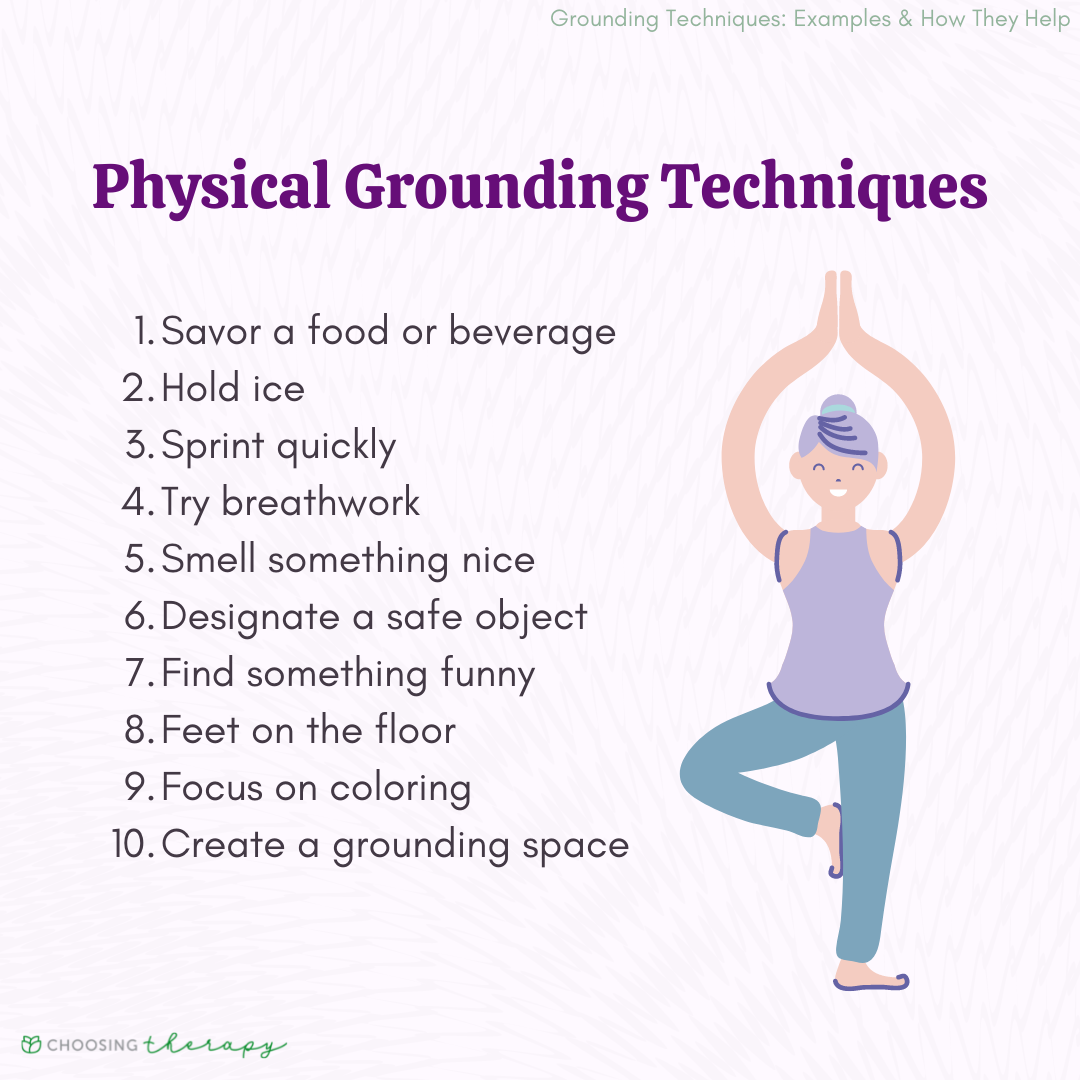
The following are grounding techniques that use the five senses or tangible objects to reduce distress:
13. Savor a Food or Beverage
Try to mindfully enjoy a few bites of something you really enjoy. Focus on the sensations that arise as you eat or drink this item. Avoid or limit any other distractions during this exercise.
14. Hold Ice
The ice technique can be extremely helpful when you feel anxious. Simply hold a few ice cubes in your hand or trace them along your arms or legs. Focus on the sensation and try to direct your thinking to that if your mind wanders.
15. Sprint Quickly
Set a timer and run as fast as you can for thirty seconds. Take a few moments to catch your breath, and then repeat one or two more times. This spurt of physical activity can promote healthy blood flow and release endorphins. Running can also produce the short-lasting joy known as “runner’s high.” *3
16. Try Breathwork
Breathwork is a conscious exercise where you control how you breathe. While you can do this technique on your own, it’s often helpful to learn it in a structured program. Breathwork allows you to deactivate your sympathetic nervous system while also activating your parasympathetic nervous system.
17. Smell Something
Whether it’s lighting a candle, baking your favorite dessert, or putting on lotion, smell can be undoubtedly soothing. The next time you feel distressed, try to engage in this sense as a way to help you calm down.
18. Designate a Safe Object
Holding a designated stone, coin, or another small item can serve as a grounding piece when you feel stressed. Keep it in your pocket or purse and hold onto it as needed. You can also focus on the item when you’re feeling anxious as a way to promote mindfulness.
19. Clench & Release Your Fists
Clenching your fist and muscles makes you physically very aware that you are using that muscle. Doing this can be helpful when trying to ground yourself as your mind and body become more fixated on the physical sensation.
20. Listen to the Sounds in Your Environment
Being mindful and aware of the sounds in your environment can also be grounding. It can help you mentally recognize where you are as well as physically relax your body out of a state of fear or anxiety.
21. Feet on the Floor
The “feet on the floor” exercise refers to simply shifting as much weight as you can to your feet and “grounding” them into the earth. This technique—while simple—can remind you that you are a single entity connected to a universe much larger than yourself.
22. Create a Grounding Space
If possible, designate a specific grounding space in your room. It can be an entire room or a small section, such as a favorite chair or table. Go to that space when you feel overwhelmed. Eventually, you will associate it with a safe location for calming yourself down.
23. Take a Shower or Bath
Something that always feels nice physically and makes you aware of yourself is taking a hot shower or bath. It gets you in touch with your body and the heat can be physically relaxing.

Anxiety Workbook
Our workbook contains our best anxiety worksheets, designed to help you understand your anxiety, develop effective coping skills, and better manage challenging moments.
Soothing Grounding Techniques
24. Find Something Funny
Whether it’s finding a good meme or watching a clip of your favorite comedian, seeking humor can help diffuse intense emotions. Of course, you shouldn’t feel pressured to “laugh off” your pain, but laughter can certainly be an appropriate response in managing your overall well-being.
25. Focus on Coloring
Adult coloring books have exploded in popularity in recent years, and for a good reason. Coloring helps you focus on a pleasant task, which can promote a sense of calmness and mindfulness.
26. List All Your Favorite Things
Listing out all of your favorite things can be really helpful; things like listing all your favorite foods, your favorite colors, and your favorite types of physical activities, can be really therapeutic as you are reminded of all of the things that bring you joy.
27. Sit With Your Pet
Spending time with your pet can be very therapeutic. Studies show that the vibrations that your animals make can help to reduce feelings of anxiety in your body.
28. Plan an Activity You Enjoy for Later
This can include things like planning a hike, planning a meal, planning to go to a concert with friends, planning a dinner out with family, and anything else that you feel would be beneficial for your well-being.
29. Listen to Music
There is a lot of research that suggests that music and music therapy are very therapeutic for healing things such as anxiety, depression, trauma, and pain. Listening to a favorite song is a great way to distract yourself momentarily, too.
30. Practice Self-Compassion & Positive Self-Talk
We all talk about the importance of self compassion and positive self-talk, but rarely do we know how to truly practice this. Take some time to write out all of the ways in which you contribute to the world and all of your favorite qualities about yourself. Look at this list often and it will help to ground you when you are feeling overwhelmed and anxious.
How to Utilize Grounding Exercises
Regular practice of grounding techniques, even during calm moments, can make them more effective during times of distress.
Here are four tips for getting the most out of grounding techniques:
Practice Often
Commit to making these exercises a standard part of your everyday routine. You want them to feel like a regular habit, and not just an awkward intervention you practice when things feel tough.
Intervene Early
You can start grounding yourself as soon as you notice early signs of distress. Prevention and early intervention can reduce symptoms before they escalate.
Try to Avoid Judging Yourself
Your symptoms do not define your worth, capability, or character! It is not your fault if you struggle with certain mental health issues. Try to be compassionate towards yourself as you practice these exercises.
Seek More Support
Grounding techniques are a great start for managing your mental health, but you may need additional guidance. Therapy can be helpful in learning new tools to treat your symptoms and improve your emotional well-being.
Are Grounding Exercises Effective?
Grounding exercises are accessible and effective tools for managing mental health. Research indicates they can enhance mood and reduce symptoms of anxiety and depression.4, 5
Personalized Treatment for Anxiety
Talkiatry can match you with a real psychiatrist who accepts insurance. Talkiatry psychiatrists can evaluate you for anxiety and implement a personalized treatment plan, including medication. If appropriate for you and allowed by your state, this can include controlled substances. Get started with a short online assessment.
In My Experience
“Grounding exercises are a great way to calm yourself down during an escalated moment. Regularly practicing these skills can decrease anxiety, trauma symptoms, and intense cravings. Remember that practice is key—the more you make grounding a necessary part of your routine, the easier it becomes.”

Grounding Techniques Infographics

ChoosingTherapy.com strives to provide our readers with mental health content that is accurate and actionable. We have high standards for what can be cited within our articles. Acceptable sources include government agencies, universities and colleges, scholarly journals, industry and professional associations, and other high-integrity sources of mental health journalism. Learn more by reviewing our full editorial policy.
-
What Is Mindfulness? (2022). Greater Good Science Center at the University of California, Berkeley. https://greatergood.berkeley.edu/topic/mindfulness/definition.
-
Just 10 minutes of meditation helps anxious people have better focus (2017, May). ScienceDaily. Retrieved from: https://www.sciencedaily.com/releases/2017/05/170501094325.htm.
-
The Truth Behind ‘Runner’s High’ and Other Mental Benefits of Running (2022). John Hopkins Medicine. Retrieved from: https://www.hopkinsmedicine.org/health/wellness-and-prevention/the-truth-behind-runners-high-and-other-mental-benefits-of-running
-
The effect of grounding the human body on mood (2015, April). National Library of Medicine.Retrieved from: https://pubmed.ncbi.nlm.nih.gov/25748085/.
-
Meditation: In Depth. (2022, February). National Center for Complementary and Integrative Health. Retrieved from: https://www.nccih.nih.gov/health/meditation-in-depth.

We regularly update the articles on ChoosingTherapy.com to ensure we continue to reflect scientific consensus on the topics we cover, to incorporate new research into our articles, and to better answer our audience’s questions. When our content undergoes a significant revision, we summarize the changes that were made and the date on which they occurred. We also record the authors and medical reviewers who contributed to previous versions of the article. Read more about our editorial policies here.
Author: No Change
Reviewer: No Change
Primary Changes: Updated for readability and clarity. Added Anxiety worksheets.
Author: No Change
Reviewer: No Change
Primary Changes: Updated for readability and clarity. Reviewed and added relevant resources. Added ten new grounding techniques. New material written by Silvi Saxena, MBA, MSW, LSW, CCTP, OSW-C and reviewed by Kristen Fuller, MD.
Author: Nicole Arzt, LMFT
Reviewer: Naveed Saleh, MD, MS
Your Voice Matters
Can't find what you're looking for?
Request an article! Tell ChoosingTherapy.com’s editorial team what questions you have about mental health, emotional wellness, relationships, and parenting. Our licensed therapists are just waiting to cover new topics you care about!
Leave your feedback for our editors.
Share your feedback on this article with our editors. If there’s something we missed or something we could improve on, we’d love to hear it.
Our writers and editors love compliments, too. :)
Additional Resources
To help our readers take the next step in their mental health journey, ChoosingTherapy.com has partnered with leaders in mental health and wellness. ChoosingTherapy.com is compensated for marketing by the companies included below.
Personalized Treatment for Anxiety
Talkiatry – can match you with a real psychiatrist who accepts insurance. Talkiatry psychiatrists can evaluate you for anxiety and implement a personalized treatment plan, including medication. If appropriate for you and allowed by your state, this can include controlled substances. Get started with a short online assessment.
Therapy for Anxiety & Medication Management
Brightside Health – develops personalized plans that are unique to you and offers 1 on 1 support from start to finish. Brightside Health accepts United Healthcare, Anthem, Cigna, and Aetna. Appointments in as little as 24 hours. Start Free Assessment
Learn Mindfulness, Meditation, & Relaxation Techniques
Mindfulness.com – Change your life by practicing mindfulness. In a few minutes a day, you can start developing mindfulness and meditation skills. Free Trial
Anxiety Newsletter
A free newsletter from the experts at ChoosingTherapy.com for those impacted by anxiety. Get helpful tips and the latest information. Sign Up
ChoosingTherapy.com Directory
Find local therapists that offer online and in-person therapy. Search for therapists by specialty, experience, insurance, and location. Find a therapist near you.
Online Anxiety Test Answering a few questions can help you understand your symptoms and give you a recommendation for what to do next. Best Online Therapy for Anxiety Anxiety is one of the most prevalent mental health issues in the world. To find the best online therapy for anxiety, we reviewed over 50 providers. Our evaluation focused on their geographic coverage area, cost, convenience, extra features, and more. Our top recommendations are based on more than three years of research and over 250 hours of hands-on testing. Read on to see our top picks for the best online anxiety counseling platforms. Best Online Psychiatry Services Online psychiatry, sometimes called telepsychiatry, platforms offer medication management by phone, video, or secure messaging for a variety of mental health conditions. In some cases, online psychiatry may be more affordable than seeing an in-person provider. Mental health treatment has expanded to include many online psychiatry and therapy services. With so many choices, it can feel overwhelming to find the one that is right for you.