Intimacy anorexia is a term for using resentment or silence to control an intimate partner. These actions create a withholding pattern, where one person withholds love and affection in a relationship. Over time, this pattern can erode trust and safety. However, it is possible for partners to heal from this troubling dynamic and restore a greater connection.
ChoosingTherapy.com may earn a commission from the companies whose services are linked on this page.
Sex & Intimacy Counseling for Couples Receive online counseling in a safe, unbiased space from a licensed therapist. BetterHelp has a large network of licensed therapists worldwide who provide convenient and affordable online therapy. Take a brief assessment and get matched with a therapist who fits your needs in as little as 48 hours. Insurance options may be available for eligible members.* *Insurance availability and coverage may vary by state, plan, provider network, and therapist availability.
What Is Intimacy Anorexia?
Dr. Doug Weiss uses intimacy anorexia to describe patterns of people “withholding emotional, spiritual, and sexual intimacy” within their romantic relationships. Both partners in this dynamic experience sadness and hurt, and the recipient generally feels lonely. Intimacy anorexia can emerge from poor attachment patterns and trauma responses–someone might not even be aware of the implications of their withholding behavior.
In a more extreme form, intimacy anorexia can be a form of emotional abuse, although it’s important to not conflate the two issues. Emotional abuse entails non-physical actions that are meant to control or isolate a person. These actions are intentional and can include any combination of threats, privacy violations, jealousy, intimidation, criticism, and hostility.1
Is Intimacy Anorexia a Real Condition?
Intimacy anorexia isn’t categorized within the Diagnostic and Statistical Manual of Mental Disorders (DSM). Therefore, it isn’t established as an official mental health diagnosis. It also isn’t an issue that all therapists or health providers treat. However, many couples and relational therapists recognize symptoms of intimacy anorexia in their work, even if they use different terms to describe the pattern.
Although Dr. Weiss introduced this concept, it isn’t evidence-based, and many mental health providers aren’t familiar with the term. The cluster of symptoms likely emerges from issues like underlying anxiety, relational trauma, low self-esteem, or poor modeling of healthy relationships.
Personality Traits of Intimacy Anorexia
No two cases of intimacy anorexia are identical, but people who act in this type of withholding pattern often share similar characteristics. Among the shared traits, intimacy anorexia embodies a sense of distance and detachment. As a result, within relationships, both partners become disconnected from one another. Reconnecting is possible, but it requires intention and effort.
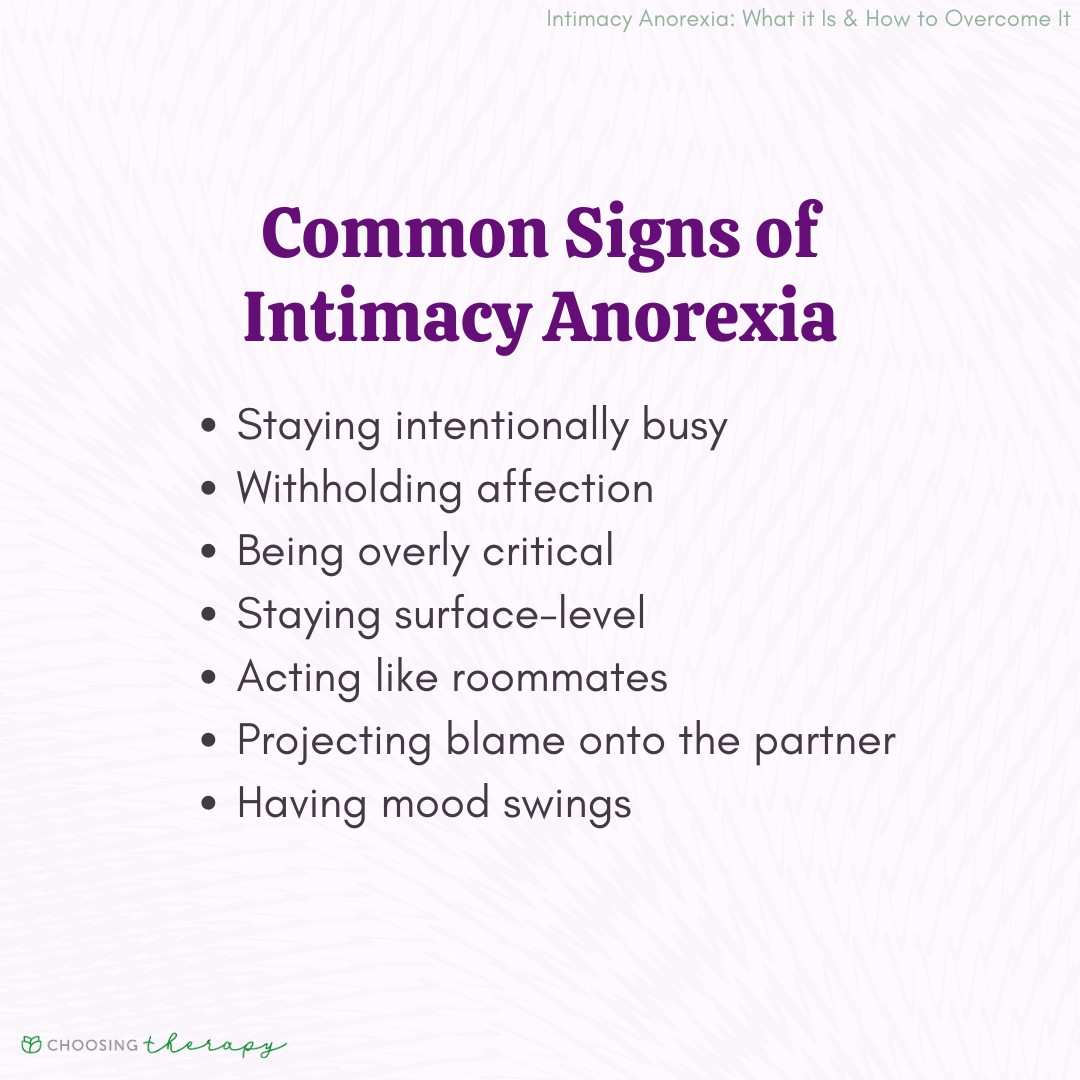
Common signs of intimacy anorexia include:
Staying Intentionally Busy
Someone with intimacy anorexia might keep themselves overly preoccupied as a way to avoid connection with their partner. This “need” to be busy can show up in work, parenting, or completing chores around the house. They seemingly never have time for the relationship. When they talk, they often put their partner down or make demands.
Withholding Affection
Intimacy anorexia is characterized by withholding affection, both in physical and emotional forms. Even if they know exactly what makes their partner feel loved, they won’t offer such love. When they are affectionate, it’s highly conditional. It also feels sporadic and can be taken away at any moment. This results in partners feeling rejected, lonely, and upset.
Being Overly Critical
Intimacy anorexia can often emerge as sarcasm and criticism in the relationship. The withholder may deny praise and become harsh and demanding. Partners may feel like they are perpetually walking on eggshells and as though they do nothing right. Subsequently, they might also find themselves avoiding the relationship to prevent ongoing backlash.
Staying Surface-Level
Someone with intimacy anorexia often fears and resists deeper conversations. Emotional connection often feels too vulnerable. Staying on the surface also provides a level of defense. It’s a subconscious way of keeping other people at a safe distance. In this vein, the person with intimacy anorexia seemingly avoids the risk of getting hurt by truly opening themselves to the relationship.
Acting Like Roommates
Intimacy anorexia can look like two people coexisting like roommates rather than intimate partners. There’s no romance, real emotional connection, or enjoyable playfulness. There may be civility and, at times, pleasant engagement, but the dynamic feels no different than casual acquaintances living under the same roof.
Projecting Blame Onto the Partner
People with intimacy anorexia may accuse their partner of being distant, detached, or even withdrawn from the relationship. This is a classic form of projection, which refers to people identifying certain emotions, traits, or beliefs onto another person. Projection acts as a way to find fault in others and avoid taking personal accountability.
Having Mood Swings
Some people with intimacy anorexia ebb and flow with their withdrawal patterns. In some moments, they can act romantically and affectionately. Then, without notice or warning, they suddenly change their behavior. Or they become upset over a seemingly benign trigger (and may stay upset for many hours or days). This can also perpetuate a dynamic where the partner feels like they’re walking on eggshells.
Sex & Intimacy Counseling for Couples Receive online counseling in a safe, unbiased space from a licensed therapist. BetterHelp has a large network of licensed therapists worldwide who provide convenient and affordable online therapy. Take a brief assessment and get matched with a therapist who fits your needs in as little as 48 hours. Insurance options may be available for eligible members.* *Insurance availability and coverage may vary by state, plan, provider network, and therapist availability.
What Causes Intimacy Anorexia?
Intimacy anorexia likely stems from a combination of individual temperament, past relationship problems, and trauma. People with intimacy anorexia may avoid intimacy intentionally, but they often aren’t aware of the true implications of their behavior. When they are aware, it’s often a sign that they’re operating from a more emotionally abusive and gaslighting framework.
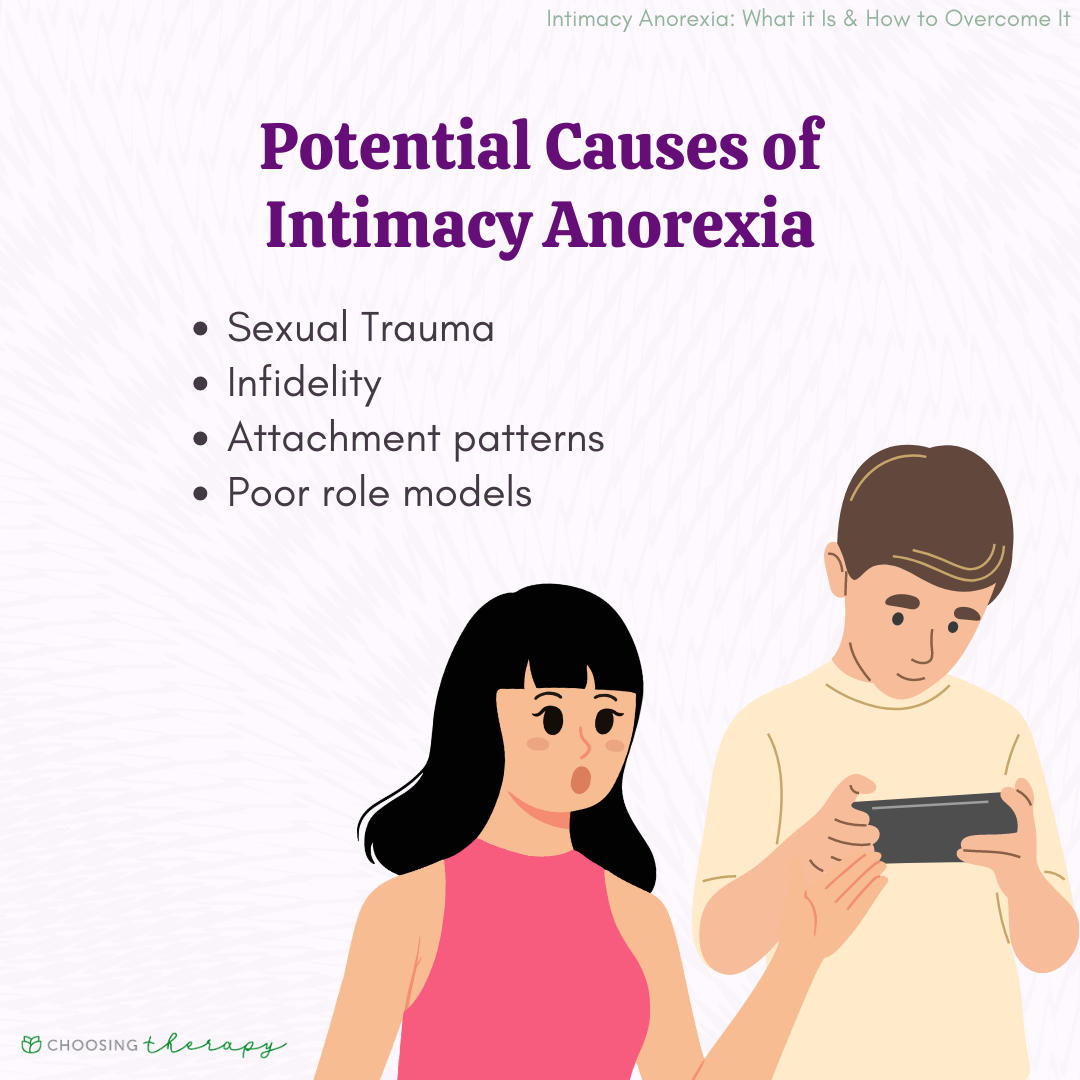
Potential causes of intimacy anorexia include:
Sexual Trauma
Sexual trauma can significantly impact relationships, self-esteem, and emotional wellness. This applies regardless of when the trauma occurred.2 Someone might withhold intimacy because the idea of intimacy genuinely scares them. They might also withhold intimacy if parts of their current relationship remind them of past abuse (even if current abuse isn’t occurring).
Infidelity
Infidelity may result in people fulfilling intimacy needs outside of their primary relationship. As a result, they may withhold love and affection from their partner because they simply lack interest. By this point, they may have already emotionally checked out from the relationship. Although the concept of sex addiction is somewhat controversial, people who compulsively cheat on their partners may coincide with intimate-anorexic behaviors.3
Attachment Patterns
Attachment styles are developed during early childhood. When a parent doesn’t attune well to their child’s needs, that child may grow up with an insecure attachment style, which can result in adult attachment disorders and other attachment issues. Intimacy anorexia is just one of those attachment issues that may emerge. The individual doesn’t know how to healthily express love and affection.
Poor Role Models
Like attachment patterns, intimacy anorexia can sometimes be a learned behavior passed down intergenerationally.4 How people observed their caregivers behave can directly impact how they behave in relationships later in life. If someone watched patterns that mimicked intimacy anorexia–or they grew up in households where chaos was prevalent–they may adopt similar tactics themselves.
How to Overcome Intimacy Anorexia
Intimacy anorexia can be a complicated relational issue and often requires internal processing and healing. Both partners can play a role in healing the dynamic, but the person with the presenting issue must be willing to work on their withholding patterns. Within this work, it’s important to reevaluate needs and boundaries. Change can take time, but reestablishing a connection is possible.
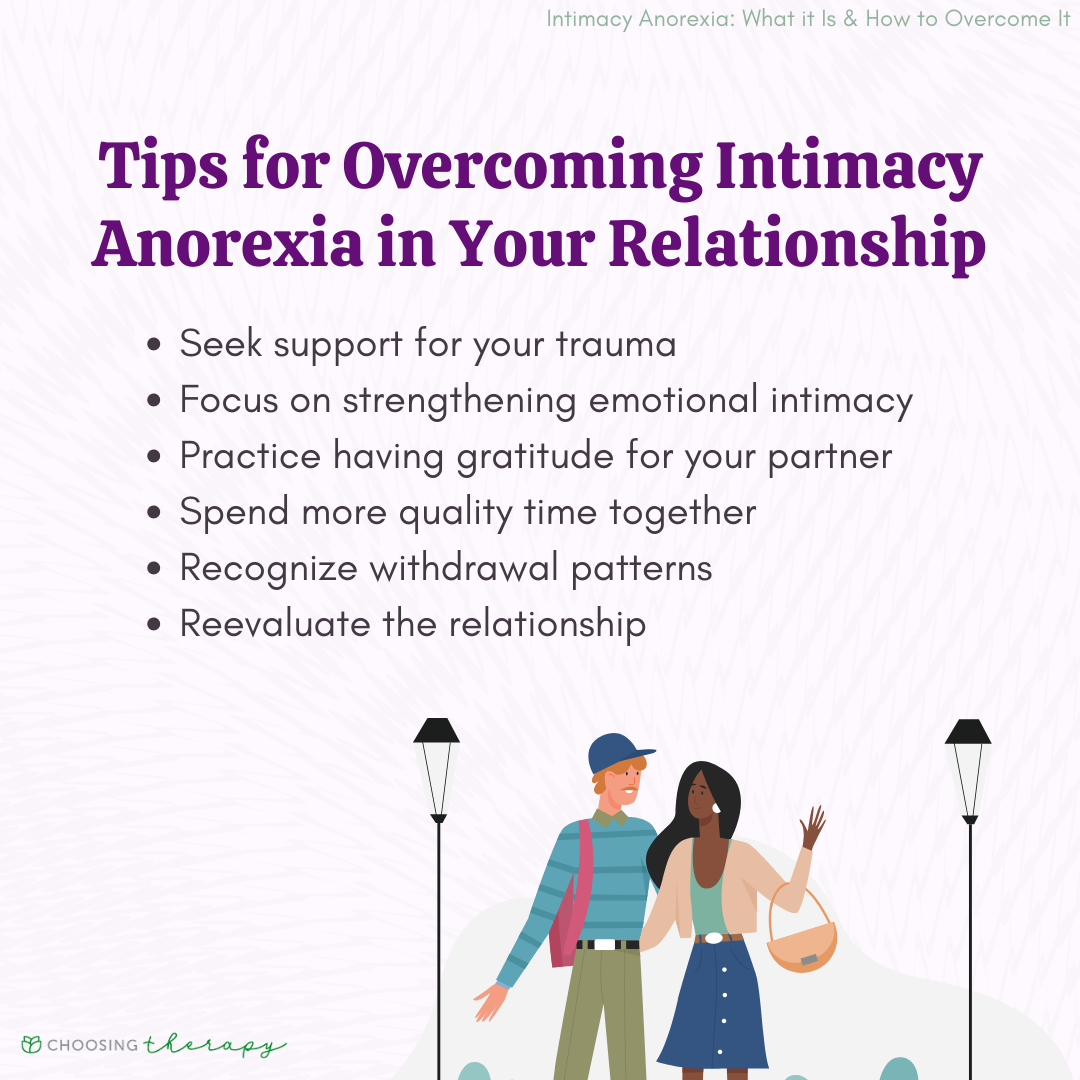
Below are tips for overcoming intimacy anorexia in your relationship:
- Seek support for your trauma: Healing inner trauma is one of the best steps for changing attachment patterns and enjoying more intimate relationships with others. Recovery takes time, but it’s possible to heal from past pain.
- Focus on strengthening emotional intimacy: Rebuilding emotional intimacy can be an important stepping stone for cultivating more physical affection.
- Practice having gratitude for your partner: Sometimes, people lose sight of what they appreciate once they become used to its presence. Remind yourself often what makes you grateful for your relationship.
- Spend more quality time together: Commit to working on the relationship and spending time with one another. Prioritize this goal as you would prioritize any other important obligation.
- Recognize withdrawal patterns: Withdrawal patterns will likely still emerge despite your desire to change. Identify when these happen, be more mindful of your triggers, and consider sharing your feelings with your partner.5
- Reevaluate the relationship: If you find that you can’t enjoy spending time with your partner–or if you often feel irritated–it may be a sign of deeper relational dissatisfaction. Consider assessing whether you want to remain in this relationship.
How Therapy Can Help With Intimacy Anorexia
While most people want a healthy, intimate relationship, this isn’t always the easiest goal to achieve. If you’re struggling with feeling connected to your partner, seeking therapy for intimacy problems can be beneficial. Individual therapy is most helpful if you want specific trauma support- or if you’ve identified internal issues contributing to your relationship’s dynamic.
Couples or marriage counseling also helps couples improve intimacy problems. Marriage counseling works by showing partners how they both play a role within a specific dynamic. Neither party is entirely blamed for a specific behavior, and each person is encouraged to reflect and take action to change. If the issues are specific to sexual function, sex therapy may be beneficial.
Sex & Intimacy Counseling for Couples Receive online counseling in a safe, unbiased space from a licensed therapist. BetterHelp has a large network of licensed therapists worldwide who provide convenient and affordable online therapy. Take a brief assessment and get matched with a therapist who fits your needs in as little as 48 hours. Insurance options may be available for eligible members.* *Insurance availability and coverage may vary by state, plan, provider network, and therapist availability.
In My Experience
Intimacy anorexia often coincides with avoidant attachment patterns and can generally be traced back to early childhood experiences. If a caregiver withdrew love and affection from you, you may have subconsciously emulated that pattern yourself. If you see yourself in this pattern, the insight can be painful. But change is possible, and you can learn how to feel more comfortable in your most vulnerable, important relationships. Therapy can be transformative, helping you understand the emotions causing you to withdraw and helping you cope with your relationship stress.

Intimacy Anorexia Infographics
ChoosingTherapy.com strives to provide our readers with mental health content that is accurate and actionable. We have high standards for what can be cited within our articles. Acceptable sources include government agencies, universities and colleges, scholarly journals, industry and professional associations, and other high-integrity sources of mental health journalism. Learn more by reviewing our full editorial policy.
-
What Is Emotional Abuse? National Domestic Violence Hotline. Retrieved from: https://www.thehotline.org/resources/what-is-emotional-abuse/.
-
Where Did She Go? The Transformation of Self-Esteem, Self-Identity, and Mental Well-Being among Women Who Have Experienced Intimate Partner Violence (2015, September). ScienceDirect. Retrieved from: https://www.sciencedirect.com/science/article/abs/pii/S1049386715000596.
-
Sex “addiction”: compulsion and controversy (2002, October). National Library of Medicine. Retrieved from: https://pubmed.ncbi.nlm.nih.gov/12557802/.
-
Is Attachment Transmitted Across Generations? The Plot Thickens (2011). National Library of Medicine. Retrieved from: https://www.ncbi.nlm.nih.gov/pmc/articles/PMC3060612/.
-
Demand-Withdraw Patterns in Marital Conflict in the Home (2011, November). National Library of Medicine. Retrieved from: https://www.ncbi.nlm.nih.gov/pmc/articles/PMC3218801/.

Your Voice Matters
Can't find what you're looking for?
Request an article! Tell ChoosingTherapy.com’s editorial team what questions you have about mental health, emotional wellness, relationships, and parenting. Our licensed therapists are just waiting to cover new topics you care about!
Leave your feedback for our editors.
Share your feedback on this article with our editors. If there’s something we missed or something we could improve on, we’d love to hear it.
Our writers and editors love compliments, too. :)
To help our readers take the next step in their mental health journey, ChoosingTherapy.com has partnered with leaders in mental health and wellness. ChoosingTherapy.com is compensated for marketing by the companies included below Sex & Intimacy Counseling for Couples Receive online counseling in a safe, unbiased space from a licensed therapist. BetterHelp has a large network of licensed therapists worldwide who provide convenient and affordable online therapy. Take a brief assessment and get matched with a therapist who fits your needs in as little as 48 hours. Insurance options may be available for eligible members.* *Insurance availability and coverage may vary by state, plan, provider network, and therapist availability. Modern Support For Sex & Intimacy OurRitual is an effective, modern alternative to traditional sex therapy for couples or individuals. With expert-led sessions and personalized, science-backed practices to improve intimate relationships. Plans start at $36 per week. Get 20% off your first month with code: choosingtherapy20 Visit OurRitual Sexual Healthcare For Men Get ED meds online shipped to you if prescribed. FDA-approved ED pills, with treatments starting at less than $2/day. 100% online, discreet delivery. No waiting weeks for an appointment. Visit Hims Sexual Healthcare For Women Plushcare – Get personalized, high-quality healthcare online. In-network with most major insurers, with a typical out-of-pocket cost of just $30. Painful Sex Treatment and HSDD (low sex drive in women)Additional Resources
Best Online Therapy Services There are a number of factors to consider when trying to determine which online therapy platform is going to be the best fit for you. It’s important to be mindful of what each platform costs, the services they provide you with, their providers’ training and level of expertise, and several other important criteria.
Best Online Psychiatry Services Online psychiatry, sometimes called telepsychiatry, platforms offer medication management by phone, video, or secure messaging for a variety of mental health conditions. In some cases, online psychiatry may be more affordable than seeing an in-person provider. Mental health treatment has expanded to include many online psychiatry and therapy services. With so many choices, it can feel overwhelming to find the one that is right for you.