Dependent personality disorder (DPD) is characterized by a need to be taken care of. Individuals with DPD prefer to have decisions made on their behalf and experience low self-confidence, fears of abandonment, and feelings of helplessness. However, with treatment for dependent personality disorder, a person can develop healthy coping skills for managing their symptoms.
ChoosingTherapy.com may earn a commission from the companies whose services are linked on this page.
Find a Therapist Who Specializes in Personality Disorders. BetterHelp has a large network of licensed therapists worldwide who provide convenient and affordable online therapy. Take a brief assessment and get matched with a therapist who fits your needs in as little as 48 hours. Insurance options may be available for eligible members.* *Insurance availability and coverage may vary by state, plan, provider network, and therapist availability.
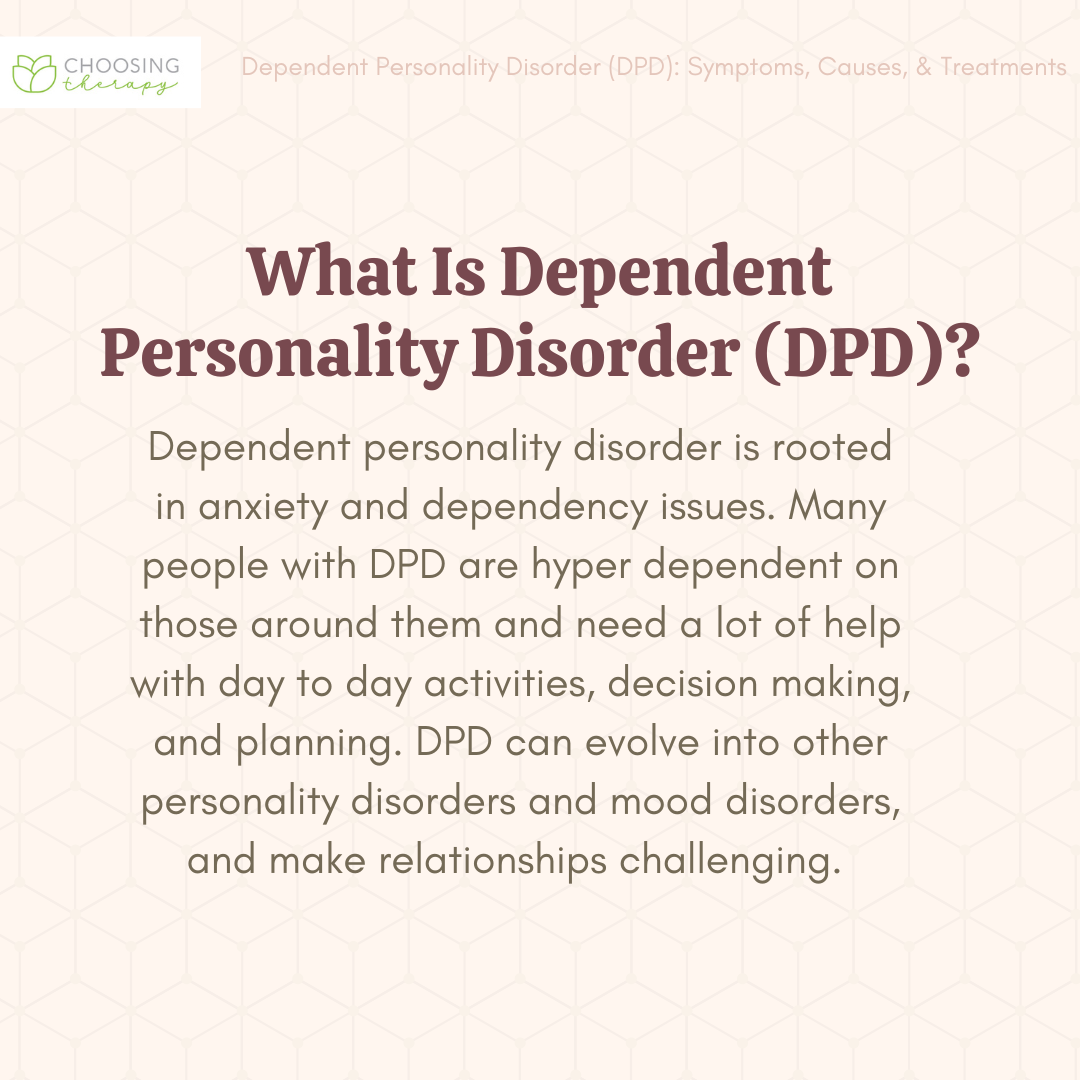
What Is Dependent Personality Disorder (DPD)?
Dependent personality disorder is rooted in anxiety and dependency issues. Many people with DPD are hyper dependent on those around them and need a lot of help with day to day activities, decision making, and planning. DPD can evolve into other personality disorders and mood disorders, and make relationships challenging.
Dependent Personality Disorder Vs. Codependency
DPD and codependency may appear to have a lot of common symptoms, however there are distinct differences. DPD involves having feelings of dependency on someone else—and that could be anyone. Codependency typically happens between specific people, likely a close friend or a romantic partner.
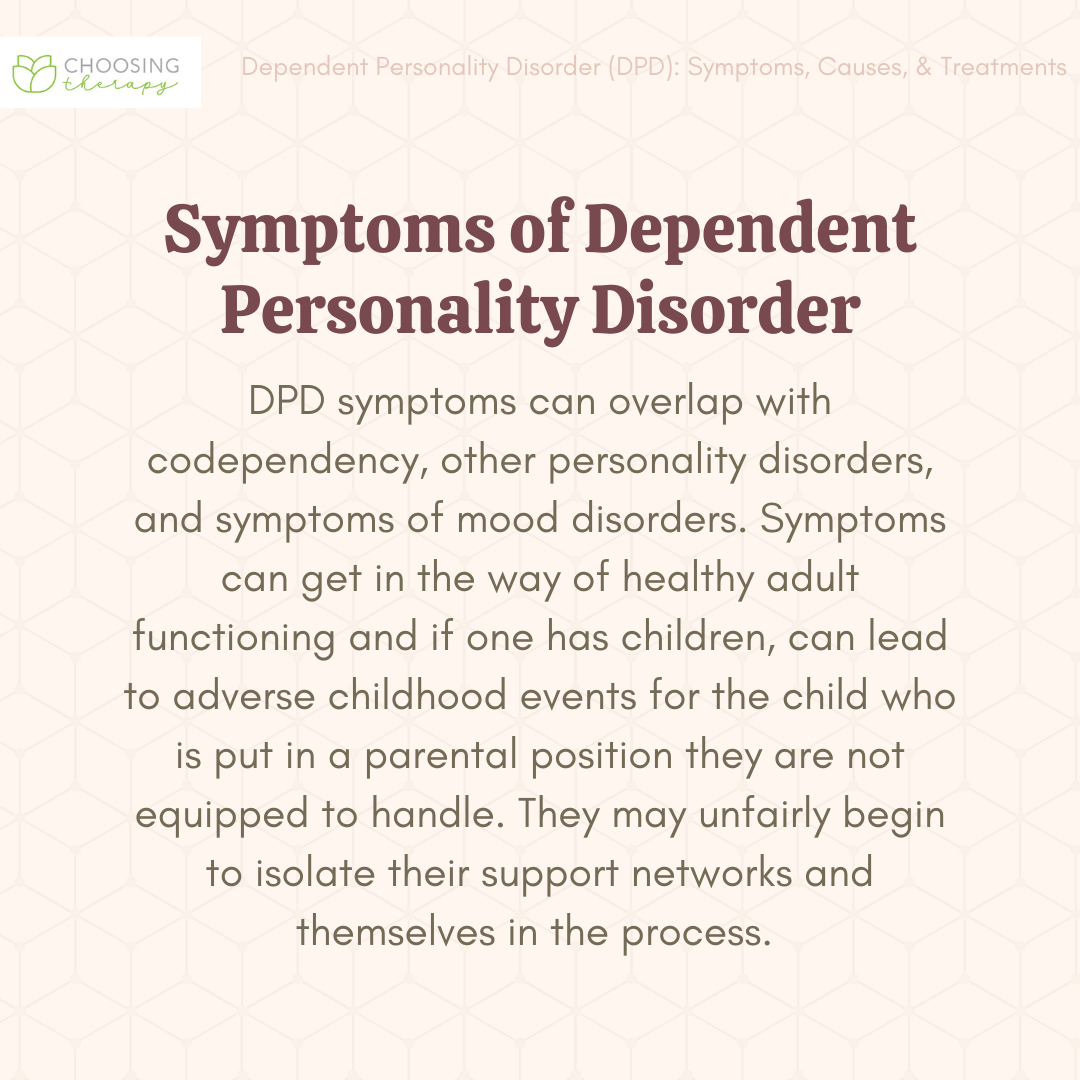
Symptoms of Dependent Personality Disorder
DPD symptoms can overlap with codependency, other personality disorders, and symptoms of mood disorders. Symptoms can get in the way of healthy adult functioning and if one has children, can lead to adverse childhood events for the child who is put in a parental position they are not equipped to handle. They may unfairly begin to isolate their support networks and themselves in the process.
Common dependent personality disorder symptoms include:7
- Difficulty making everyday decisions
- Avoidance of personal responsibility
- Difficulty expressing disagreement with others
- Lack of self-confidence in judgment or abilities
- Going to extreme lengths to receive support from others
- Feeling uncomfortable or helpless when alone
- Fears of abandonment
- Sense of helplessness when relationships end
- Oversensitivity to criticism
Signs of Dependent Personality Disorder
Signs of dependent personality disorder often include an overall state of submissiveness and the sense that one cannot be responsible for their own life. Those with DPD are frequently defined as clingy by others, as making even a simple decision on their own can throw them into worry, tears, and panic.4
Common signs of dependent personality disorder include:6
- Needing others to take responsibility for them
- Feeling worthless and incompetent
- Submission and not being able to say “no”
- Never offering a dissenting opinion
- Volunteering to do things they don’t want to
- Struggling to do things on their own
- Difficulty starting new projects
- Overly clingy and reliant on others
- Idealizing the person on whom they depend
- Shying away from social situations
- Catastrophic thinking
Find An Experienced, Capable Therapist Whether you’re struggling with relationships, identity, or emotional ups and downs, the right therapist can help you understand your patterns and chart a healthier path forward. ChoosingTherapy.com’s directory connects you with licensed professionals who are committed to providing respectful, informed, and nonjudgmental care. Many therapists accept insurance, offer in-person and online appointments, and have immediate availability.
Dependent Personality Disorder Causes & Risk Factors
The causes of dependent personality disorder most likely include genetic, familial, and environmental influences. Some studies show that individuals with DPD have experienced some form of abuse or trauma. It is also possible they may have faced serious illnesses that resulted in them relying on others for care.
Possible causes of dependent personality disorder include:
- Genetic factors: Research suggests that having one parent who has DPD can influence the likelihood of DPD.6
- Parenting styles: There is evidence that parenting style has an influence on the development of DPD. Authoritarian parents who don’t allow children the freedom to learn from failure can prevent independent development.3 An overprotective parent can also contribute to DPD as the child relies too heavily on the parent for everyday needs.3
- Cultural or religious behaviors: People who are raised in highly restrictive environments, like cults or religious groups, are more susceptible to developing DPD.6
- Abusive relationships: Being in abusive relationships with intimate partners can also lead to developing personality disorders through maladaptive coping mechanisms.
- Childhood trauma: Enduring physical, emotional, and/or sexual abuse primes children for developing personality disorders, as their normal trajectory of development is hindered by these events. Children are left to compensate in their own ways which often develops into poor coping mechanisms and distorted thought patterns.
- Family mental health history: A family history of mental health issues leaves those in the family more likely to develop mental health issues, some of which can be genetic.
- Childhood illnesses: Having an illness as a child that was debilitating and chronic can leave children feeling like they are helpless. As they grow, they may be more likely to ask for help and more likely to receive help due to their history.
Complications of Living With DPD
There are many complications of living with DPD. It can lead to worsening mood, poor self image and self esteem, and a higher likelihood of experiencing abuse or mistreatment.
Below are possible complications of living with dependent personality disorder:
- Poor relationships: DPD puts all the pressure on one person and can ruin the stability of a relationship.
- Missing out on opportunities: When you are unable to make decisions for yourself, you will miss out on opportunities you may not get again.
- Depression and anxiety: DPD increases your chances of developing depression due to the ongoing feeling of feeling worthless, and/or of developing anxiety due to the inability to make decisions for yourself.
- Substance misuse: It is common that someone with DPD may use substances to numb their feelings.
- Domestic abuse: The severe dependency associated with DPD makes people vulnerable to exploitation, abuse, and emotional misery.5 Sadly, they commonly find themselves in situations of domestic violence or other harm.
How Is Dependent Personality Disorder Diagnosed?
Diagnosing dependent personality disorder requires assessment, a thorough review of one’s history, and a physical exam.4 There is no specific dependent personality disorder test, and receiving an accurate diagnosis may take time as physicians rule out other conditions with overlapping symptoms. It is possible that the person with DPD has more than one diagnosis that requires treatment.
To be diagnosed with DPD, one must display at least five of the following dependent personality disorder criteria from the DSM-V:1
- Difficulty making everyday decisions without an excessive amount of advice and reassurance from others
- Needing others to assume responsibility for most major areas of their life
- Having difficulty expressing disagreement with others because of fear of loss of support or approval. (Does not include realistic fears of retribution.)
- Difficulty initiating projects or doing things on their own
- Going to excessive lengths to obtain nurturance and support from others to the point of volunteering to do things that are unpleasant
- Feeling uncomfortable or helpless when alone due to exaggerated fears of being unable to care for themselves
- Urgently seeking another relationship as a source of care and support when another one ends
- Being unrealistically preoccupied with fears of being left to tend to themselves
Can Dependent Personality Disorder Be Prevented?
While personality disorders can’t necessarily be prevented, there are some measures you can take to ensure you don’t develop it moving forward or that your children would be less likely to develop it. By having healthy boundaries and working on yourself and going to therapy, you can learn the skills needed to fully function on your own.
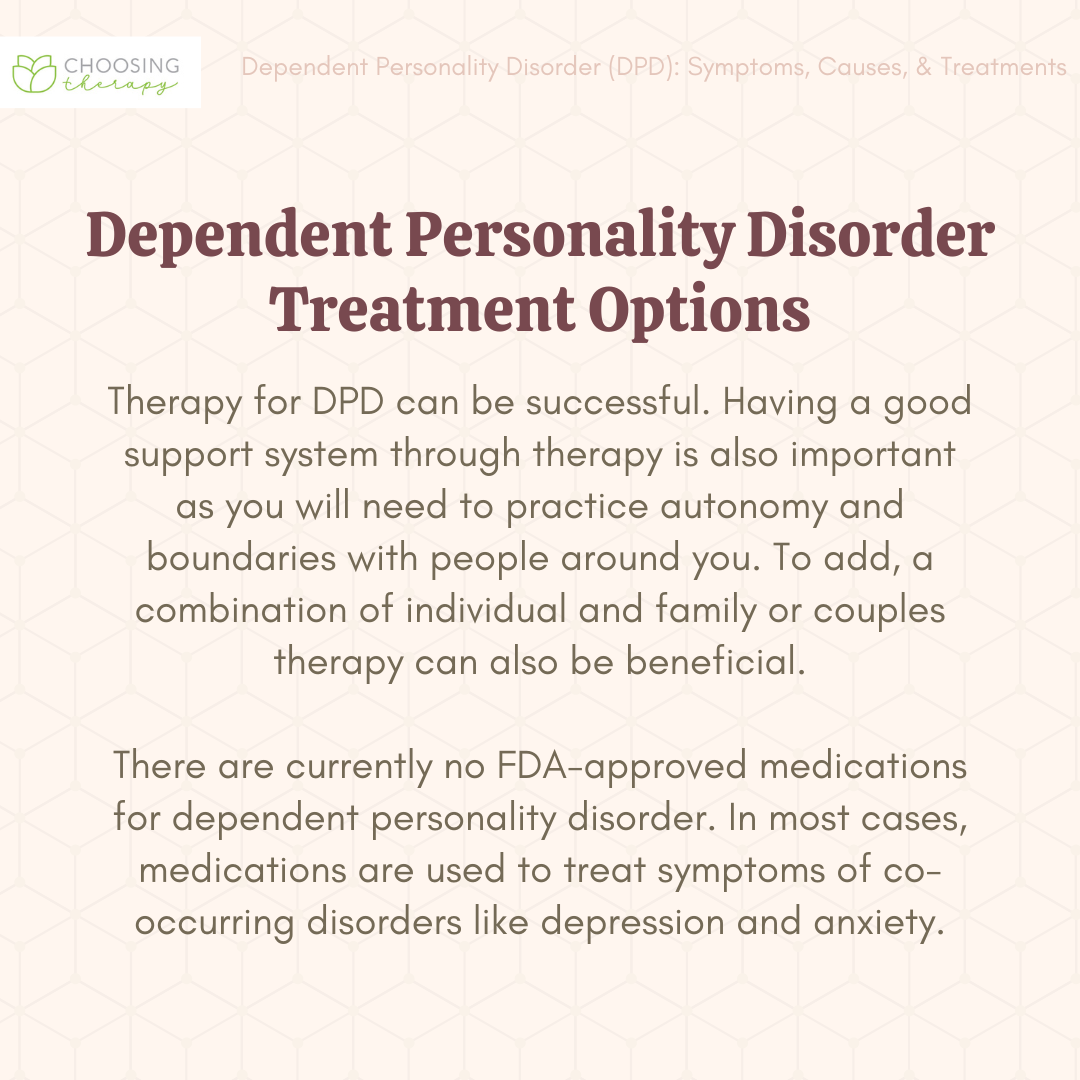
Dependent Personality Disorder Treatment Options
Dependent personality disorder treatment options are available for those who struggle. There are many modalities that can be used to help treat DPD.
Therapy
Therapy for DPD can be successful. Having a good support system through therapy is also important as you will need to practice autonomy and boundaries with people around you. To add, a combination of individual and family or couples therapy can also be beneficial to help your partner or family learn how to support you.
Below are common therapies for dependent personality disorder:
- Cognitive behavioral therapy (CBT): In CBT, the goal is to gain autonomy and assertiveness by challenging one’s negative thoughts and beliefs and replacing them with adaptive alternatives. The therapy relationship is supportive and encouraging while holding the client accountable.
- Psychodynamic therapy: Through psychodynamic therapy, a client is guided to what causes their dependent behaviors, such as abandonment, trauma, and overprotection. As these issues are addressed, the client learns new skills to deal with triggering events.
- Schema therapy: Schema therapy targets specific ideas and visions of the future, or visions of a certain situation, and works through them in a way that challenges the maladaptive thought patterns.
- Family therapy: Family therapy helps families learn how to support someone with DPD while also feeling validated and heard regarding how it impacts them, which can be important feedback the DPD person needs to hear for their healing.
- Couples therapy: Couples therapy helps couples find a way to support one another without becoming codependent or enabling DPD symptoms and establishes ways to set healthier boundaries.
Medication
There are currently no FDA-approved medications for dependent personality disorder. In most cases, medications are used to treat symptoms of co-occurring disorders like depression and anxiety.2 A psychiatrist or psychiatric nurse practitioner can work with the individual to diagnose and prescribe according to his or her needs.
Would You Like to Try Therapy? BetterHelp has a large network of licensed therapists worldwide who provide convenient and affordable online therapy. Take a brief assessment and get matched with a therapist who fits your needs in as little as 48 hours. Insurance options may be available for eligible members.* *Insurance availability and coverage may vary by state, plan, provider network, and therapist availability.
How to Cope With DPD
While DPD is not preventable or curable, it is possible to cope with this condition. DPD is manageable with lifestyle changes and intentional inner work.
Here are tips for coping with dependent personality disorder:
- Recognize you’re in control of your life: Learning to become self aware can take time and practice, but building the skills and tools you need to be in control of your own life is the first step toward healing.
- Ask to be held accountable for your actions: When you are trying to find ways to cope with DPD, it is important that you are aware and willing to be held accountable for the change that is needed.
- Join a support group: Support groups give you a sense of community while you learn how to build your own life.
- Practice building autonomy: Building autonomy is important and can help you feel empowered when you make a decision and follow through on it.
- Start a meditation routine: Meditation is a great way to stay grounded and be in touch with your emotions.
- Try journaling: Journaling gives you the space to write and process all your emotions in a safe space where you can reflect on them.
- Start sleeping on decisions: Sleeping on decisions can give you a clear head on what you should do.
Final Thoughts
When one feels worthless and dependent, there is a feeling of always being stuck. For those with dependent personality disorder, being a victim is very real, degrading, and sometimes dangerous. The key to a better life is educating yourself about and receiving treatment for dependent personality disorder so you can make positive changes.
Dependent Personality Disorder Infographics
ChoosingTherapy.com strives to provide our readers with mental health content that is accurate and actionable. We have high standards for what can be cited within our articles. Acceptable sources include government agencies, universities and colleges, scholarly journals, industry and professional associations, and other high-integrity sources of mental health journalism. Learn more by reviewing our full editorial policy.
-
American Psychiatric Association. (2013). Diagnostic and statistical manual of mental disorders (DSM-5). American Psychiatric Pub.
-
MedlinePlus. (2022). Dependent personality disorder. https://medlineplus.gov/ency/article/000941.htm
-
Cleveland Clinic Health Library. (2020). Dependent personality disorder. https://my.clevelandclinic.org/health/diseases/9783-dependent-personality-disorder
-
Disney K. L. (2013). Dependent personality disorder: a critical review. Clinical psychology review, 33(8), 1184–1196. https://doi.org/10.1016/j.cpr.2013.10.001
-
Faith, C. (2009). Dependent personality disorder: a review of etiology and treatment. Graduate Journal of Counseling Psychology, 1(2), 7. https://epublications.marquette.edu/gjcp/vol1/iss2/7
-
Harvard Mental Health Letter. (2007). Dependent personality disorder. Harvard Health Publishing. https://www.health.harvard.edu/newsletter_article/dependent_personality_disorder
-
Mental Health Foundation. (2021). Dependent personality disorder. https://mentalhealthfoundation.org/health-conditions/personality-disorders/dependent/
-
Ramsay, G., & Jolayemi, A. (2020). Personality Disorders Revisited: A Newly Proposed Mental Illness. Cureus, 12(8), e9634. https://doi.org/10.7759/cureus.9634
-
Volkert, J., Gablonski, T., & Rabung, S. (2018). Prevalence of personality disorders in the general adult population in Western countries: Systematic review and meta-analysis. The British Journal of Psychiatry, 213(6), 709-715.

We regularly update the articles on ChoosingTherapy.com to ensure we continue to reflect scientific consensus on the topics we cover, to incorporate new research into our articles, and to better answer our audience’s questions. When our content undergoes a significant revision, we summarize the changes that were made and the date on which they occurred. We also record the authors and medical reviewers who contributed to previous versions of the article. Read more about our editorial policies here.
Author: No Change
Reviewer: No Change
Primary Changes: Updated for readability and clarity. Reviewed and added relevant resources. Added “What Is Dependent Personality Disorder (DPD)?”, “Symptoms of Dependent Personality Disorder”, “Complications of Living With DPD”, “Can Dependent Personality Disorder Be Prevented?”, “Dependent Personality Disorder Treatment Options”, and “How to Cope With DPD”. New material written by Silvi Saxena, MBA, MSW, LSW, CCTP, OSW-C and reviewed by Kristen Fuller, MD.
Author: Emma Jane Watson, M.Ed., MSW, LICSW
Reviewer: Trishanna Sookdeo, MD, MPH, FAAFP
Your Voice Matters
Can't find what you're looking for?
Request an article! Tell ChoosingTherapy.com’s editorial team what questions you have about mental health, emotional wellness, relationships, and parenting. Our licensed therapists are just waiting to cover new topics you care about!
Leave your feedback for our editors.
Share your feedback on this article with our editors. If there’s something we missed or something we could improve on, we’d love to hear it.
Our writers and editors love compliments, too. :)
To help our readers take the next step in their mental health journey, ChoosingTherapy.com has partnered with leaders in mental health and wellness. ChoosingTherapy.com is compensated for marketing by the companies included below Talk Therapy Online-Therapy.com – Get support and guidance from a licensed therapist. Online-Therapy.com provides 45 minute weekly video sessions and unlimited text messaging with your therapist for only $64/week. Get started Psychiatry, with You in Mind Talkiatry – Our psychiatrists can diagnose your condition, prescribe medication, and monitor your progress. Most psychiatry visits cost patients $30 or less* Free Assessment DBT Skills Course Jones Mindful Living Dialectical Behavior Therapy (DBT) is a popular treatment for BPD. Learn DBT skills with live weekly classes and online video courses for only $19 per month. Free one-week trial Tips for Starting Therapy Newsletter A free newsletter from the experts at ChoosingTherapy.com for those interested in learning about therapy and how to get the most benefits out of therapy. Get helpful tips and the latest information. Sign Up ChoosingTherapy.com Directory Find local therapists that offer online and in-person therapy. Search for therapists by specialty, experience, insurance, and location. Find a therapist near you. *Includes copayment, deductible, coinsurance, and $0 Visits. Excludes no shows.Additional Resources
Online Anxiety Test A few questions from Talkiatry can help you understand your symptoms and give you a recommendation for what to do next. Best Online Therapy Services There are a number of factors to consider when trying to determine which online therapy platform is going to be the best fit for you. It’s important to be mindful of what each platform costs, the services they provide you with, their providers’ training and level of expertise, and several other important criteria.