Spiritual intimacy is the closeness partners build by sharing their beliefs, values, and sense of meaning. This spiritual connection can grow through a shared religion, but couples of different faiths, and couples with no religion at all, can build it too. Research links shared spiritual closeness with stronger trust, better conflict resolution, and higher relationship satisfaction.
ChoosingTherapy.com may earn a commission from the companies whose services are linked on this page.
Find the Perfect Therapist for You, with BetterHelp.
If you don’t click with your first match, you can easily switch therapists. BetterHelp has a large network of licensed therapists worldwide who provide convenient and affordable online therapy. Take a brief assessment and get matched with a therapist who fits your needs in as little as 48 hours. Insurance options may be available for eligible members.* *Insurance availability and coverage may vary by state, plan, provider network, and therapist availability.
What Is Spiritual Intimacy?
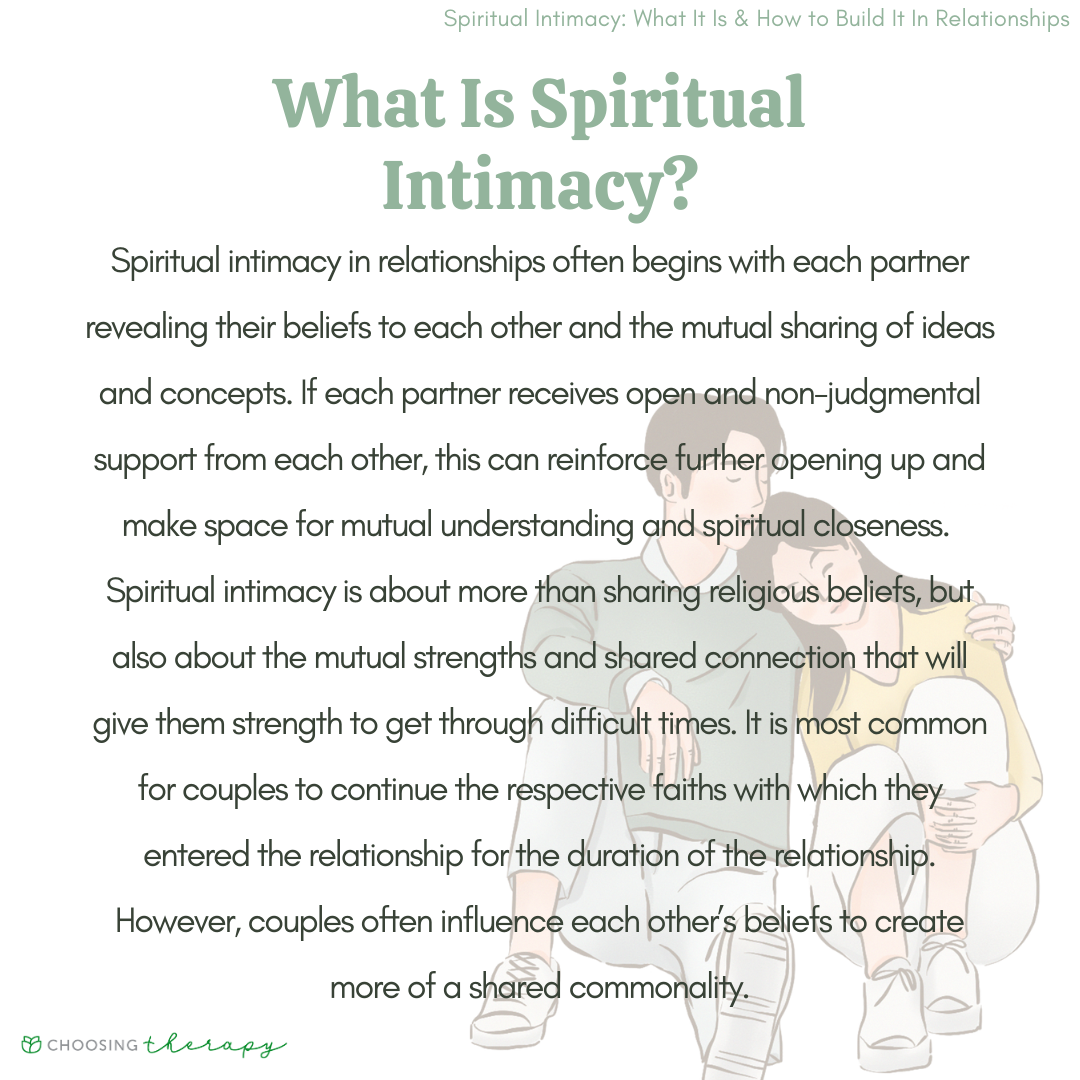
Spiritual intimacy is one of the types of intimacy in relationships that often begins with each partner revealing their beliefs to each other and the mutual sharing of ideas and concepts. If each partner receives open and non-judgmental support from each other, this can reinforce further opening up and make space for mutual understanding and spiritual closeness.
Spiritual intimacy is about more than sharing religious beliefs, but also about the mutual strengths and shared connection that will give them strength to get through difficult times. It is most common for couples to continue the respective faiths with which they entered the relationship for the duration of the relationship. However, couples often influence each other’s beliefs to create more of a shared commonality.
Here is how spiritual intimacy compares with the other core types of intimacy:
| Type of intimacy | What it means | Example |
|---|---|---|
| Emotional | Feeling safe sharing feelings and being understood | Talking through a hard day without judgment |
| Physical | Affectionate touch and sexual connection | Holding hands, hugging, sex |
| Intellectual | Exchanging ideas, opinions, and curiosity | Debating a book or idea you both find interesting |
| Spiritual | Connecting over beliefs, values, and meaning | Praying, meditating, or discussing life purpose together |
Can You Have Spiritual Intimacy Without Religion?
Having shared spiritual intimacy with a partner does not always have to mean religion or faith. It is possible to have spiritual intimacy with your partner if you have different religious faiths or even if one of you is not religious. Spirituality has little to do with religion and more with one’s relationship with the universe around us.
For couples with different spiritual ideas, maintaining a shared connection is still possible with mutual respect and open communication. Intermingling different faiths and spiritual beliefs can help couples create a more diverse spirituality and expand their closeness. Couples with strong spiritual intimacy are sometimes referred to as having soul ties.
What Are the Signs of Spiritual Intimacy?
Spiritual intimacy shows up as strong trust, mutual admiration, shared goals, and an easier time navigating challenges together. Because faiths and spiritual practices vary widely, these signs look different in every couple. For couples whose faith places greater importance on a marital union, being married might affect their level of spiritual intimacy.
Signs of spiritual intimacy may include:
- Strong trust: Sharing beliefs encourages greater trust in each other. When someone has the same or similar spirituality, it can foster stronger shared goals for the relationship and even help with conflict resolution.
- Physical intimacy: Sharing faith or spirituality can intensify sexual chemistry and physical intimacy due to increased marital connection and satisfaction. One factor in this could be that in some cultures, marriage is considered a prerequisite to physical and sexual contact.1 A 2025 study of adults in committed relationships found that viewing sexuality within the relationship as sacred (what researchers call sanctification) was tied to higher sexual satisfaction.
- Strong Emotional Connection: Research continues to link shared faith and spiritual practice with higher marital satisfaction, including a 2021 study in The Family Journal that found religious faith positively associated with marital satisfaction.1
- Mutual Admiration: Many couples report that they admire their partner’s representation of their faith and that seeing their partner practicing their faith creates a sense of admiration.
- Mutual Understanding: Shared spirituality can make it easier for couples to understand each other based on ideas and concepts that are related to one’s spiritual life. Studies show that couples with similar levels of communication and understanding have a greater connection and increased attraction.1
- Shared Goals: Having shared faith can help couples create goals. As shared goals are an important part of having a lasting supportive relationship, having a shared religion or spirituality can contribute to having shared goals for the partnership.
- Greater ability to navigate challenges: Those with shared spiritual intimacy often find that they are better able to work through crises or challenging situations. Their faith can get them through challenges by giving them a reason and a shared goal.
Top Rated Online Therapy Services
BetterHelp – Best Overall
“BetterHelp is an online therapy platform that quickly connects you with a licensed counselor or therapist and earned 4 out of 5 stars.” Take a free assessment
Online-Therapy.com – Great Alternative
In addition to therapy, all Online-Therapy.com subscriptions include a self-guided CBT course. Visit Online-Therapy.com
Why Is Spiritual Intimacy Important in a Relationship?
Having shared spiritual intimacy can bring two people closer together. Studies have shown that couples who report stronger shared faith report a stronger and more satisfying marriage.1 Couples with a shared spirituality or faith often report that this contributes to stronger bonds. “More specifically, research has consistently found a positive relationship between marital satisfaction and religious faith.”2 Thus, spiritual intimacy can strengthen physical and emotional intimacy due to the shared connection and meaning.
What Causes Spiritual Intimacy Problems?
Spiritual intimacy problems usually develop when daily pressures crowd out shared spiritual practice, or when respect for a partner’s beliefs breaks down.
Many things make it challenging to maintain or develop a spiritual connection:
- Having a busy life
- Taking care of kids
- A busy job or career path
- Dealing with the pressures of financial stressors
- Family or personal conflicts
- Lack of respect for one’s partner
- One member of the couple is experiencing spiritual abuse, or the faith is used against them due to their gender, sexuality, or other factors.
What Does Recent Research Say About Spiritual Intimacy?
Recent research treats spiritual intimacy as a measurable ingredient of relationship health, not just a byproduct of shared religion. Psychologists Annette Mahoney and Kenneth Pargament at Bowling Green State University developed the relational spirituality framework, which describes three pathways through which faith shapes couples: connection with the divine, involvement in a spiritual community, and sanctification, meaning the tendency to see the relationship itself as sacred. Studies within this framework consistently find that couples who sanctify their relationship report more commitment, closeness, and satisfaction.
Newer work extends these findings beyond marriage and beyond any single religion. A 2025 study published in Humanities and Social Sciences Communications, co-authored by Mahoney, found that adults in committed relationships who viewed their sexual relationship as sacred reported higher sexual satisfaction, while unresolved religious and spiritual struggles predicted lower satisfaction. Earlier observational research from the Bowling Green team also showed that spouses who reported more spiritual intimacy handled their most contentious conflict topics with more warmth and less hostility when observed in the lab.
The practical takeaway is that spiritual intimacy works through everyday behavior. Talking openly about beliefs, treating the relationship as something worth protecting, and addressing spiritual doubts together appear to matter more than formal religious labels.
How Do You Build Spiritual Intimacy?
There are things you can do to increase spiritual intimacy within your partnership. Spiritual intimacy takes time and commitment to build, but it can be enjoyable for each partner to work towards.
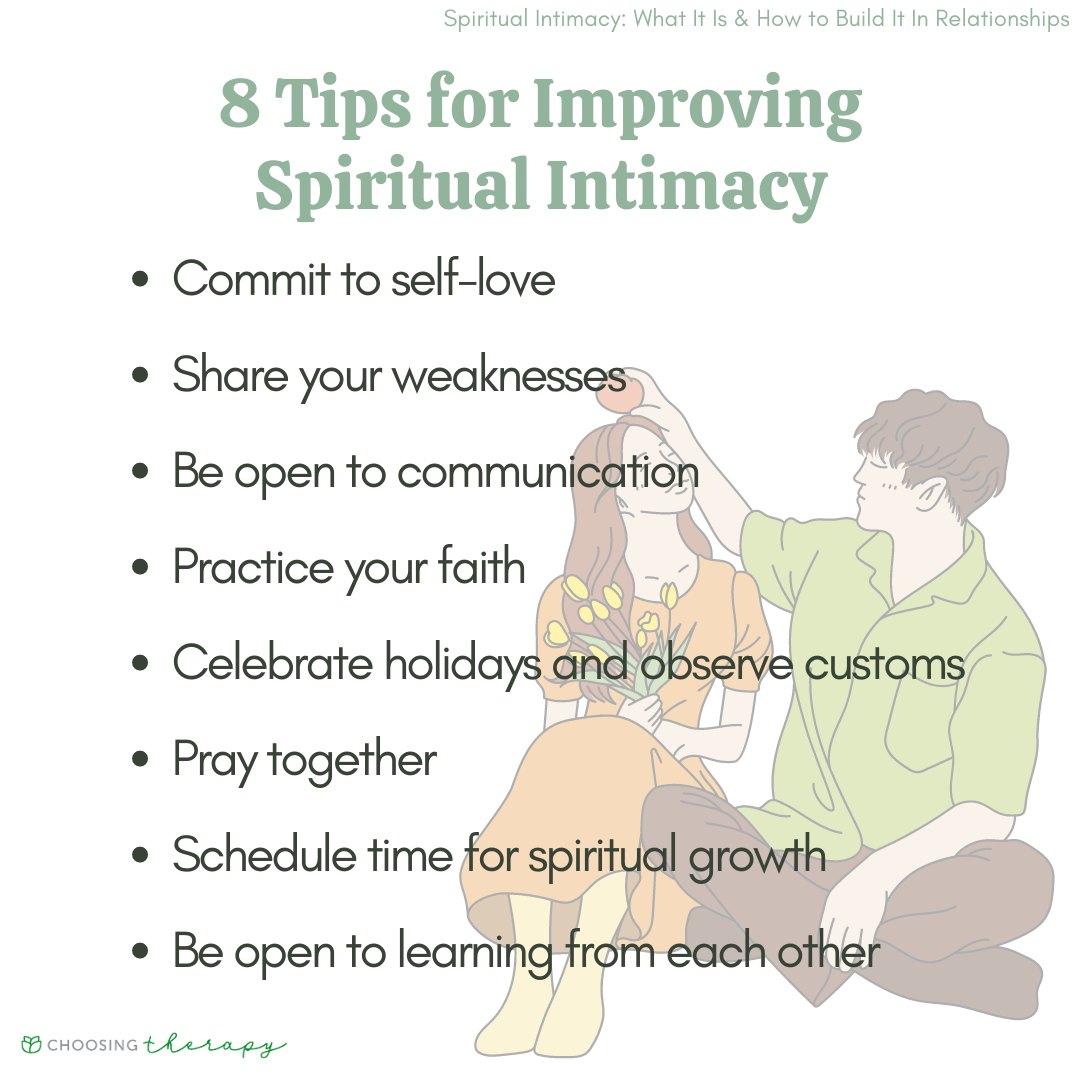
Below are eight tips for strengthening spiritual intimacy in your relationship:
1. Commit to Self-Love
One way to improve spiritual intimacy in your relationship is by improving self-love. Practicing kindness and self-acceptance and learning to love oneself makes someone better able to accept and love others, especially their partner.
Increasing self-love helps create a greater amount of shared respect. It can help the person be better prepared to navigate life’s challenges or to support their partner through a difficult time. It also allows couples to create more shared acceptance of each other as imperfect humans.
2. Share Your Weaknesses
Being open and honest about your weaknesses with your partner can help deepen your spiritual connection. Sharing shortcomings and being truthful can help strengthen a deeper relationship and grow spiritual intimacy by allowing couples to be vulnerable.
Self-disclosure and its subsequent empathetic response can increase feelings of connection and intimacy within a relationship. When there is enough trust and security to share one’s weaknesses, it strengthens the intimate bond within the couple.3
3. Be Open to Communication
Poor communication is often the first reason couples seek marital or couples therapy.4 Therefore, being open to communication, especially in improving your communication and understanding of spiritual concepts, can help enhance the satisfaction of your partnership.
“As with marital intimacy, communication is key to spiritual intimacy.”5 Open communication can increase the relationship’s longevity and create a more shared spiritual connection.
4. Practice Your Faith
Allowing time and space to practice your faith is an important part of deepening spiritual connection within your relationship. Couples with a shared faith may find it easier to practice their faith together because both people are more understanding and aware of practices.
However, both members of the couple do not have to be of the same faith to practice the faith. Respecting your partner’s beliefs and allowing them to practice is important to be a good partner.
5. Celebrate Holidays & Observe Customs
Celebrating holidays and observing customs together keeps a couple’s shared faith visible in everyday life, especially for partners whose traditions fall outside the mainstream calendar.
Even if it takes more effort to observe your faith’s customs, such as taking time off from work to fast or scheduling family time for holiday meals, prioritizing these things is essential. Making sure to celebrate and observe these things can help the couple feel like they are connecting over a shared meaning and goal.
6. Pray Together
When couples pray together, it can strengthen connection and build intimacy. The act of praying together can increase trust and intimacy, make a shared goal, and create space for acceptance and forgiveness within the couple. Research by Frank Fincham at Florida State University has repeatedly linked praying for a partner with greater trust, forgiveness, and relationship satisfaction, and a 2026 study in the journal Religions found couple prayer associated with marital happiness.
Praying takes many different forms depending on the person’s faith or spirituality. Taking time to pray, whether next to each other or simultaneously, can foster a shared connection of spirituality.
7. Schedule Time for Spiritual Growth
Like all areas of our life and relationship, spirituality and faith need nurturing. Spirituality often falls to the last of importance with today’s busy lifestyles. Scheduling time to make sure that you practice spiritual growth will ensure that you prioritize this aspect of your life and will allow you to balance it into your busy schedule.
8. Be Open to Learning From Each Other
In a 1998 University of Washington study of 130 newlywed couples, John Gottman and colleagues found that marriages were happier and more stable when husbands accepted influence from their wives. If each member of the couple can accept different ways of thinking about things, it can enhance the connection between them.
While this is true for everyone, it is especially crucial for men. “A husband’s ability to be influenced by his wife (rather than vice-versa) is crucial because research shows that women are already well practiced at accepting influence from men.”6
When to Seek Couples Counseling
Many couples successfully navigate differences in spirituality without help as long as they have open communication and respect. However, if you find issues in your spirituality manifesting in your relationship, or if you or your partner are struggling with different faiths and understandings of each other, finding a marriage counselor who understands spirituality within relationships might be beneficial.
With online therapy options, finding a therapist who can help you is easier than ever. Look for someone who understands how spirituality and faith affect relationships and can help you develop self-awareness and work together to compromise and better understand each other. Consider using an online therapy directory in your search.
In My Experience
Being with a partner with different ideas about spirituality is not a deal breaker. However, having shared morals and values and having mutual respect and understanding are crucial for a lasting relationship. While couples with different faiths can bond over their similarities, couples with strikingly different religions might be much more difficult. For example, for my clients with strong religious faiths that have specific expectations based on their gender or position within the family, being with a partner with a different idea of these roles might be more difficult or even stressful for them.
Additional Resources
To help our readers take the next step in their mental health journey, ChoosingTherapy.com has partnered with leaders in mental health and wellness. ChoosingTherapy.com is compensated for marketing by the companies included below.
Online Therapy
BetterHelp Get support and guidance from a licensed therapist. BetterHelp has over 30,000 therapists, who provide convenient and affordable online therapy. BetterHelp starts at $65 per week and is FSA/HSA eligible by most providers. Take a free online assessment and get matched with the right therapist for you. Free Assessment
Psychiatry, with You in Mind
Talkiatry Our psychiatrists can diagnose your condition, prescribe medication, and monitor your progress. Most psychiatry visits cost patients $30 or less* Free Assessment
Drinking Moderation
Sunnyside Want to drink less? Sunnyside helps you ease into mindful drinking at your own pace. Think lifestyle change, not a fad diet. Develop new daily routines, so you maintain your new habits for life. Take a 3 Minute Quiz
*Includes copayment, deductible, coinsurance, and $0 Visits. Excludes no shows.
Frequently Asked Questions
What are the 4 types of intimacy?


The four core types of intimacy are emotional, physical, intellectual, and spiritual. Emotional intimacy is feeling safe sharing feelings, physical intimacy includes affectionate touch and sex, intellectual intimacy is exchanging ideas and opinions, and spiritual intimacy is connecting over beliefs, values, and meaning. Healthy relationships usually blend several types, and couples can strengthen each one deliberately.
What is spiritual intimacy?
Spiritual intimacy is the closeness partners build by sharing their beliefs, values, and sense of meaning with each other. It can grow through religion, but it does not require one; couples may connect through prayer, meditation, time in nature, or honest conversations about purpose. Research links this kind of shared spiritual connection with higher relationship satisfaction.
What are the 4 levels of intimacy?
Intimacy typically deepens through four levels of self-disclosure: surface-level small talk, sharing facts and ideas, sharing opinions and feelings, and finally sharing vulnerabilities, fears, and needs. Each level requires more trust than the last. Spiritual intimacy usually lives at the deeper levels, because revealing your beliefs and doubts asks for real vulnerability.
How do you build spiritual intimacy?
You build spiritual intimacy through small, repeated practices: talk openly about your beliefs and doubts, practice your faith or spiritual routines together, celebrate meaningful holidays and customs, pray or meditate as a couple, and stay curious about your partner’s worldview. Scheduling regular time for these practices matters, since spiritual connection tends to fade when life gets busy.
Can you have spiritual intimacy without religion?
Yes, spiritual intimacy does not require religion or matching faiths. Partners can connect over shared values, awe, gratitude, mindfulness, or a sense of purpose larger than themselves. Interfaith and secular couples can build strong spiritual intimacy through mutual respect, open communication, and honest conversations about what gives their lives meaning.

Online Anxiety Test
A few questions from Talkiatry can help you understand your symptoms and give you a recommendation for what to do next.
Best Online Therapy Services
There are a number of factors to consider when trying to determine which online therapy platform is going to be the best fit for you. It’s important to be mindful of what each platform costs, the services they provide you with, their providers’ training and level of expertise, and several other important criteria.
Spiritual Intimacy Infographics