


If you’re concerned that you have narcissistic personality disorder (NPD) or narcissistic traits, awareness is an important first step. Narcissism exists on a vast spectrum and many people use narcissistic behaviors from time to time. That said, narcissism is a complex issue with numerous symptoms. Even if you identify with some characteristics, know that it is possible to change and heal.
ChoosingTherapy.com may earn a commission from the companies whose services are linked on this page.
Would You Like to Try Therapy?
Most people (76%) who try therapy have a positive experience! Stat Source BetterHelp has a large network of licensed therapists worldwide who provide convenient and affordable online therapy. Take a brief assessment and get matched with a therapist who fits your needs in as little as 48 hours. Insurance options may be available for eligible members.* *Insurance availability and coverage may vary by state, plan, provider network, and therapist availability.
What Is Narcissistic Personality Disorder (NPD)?
Narcissistic personality disorder (NPD) is characterized by an inflated sense of self and a diminished ability to experience empathy for others. Research shows that between .5% and 5% of the population may meet the criteria for NPD. 1 However, exact statistics are challenging to discern, as personality disorders are different from having traits, and many people with NPD do not seek treatment. Rates of NPD generally tend to be higher for men, younger adults, and people who are either separated/divorced/never married. 2
Narcissism can affect people in different ways, and there are different types of narcissism. That said, in almost all cases, narcissism is rooted in low self-esteem and a wounded ego. NPD closely coincides with childhood trauma, and narcissistic behavior likely emerges as a trauma response.
Do I Have NPD?
It can be challenging to discern narcissistic traits, especially if someone identifies them in you. You may wonder, “Am I the narcissist here?” Despite what may be presented in the media, narcissism isn’t the same as being selfish or overly conceited. Instead, narcissism refers to a constellation of traits that focus on self-centeredness and prioritizing individual needs.
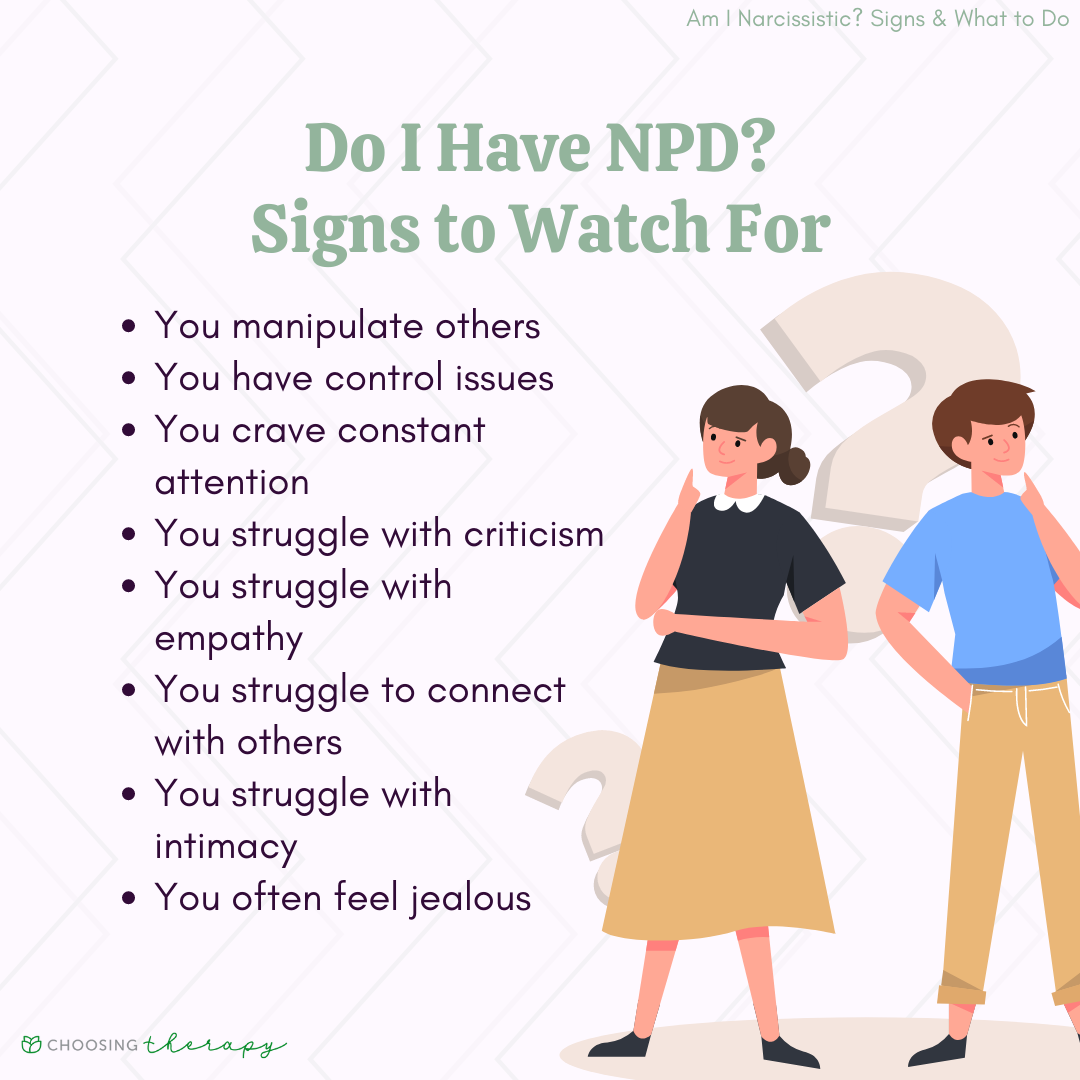
Here are eight signs that you may have narcissistic traits:
1. You Manipulate Others
People with narcissism often manipulate others to maintain control and fulfill narcissistic supply needs. Narcissistic manipulation tactics may include narcissistic gaslighting (denying or trying to contort someone’s sense of reality) and narcissistic triangulation (using others to change, distract, or sabotage a specific relationship dynamic). At its core, narcissistic manipulation is about maintaining a sense of worth and feeling a sense of control over a given situation.
2. You Have Control Issues
Narcissism closely aligns with a strong need for order, leading to control issues in many life areas. People with NPD often want things done in a very specific way, and it can become highly distressing if things don’t go according to plan. This may stem from perfectionism, but it often causes people to feel like they must walk on eggshells. Others may get the impression that, no matter how hard they try something, it’s never good enough. Narcissists demand a lot from others, but not necessarily from themselves.
3. You Crave Constant Attention
The need for attention is a classic symptom of narcissism. Someone with NPD has a diminished concept of self-worth, so they look outward for love and approval. As a result, they may be willing to do whatever it takes to receive that attention. Some people engage in grandiose, overt behaviors, while others are more covert or passive in their attempts to get what they need.
4. You Struggle With Criticism
People with NPD struggle to accept feedback or imperfections about themselves. Criticism often feels unacceptable, and they tend to become highly reactive to it. Sometimes, they will downplay or outright lie about the situation. Other times, they may engage in revenge tactics to get back at the other person for hurting them.
5. You Struggle With Empathy
People with NPD often feel limited empathy for others. Likewise, their empathy may fluctuate based on their emotional capacity for a given situation.3 That said, you may find it difficult to attune to other people’s needs. Vulnerability can be difficult, and you may judge others for their emotional expressions while rationalizing your own.
6. You Struggle to Connect With Others
Because of their problems with empathy, people with NPD find it challenging to enjoy meaningful relationships. Getting too close often feels too vulnerable. Instead, relationships often feel transactional. You focus on what others give to you, and if they take something away (whether intentionally or not), you may become extremely reactive.
7. You Struggle With Intimacy
It’s possible for people with NPD to experience love. However, love tends to be more conditional, and it’s often rooted in the idea of loving someone than actually loving that person. This is why love bombing and devaluation cycles are so common. Someone with narcissism often wants another person to complete them. And, at first, when they find someone who can seemingly do that, it feels euphoric. But over time, as the human side of the other person emerges, it’s harder to hold onto that fantasy.
8. You Often Feel Jealous
Even if they present as self-centered, someone with narcissism often focuses on what they lack. They often feel like the world has wronged them- or that they’re entitled to certain benefits. When reality doesn’t unfold the way they’d like, they become jealous of people who have what they want.
Would You Like to Try Therapy?
Most people (76%) who try therapy have a positive experience! Stat Source BetterHelp has a large network of licensed therapists worldwide who provide convenient and affordable online therapy. Take a brief assessment and get matched with a therapist who fits your needs in as little as 48 hours. Insurance options may be available for eligible members.* *Insurance availability and coverage may vary by state, plan, provider network, and therapist availability.
Things to Consider if You Are Asking Yourself, “Am I Narcissistic?”
NPD is a complex clinical condition. Certain behaviors, particularly if they’re temporary or only present in a specific context, don’t inherently indicate narcissism. Narcissism is pervasive, chronic, and present in numerous settings. Many people who have it are unaware of it, although it is certainly possible to have insight into your behaviors.
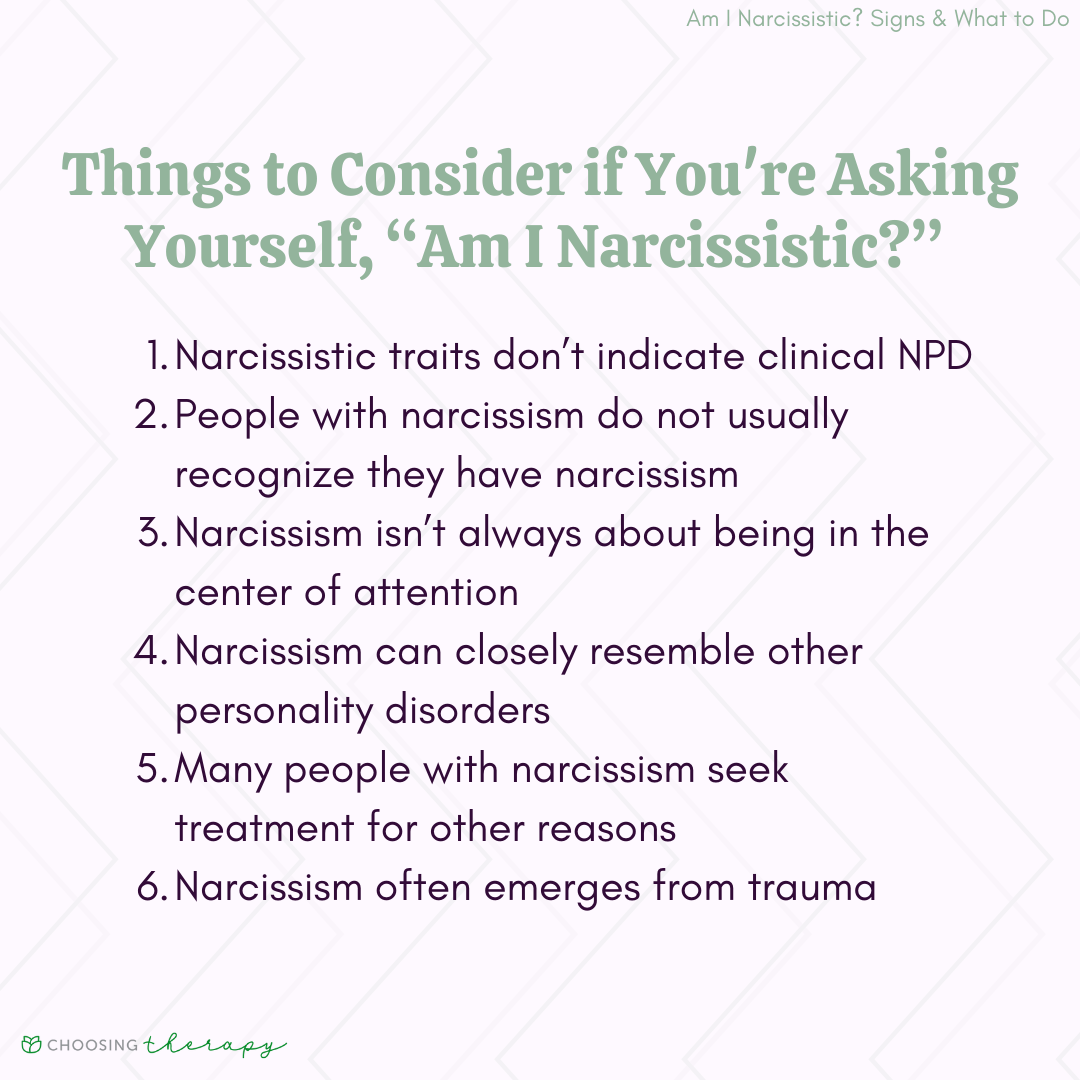
Below are things to consider if you think you might have narcissism:
Narcissistic Traits Don’t Indicate Clinical NPD
Situational stressors may coincide with narcissistic traits. Likewise, it’s normal for people to “act” narcissistically in certain settings (i.e., in specific types of careers). Similarly, many children and adolescents act in ways that mimic narcissism- even though their traits are developmentally normal.
A child experiencing childhood trauma may, for instance, present as self-centered or ‘act out’ around others. Likewise, children growing up in homes with specific parenting styles (uninvolved or authoritarian) may present with narcissistic traits to get attention elsewhere. These reactions do not inherently indicate NPD.
People With Narcissism Do Not Usually Recognize They Have Narcissism
Many people with narcissism do not recognize the full impact of their behaviors or choices, leaving friends and family members to wonder if narcissists know they are narcissists. Moreover, they don’t inherently identify their personality as problematic (this is also known as being ego-syntonic). Sometimes, they do have insight into their patterns, but they still often justify their behaviors or assume that others are more of the problem.
Narcissism Isn’t Always About Being in the Center of Attention
Many people think of famous celebrities, politicians, or sociopaths when they think of narcissism. But many times, narcissism is far more discreet. In cases of vulnerable or covert narcissism, people often present themselves as compassionate and empathic. They may even have very low self-esteem. Their hypersensitivity, in a sense, draws others in, and there is still a high level of being self-absorbed amid the insecurity.
Narcissism Can Closely Resemble Other Personality Disorders
NPD shares similar traits to borderline personality disorder, histrionic personality disorder, and antisocial personality disorder. Many symptoms overlap, and symptoms can certainly ebb and flow with their intensity over time. Therefore, it can be challenging for loved ones (and even mental health professionals) to properly assess the situation.
Many People With Narcissism Seek Treatment For Other Reasons
Research shows that people with NPD frequently have comorbid diagnoses with other mental health conditions, including substance use disorders, bipolar disorder, depression, anxiety, and other personality disorders.4 If someone with narcissism does seek professional treatment, it’s often for other mental health symptoms or relationship problems (which are often related to their narcissism).
Narcissism Often Emerges From Trauma
People do not choose to have narcissism. In clinical frameworks, narcissism is often perceived as a defense mechanism against complex childhood trauma. People with NPD often grew up in homes with a caregiver with NPD. Or, they experienced either extreme expectations or no expectations while growing up. Narcissism is a way to seek control and gain approval- two features that often felt lacking in childhood.5
If I Am a Narcissist, Can I Change?
With intention, effort, and hard work, you may wonder if a narcissist can change. Sustainable change requires someone to accurately identify their narcissistic traits and make an ongoing, conscious desire to choose different responses.
Here are some tips to try if you think you have narcissism:
- Learn to regulate your emotions: People with NPD struggle to cope with intense emotions, so learning about emotional regulation is the first step for pausing before reacting.
- Practice meditating: Meditating is a tangible way to understand the connection between your mind and body. Slowing down can also make you less susceptible to stress.
- Absorb how others respond to stress: Aim to find healthy role models who cope well with life’s stressors. Pay attention to their reactions and consider how you can integrate them into your life.
- Try journaling: There are numerous mental health benefits of journaling. Keep track of how you respond to certain situations throughout the day to take note of various patterns.
- Work on your self-esteem: Despite the misconceptions, narcissism is actually a manifestation of very low self-esteem. Learning to love yourself, not a false image of yourself, may reduce your tendency to seek narcissistic supply.
- Apologize when you make a mistake: As much as possible, get in the habit of calling yourself out when you hurt someone else. Although this may feel uncomfortable (and even defeating) at first, it’s paramount if you want to improve your relationships.
- Practice challenging automatic thoughts: Someone with NPD may assume their feelings automatically indicate the truth. Try to get in the habit of challenging the validity or legitimacy of an intense thought before acting on an impulse.
- Know your triggers: Try to identify the people, situations, or feelings that trigger narcissistic behavior. Although you can’t avoid your triggers entirely, being aware of them can help you develop a better plan for coping.
Would You Like to Try Therapy?
Most people (76%) who try therapy have a positive experience! Stat Source BetterHelp has a large network of licensed therapists worldwide who provide convenient and affordable online therapy. Take a brief assessment and get matched with a therapist who fits your needs in as little as 48 hours. Insurance options may be available for eligible members.* *Insurance availability and coverage may vary by state, plan, provider network, and therapist availability.
When to Seek Professional Help
Although personality disorders can be challenging to treat, the benefits of therapy and the right support often make a valuable difference in how you feel. It’s important to find the right therapist, particularly one who is familiar with narcissism and trauma. Keep in mind that it’s common for someone with NPD to dismiss therapy and assume that it won’t help, but try to commit to the process. You can look through an online therapist directory as a first step.
Therapy options for addressing narcissism may include:
- Cognitive-behavioral therapy (CBT): CBT focuses on examining negative thoughts and changing them into more adaptive ones. CBT can also help you choose healthier coping strategies to manage distress.
- Internal family systems (IFS) therapy: IFS encourages people to get in touch with their Self and also to acknowledge that there are no ‘bad parts.’ By accessing the Self, you can slowly heal the wounded parts causing narcissistic behavior.
- Trauma-informed therapy: Trauma-informed therapy focuses on understanding the role trauma plays in a person’s development and personality. This work may help you heal from the trauma affecting your narcissistic behaviors.
- Psychodynamic therapy: Psychodynamic therapy helps you understand how current interactions relate to past interactions. In learning more about your unconscious fears and defenses, you can better get to the root of your narcissism.
- Schema therapy: Schema therapy helps people recognize how certain schemas affect thoughts, feelings, and behaviors. This work can help you stop using schema modes that block access to your real feelings, and it can establish better limits for emotional expression.
Final Thoughts
Narcissism occurs on a spectrum, and the presence of certain traits doesn’t necessarily mean you have NPD. However, regardless of your symptoms, you can improve how you feel and get help. If you are struggling, seek support.
Am I Narcissistic? Infographics
ChoosingTherapy.com strives to provide our readers with mental health content that is accurate and actionable. We have high standards for what can be cited within our articles. Acceptable sources include government agencies, universities and colleges, scholarly journals, industry and professional associations, and other high-integrity sources of mental health journalism. Learn more by reviewing our full editorial policy.
-
Mitra, P. & Fluyau, D. (2022). Narcissistic Personality Disorder. StatPearls Publishing. Retrieved from https://www.ncbi.nlm.nih.gov/books/NBK556001/
-
Stinson, F. S., et al. (2008). Prevalence, correlates, disability, and comorbidity of DSM-IV narcissistic personality disorder: results from the wave 2 national epidemiologic survey on alcohol and related conditions. The Journal of clinical psychiatry, 69(7), 1033–1045. https://doi.org/10.4088/jcp.v69n0701
-
Baskin-Sommers, A., Krusemark, E., & Ronningstam, E. (2014). Empathy in narcissistic personality disorder: from clinical and empirical perspectives. Personality disorders, 5(3), 323–333. https://doi.org/10.1037/per0000061
-
Caligor, E., Levy, K. N., & Yeomans, F. E. (2015). Narcissistic Personality Disorder: Diagnostic and Clinical Challenges. American Journal of Psychiatry, 172(5), 415–422. https://doi.org/10.1176/appi.ajp.2014.14060723
-
Mosquera, D. & Gonzalez, A. (2011). Narcissism as a consequence of trauma and early experiences. European Society for Trauma and Dissociation, 1(4). Retrieved from: https://estd.org/narcissism-consequence-trauma-and-early-experiences,

Your Voice Matters
Can't find what you're looking for?
Request an article! Tell ChoosingTherapy.com’s editorial team what questions you have about mental health, emotional wellness, relationships, and parenting. Our licensed therapists are just waiting to cover new topics you care about!
Leave your feedback for our editors.
Share your feedback on this article with our editors. If there’s something we missed or something we could improve on, we’d love to hear it.
Our writers and editors love compliments, too. :)
Additional Resources
To help our readers take the next step in their mental health journey, ChoosingTherapy.com has partnered with leaders in mental health and wellness. ChoosingTherapy.com is compensated for marketing by the companies included below.
Online Therapy
BetterHelp – Get support and guidance from a licensed therapist. BetterHelp has over 30,000 therapists who provide convenient and affordable online therapy. BetterHelp starts at $65 per week and is FSA/HSA eligible by most providers. Take a free online assessment and get matched with the right therapist for you. Free Assessment
Online-Therapy – Online-Therapy.com provides a weekly live video session, unlimited text messaging, and self-guided activities like journaling. Starting at $64 per week, this is one of the most affordable options for CBT therapy. Try Online-Therapy
Narcissism Newsletter
A free newsletter from the experts at ChoosingTherapy.com for those recovering from narcissistic abuse. Get helpful tips and the latest information. Sign Up
ChoosingTherapy.com Directory
Find local therapists that offer online and in-person therapy. Search for therapists by specialty, experience, insurance, and location. Find a therapist near you.

